Gross Motor Skills: Milestones by Age, Checklist and Activities
Gross motor skills explained by an occupational therapist: milestones from birth to 5, a free checklist, signs of delay, how OT helps and 40+ activities.


What are gross motor skills?
Gross motor skills are the abilities to use the big muscles of the body for standing, walking, jumping, running and more. We start to learn these skills from the very beginning. Babies learn neck control first, then turning to the side, crawling, sitting and standing. As babies grow, they learn to walk, run and jump. They develop body balance, muscle strength and coordination between the different parts of the body.
Gross motor skills are affected by muscle tone, strength and coordination. Activities of daily living depend on gross motor skills as well as fine motor skills; both help us manage our daily routine.
If we are not able to develop gross motor skills, or the coordination between gross and fine motor skills, we may depend on others for everything from self-care to occupational tasks.
Types of gross motor skills
| Type | What it means | Examples |
|---|---|---|
| Locomotor skills | Moving the body from one place to another. These are the most basic and important developmental skills. | Walking, running, climbing, jumping, hopping, skipping |
| Non-locomotor (stability) skills | Moving the body while staying in one place | Sitting, standing, bending, turning, pushing, pulling, balancing on one foot |
| Object-control skills | Moving the body to control a ball or other object | Throwing, catching, kicking, bouncing, striking with a bat |
The building blocks underneath
| What it means | Why it matters | |
|---|---|---|
| Muscle tone | The resting tension in the muscles | Low tone makes it harder to hold positions like sitting upright |
| Strength and core stability | Power in the trunk, hips and shoulders | A stable core lets the arms and legs move with control |
| Balance | Staying steady while still (static) or moving (dynamic) | Needed for standing on one foot, stairs and playground equipment |
| Coordination | Different body parts working together in time | Needed for skipping, jumping jacks, catching and riding a bike |
| Motor planning | Working out and sequencing a new movement | Lets a child copy a new action or find a way through an obstacle course |
| Body awareness | Sensing where the body is without looking | Helps a child judge space, force and position |
| Endurance | Keeping going without tiring | Lets a child keep up with friends on the playground |
Gross motor development by age
The sequence of development is the same in all children, but the rate of development varies from child to child. Development progresses in the cephalocaudal direction, which means from head to toe. The first step towards walking is head control: strength in the neck muscles. That is why an infant can do so much with the hands before walking. Development also moves from the centre of the body outwards, so trunk control comes before precise arm and leg control.
- 2 months
- Holds head up when on tummy
- Moves both arms and both legs
- 4 months
- Holds head steady without support when held
- Pushes up onto elbows and forearms when on tummy
- 6 months
- Rolls from tummy to back
- Pushes up with straight arms when on tummy
- Leans on hands to support themselves when sitting
- 9 months
- Gets to a sitting position by themselves
- Sits without support
- 1 year
- Pulls up to stand
- Walks while holding on to furniture
- 15 months
- Takes a few steps on their own
- 18 months
- Walks without holding on to anyone or anything
- Climbs on and off a couch or chair without help
- 2 years
- Kicks a ball
- Runs
- Walks (not climbs) up a few stairs, with or without help
- 30 months
- Jumps off the ground with both feet
- 3 years
- Pedals a tricycle
- Walks up stairs alternating feet, with support
- 4 years
- Catches a large ball most of the time
- 5 years
- Hops on one foot
Source: CDC, Learn the Signs. Act Early. (2022), skills most children (75%) reach by each age. The 3-year items come from our checklist below, as CDC lists no gross motor milestones at 3 years.
Gross motor skills checklist
Here are typical developmental milestones for gross motor skills. Please keep in mind that each child is different, and there may be differences in when they acquire each milestone.
If you observe a delay in these patterns for more than 3–4 months, contact a nearby occupational therapist or another expert for an early assessment. For example, if a one-year-old cannot hold their head erect, that shows a delay in gross motor development. This checklist is basic in nature and may vary between individuals.
Tick each skill your child can do now. Ages are the usual range for learning each skill.
0 / 46 ticked
Delay in gross motor development
Use the milestone checklist to find the child’s current level and any delay.
Reasons for gross motor delay
- Intellectual disability. Intellectual disability often slows gross motor development; the degree of delay usually relates to the level of disability.
- Physical disability. Any disability of the upper or lower limbs affects gross motor development.
- Prematurity. If a child is born before completing nine months of pregnancy, gross motor development may be delayed. Doctors often use the “corrected age” (age from the due date) when checking milestones.
- Lack of nutrition. Lack of proper food during pregnancy and after birth affects the growth of a newborn.
- Lack of stimulation. If an infant is left without proper care, play and sensory stimulation, gross motor development may suffer.
Conditions where we often see delay
Most commonly, we see delays in gross motor movements in cerebral palsy, intellectual disability, Down syndrome, developmental coordination disorder and paralysis. Children with ADHD or autism may have some delay, but more often they have problems with the coordination of gross motor activities.
When to start training
There is no specific time to start. If a developmental delay is noticed, training should start as early as possible. Seek a medical opinion and have any investigations they suggest; it is better to find out the exact cause.
How to train gross motor skills
-
Find the current level
Use the checklist. If the child can sit with support, start training sitting without support.
-
Demonstrate
Show the activity or exercise first, then ask the child to follow.
-
Help, then fade
Give physical help at first, then gradually reduce it until the child does it alone.
-
Motivate and praise
Appreciate every attempt, not just success.
-
Use it every day
Encourage the new skill at school, at home and in the community.
For example, if a child can’t walk along a straight line because of a balance problem, you might hold one hand at first, then just a finger, then walk beside them without touching.
The role of the occupational therapist
How does an occupational therapist help kids improve their gross motor skills? We start with an assessment and then plan the intervention. An individual plan is designed for each child’s needs and may include exercises and functional activities.
The basic focus is muscle strength and core stability, but it doesn’t stop there. The OT sees the child as a whole and develops the skills that go along with gross motor control:
- Balance and coordination
- Strength and endurance
- Attention and concentration
- Hand function
- Body awareness and sensory processing
Gross motor activities for kids
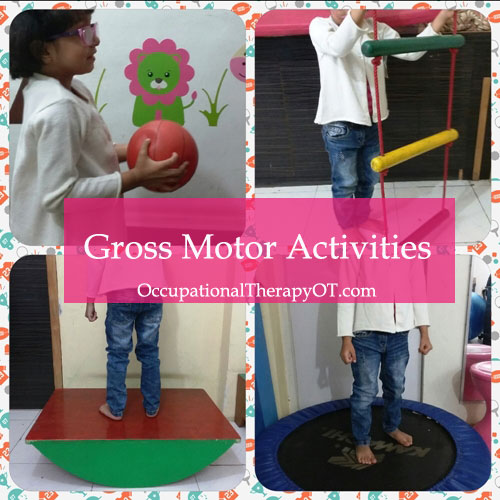
All children benefit from active movement of the large muscles in the arms, legs and trunk. Exercising these muscles builds strength, endurance, posture, balance and coordination. Taking part in gym class, and later in sports and recreation, depends heavily on gross motor skills.
Children with autism may be reluctant to practise these activities, especially if the underlying sensory skills are weak. They benefit from routine and from activities that are easy to practise. These are our favourite gross motor activities, grouped by the skill they build.
| Skill | Activities | OT tip |
|---|---|---|
| Balance | Walking along a tape line or low beam; standing on one leg like a flamingo; stepping stones made of cushions; hopscotch; walking on stilts made from cans with rope handles | Start with a wide line and hold a hand; make it narrower as balance improves. |
| Coordination | Throwing and catching a big ball; kicking a ball at a target; dancing and marching to music; skipping; jumping jacks; frisbee | Use a large, soft or slightly deflated ball first; it is easier to catch. |
| Strength and core | Wheelbarrow walking for upper-body strength; bear crawls and crab walks; scooter board on the tummy; climbing; tumbling and wrestling | Short bursts of 30–60 seconds work better than long sessions. |
| Motor planning | Obstacle courses (over, under, through); Simon says; yoga poses; crossing-the-midline games like touching opposite knee to elbow | Change one part of the obstacle course each day to keep the brain planning. |
| Jumping and hopping | Jumping on a mini-trampoline; jumping off a low step onto a cushion; hopping games; jumping over a rope on the floor | Two-foot jumps come before hopping on one foot. |
| Endurance and fun | Walks and hikes; running, skipping and hopping races; swimming; bike or tricycle riding; playground play; hide-and-seek | Join in: children move more when adults play too. |
| Ball and team games | Bowling; T-ball; tetherball; ball hockey, soccer and basketball; big ball games; racquet sports; hoop games | Make targets bigger and distances shorter at first. |
| Seasonal and outdoor | Ice skating; track and field; climbing frames; swings | Supervise closely and use safety gear. |
Indoor ideas for rainy days
- Floor tape course: a zig-zag line to walk, hop or jump along.
- Pillow path: cushions across the floor; step from one to the next without touching the floor.
- Balloon volleyball: keep a balloon in the air with hands, then feet.
- Animal walk relay: bear walk to the sofa, crab walk back.
- Hallway hopscotch: squares made with painter’s tape.
Related guides: Bilateral coordination activities, Crossing the midline, W-sitting, Toe walking, Dyspraxia (DCD), Motor planning activities, Toe walking exercises.
References
- Centers for Disease Control and Prevention. CDC’s developmental milestones. Learn the Signs. Act Early.
- Gallahue DL, Ozmun JC, Goodway JD. Understanding Motor Development: Infants, Children, Adolescents, Adults. McGraw-Hill.
- Case-Smith J, O’Brien JC. Occupational Therapy for Children and Adolescents. Elsevier.
Frequently asked questions
What are gross motor skills?
What are examples of gross motor skills by age?
When should I worry about my child's gross motor development?
What causes gross motor delay?
How can I improve my child's gross motor skills at home?
What is the difference between gross motor and fine motor skills?
Written by
Payal Mehta, OT
Payal Mehta is a practising occupational therapist and co-founder of Occupational Therapy OT. She writes on pediatrics, sensory integration, and mental-health practice.
All articles by Payal →This article is for general education and is not a substitute for individualized assessment or treatment by a licensed occupational therapist. Always seek the guidance of a qualified professional for specific concerns.