Occupational Therapy Frames of Reference: Complete Guide with Examples
Every OT frame of reference and model compared: 15 frames, 6 models, Mosey's 5 parts, which frame for which setting, a worked case, quiz and free PDF.


Occupational therapy professionals use theory to guide their practice. A theory is the base of any profession, from which construction or modification can be done with valid reasoning. Theories are usually developed by experts in a field. In general, a theory may be a belief, policy or procedure proposed or followed as the basis of action.
Theories are not always vast and complex, but many people avoid reading theories and postulates. Theories are based on research, thought or observation of phenomena. Research-based theories are more trustworthy because they have valid reasoning and references behind them.
A frame of reference uses pieces of one or more theories and makes them practical and useful. (Kramer and Hinojosa)
Theory, model, frame of reference: what’s the difference?
Students often mix these words up. A simple way to see them is as levels, from the broadest ideas at the top to what the therapist actually does in a session at the bottom.
Most abstract ↑
-
Paradigm
The shared beliefs of the whole profession: occupation matters for health.
-
Theory
Explains and predicts how something works, e.g. motor learning or learning theory.
-
Model
A broad map of person, environment and occupation used across practice, e.g. PEO, CMOP-E, MOHO.
-
Frame of reference
Links theory to specific assessment and intervention for one area of function.
-
Techniques
The specific methods used in a session, e.g. splinting, graded activity, handling.
Most practical
MOHO is often taught as a frame of reference, though its author described it as a conceptual model of practice. Either way, it guides assessment and intervention.
Frames of reference in occupational therapy
In occupational therapy, a frame of reference is used as a baseline for practical application. It uses theories to guide evaluation, assessment and their application in practice.
The frame of reference provides a structure for identifying relevant theories and then, based on this information, outlines guidelines that occupational therapists use when assessing and providing intervention.
Mosey’s structural components are used as the organising scheme for all frames of reference:
-
Theoretical base
Assumptions, concepts, definitions and postulates, and how they relate.
-
Function–dysfunction continua
The areas of concern: what ability looks like at one end and disability at the other.
-
Evaluation
Behaviours that show where the person sits on each continuum, measured with standardised or non-standardised tools.
-
Postulates regarding change
The cause-and-effect link between present problems and goals.
-
Postulates regarding intervention
The link between goals and treatment: which media, modalities and techniques to use.
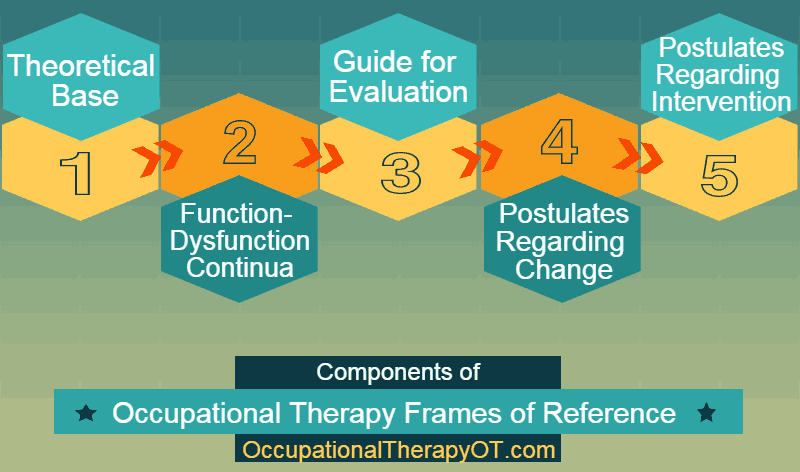
1. Theoretical base
An occupational therapist uses the theoretical base to understand the results they can expect after intervention. The theoretical base is the foundation of the entire frame of reference. It may draw from one or more theories, and includes assumptions, concepts, definitions and postulates, and the relationships between them.
2. Function–dysfunction continua
This part of a frame of reference focuses on the areas of concern. After setting a theoretical base, the therapist should be able to identify the specific areas of performance important to the individual’s skills and abilities. The functional end of the continuum represents what the therapist expects the client to be able to do (abilities), while the dysfunctional end represents disabilities. A single frame of reference usually contains several function–dysfunction continua.
Example: in the biomechanical frame, one continuum is range of motion, running from “full, pain-free movement for daily tasks” to “joint movement too limited to reach, dress or eat”.
3. Guide for evaluation
Evaluation creates the baseline for intervention. It should relate to the indicators of function and dysfunction. Specific assessment tools, scales or protocols may be used. The therapist uses tools, standardised or non-standardised, that provide an appropriate baseline of performance and help develop a meaningful plan for intervention.
4. Postulates regarding change
Postulates regarding change give the frame of reference more concrete structure. Here we see the cause and effect. They guide the therapist about the changes expected after an action, and transform the abstract material of the theoretical base into practical actions the therapist takes to facilitate change in the client.
Example: “If muscles are worked against gradually increasing resistance, strength will increase.”
5. Postulates regarding intervention
Postulates regarding intervention follow from the postulates regarding change. They describe how the occupational therapist puts theory into action. After assessment, the therapist plans the media and modalities according to the frame of reference. This step helps the therapist set client-oriented goals and use different techniques to achieve them, and guides how to use specific techniques and modalities according to the theory.
Example: “Grade a woodworking or kneading task from light to heavier resistance as the client’s strength improves.”
Occupational therapy frames of reference list
Fifteen frames of reference commonly used in occupational therapy practice are compared below. Click a name for the full guide.
| Frame of reference | Main idea | Often used for | Example assessment | Example intervention |
|---|---|---|---|---|
| Biomechanical | Movement depends on range of motion, strength and endurance | Hand injuries, fractures, burns, arthritis, positioning in CP | Goniometry, manual muscle testing, dynamometer | Graded exercise and activity, splinting, positioning |
| Rehabilitative | Compensate when a limitation can't be fixed | Spinal cord injury, chronic or progressive conditions, older adults | ADL assessment, Barthel Index, FIM, home assessment | Adaptive equipment, new techniques, home modification |
| Developmental | Skills develop in a sequence; work from the current level upwards | Children with developmental delay; Mosey's adaptive skills in adults | Developmental scales, e.g. Peabody, Bayley | Activities just above the current developmental level |
| MOHO | Motivation, habits, roles and capacity interact with the environment | Mental health, chronic illness, return to work | OPHI-II, MOHOST, OSA, Interest Checklist | Meaningful occupation, role and routine building |
| Psychodynamic | Unconscious feelings show through activity and relationships | Mental health | Projective tests, e.g. Azima Battery | Creative and expressive activities, task groups |
| Behavioural | Behaviour is learned and changed by its consequences | Learning disability, autism, habit change | Behavioural observation and recording | Reinforcement, shaping, chaining |
| Cognitive-behavioural | Thoughts, feelings and behaviour influence each other | Anxiety, depression, chronic pain | Thought and activity diaries, COPM | Activity scheduling, graded exposure, problem solving |
| Cognitive disability (Allen) | Function depends on cognitive level | Dementia, serious mental illness, brain injury | Allen Cognitive Level Screen, Routine Task Inventory | Adapting tasks and environment to the person's level |
| Neurodevelopmental (NDT) | Normalise tone and facilitate typical movement patterns | Cerebral palsy, stroke | Movement and postural analysis | Handling, facilitation, positioning |
| Motor learning / motor control | Skills are learned through practice, feedback and task variation | Stroke, DCD, brain injury, sport injury | Task performance observation, timed tasks | Task-oriented practice, CO-OP, feedback schedules |
| Sensory integration | The brain organises sensation to produce adaptive responses | Sensory processing difficulties, autism | SIPT, EASI, Sensory Profile 2 | Play-based, sensory-rich activities |
| Acquisitional | Specific skills are learned through practice and reinforcement | Self-care, handwriting, life skills | Skill checklists, task analysis | Task analysis, chaining, repetition with feedback |
| Spatiotemporal adaptation | Development spirals as earlier patterns are adapted into new ones | Children with motor difficulties | Movement observation | Activities that build on earlier movement patterns |
| Occupational adaptation | People adapt to occupational challenges; therapy builds the adaptive process | Adults after illness or injury | Relative mastery (efficiency, effectiveness, satisfaction) | Occupational readiness and activity with self-evaluation |
| Visual perceptual | Perceptual skills can be developed or compensated for | Learning difficulties, brain injury | TVPS-4, Beery VMI | Perceptual activities, environmental adaptation |
Simplified for comparison. Each frame has a wider theory base and range of tools than one row can show.
OT models of practice
Models are broader than frames of reference. They describe how the person, their occupations and their environment fit together, and guide thinking across all of practice. Read our full guide to occupational therapy models.
| Model | Developed by | Key idea | Best known for |
|---|---|---|---|
| MOHO | Kielhofner and Burke (1980) | Volition, habituation, performance capacity and environment | A large family of assessments |
| PEO | Law and colleagues (1996) | Performance comes from the fit between person, environment and occupation | Simple Venn diagram; any setting |
| CMOP-E | Canadian Association of OTs (Townsend and Polatajko, 2007) | Spirituality at the core; engagement as well as performance | Pairs with the COPM |
| PEOP | Christiansen and Baum | Person and environment factors support occupation, performance and wellbeing | Population and community practice |
| Ecology of Human Performance (EHP) | Dunn, Brown and McGuigan (1994) | Context shapes performance | 5 intervention types: establish/restore, alter, adapt, prevent, create |
| Kawa | Michael Iwama (2006) | Life as a river: water, riverbed, rocks, driftwood and spaces | Culturally responsive, drawn by the client |
A short history of OT theory
- 1960s
- Mary Reilly's occupational behaviour model: the foundation for MOHO
- 1970
- Lela Llorens' developmental frame of reference
- 1972
- A. Jean Ayres publishes Sensory Integration and Learning Disorders
- 1980
- Kielhofner and Burke publish the Model of Human Occupation
- 1981–86
- Anne Cronin Mosey sets out the structure of frames of reference used to this day
- 1985
- Claudia Allen's cognitive disability frame of reference
- 1992–96
- Occupational adaptation (1992), EHP (1994) and the PEO model (1996)
- 2006–07
- Iwama's Kawa model (2006); CMOP-E (2007)
- 2020
- AOTA's Practice Framework, 4th edition
How to choose a frame of reference
Effective practice depends on the therapist’s ability to match the client with the most appropriate frame of reference in the context of their life. After a patient is referred to occupational therapy, the therapist does a preliminary screening and looks at the person’s needs, strengths, limitations and environment.
After understanding all of this, the therapist chooses the most appropriate method for evaluation and intervention. Sometimes one specific frame of reference is enough, but at other times one isn’t adequate for the complexity of the problems the patient presents.
-
The body
- Limited range of motion
- Weakness or low endurance
- Problem can improve
Biomechanical
-
A lasting limitation
- Recovery has plateaued
- Progressive condition
- Needs to do tasks a new way
Rehabilitative
-
Development or sensation
- Skills below age level
- Over- or under-responds to sensation
Developmental or sensory integration
-
Motivation, roles, routines
- Lost interest or roles
- Disorganised routine
- Low belief in own ability
MOHO or psychosocial frames
A starting point, not a rule: many clients need more than one frame.
How to apply frames of reference in clinical practice
Many therapists read about frames of reference but don’t know how to apply their principles in clinical practice. Frames of reference are quite theoretical, and even when a therapist understands the principles, applying them to a patient can be difficult.
A therapist must understand what they are doing and why. They also need to be able to explain this rationale to patients, observers and other professionals, which builds their confidence during therapy sessions.
Early on, a therapist may learn by trial and error if there is no senior or expert to guide them. A therapist should keep improving their knowledge of each frame of reference. They may use different frames with a single patient, but it’s crucial to know the effects and why each one is being used.
For example, a physician should not prescribe medication without knowing its possible consequences; similarly, a therapist should not use a procedure without understanding its potential effects. Based on a client’s presenting problems, the therapist selects a frame of reference to specify the changes or outcomes they want to promote.
Single vs multiple frames of reference
Young occupational therapists may not yet have the knowledge to apply multiple frames of reference to one patient. They should focus on one frame at a time and, after mastering one, add others. Some patients need one frame of reference, but many need several.
- Single frame example: for a child with sensory processing disorder, the occupational therapist may apply one frame, the sensory integration frame of reference.
- Multiple frames example: for a child with cerebral palsy, the therapist may use the developmental, neurodevelopmental and biomechanical frames of reference.
Frames of reference can be used in sequence or in parallel, according to the needs of the patient.
| In sequence | In parallel | |
|---|---|---|
| What it means | One frame is used first; another is added later for a separate problem | Two frames are used at the same time for related problems, from different perspectives |
| Example | A child with cerebral palsy is treated with NDT. After several months the therapist notices cognitive difficulties, evaluates with a cognitive frame, and continues NDT while adding the cognitive frame. | A child with cerebral palsy is treated with NDT for handling, while the biomechanical frame is used at the same time to build movement abilities and as many typical patterns as possible. |
| Watch out for | Re-evaluating so the new problem isn't missed | Frames whose assumptions clash; make sure the goals support each other |
Frames of reference by practice setting
| Setting | Frames and models commonly used |
|---|---|
| Pediatrics and schools | Developmental, sensory integration, biomechanical (positioning), NDT, motor learning, acquisitional, visual perceptual |
| Stroke and neurological rehab | Motor learning and task-oriented, NDT, biomechanical, rehabilitative, cognitive. See OT for stroke. |
| Orthopaedics and hand therapy | Biomechanical, rehabilitative |
| Mental health | MOHO, psychodynamic, cognitive-behavioural, Allen, occupational adaptation. See OT in mental health. |
| Older adults and dementia | Allen cognitive levels, rehabilitative, PEO, MOHO. See OT for dementia. |
| Community and population health | PEOP, EHP, Kawa, CMOP-E |
One client, several frames: a worked case
Mr Sharma, 64, had a stroke three weeks ago. His right arm is weak, he tires quickly, he forgets steps when dressing, and he has lost confidence. He wants to go home and return to cooking for his wife.
| Problem | Frame of reference | What the OT does |
|---|---|---|
| Weak, stiff right arm | Motor learning and biomechanical | Task-oriented practice of reaching and grasping in kitchen tasks; graded resistance as strength returns |
| Can't dress independently | Rehabilitative | One-handed dressing techniques, button hook, elastic laces |
| Forgets steps | Cognitive | Picture sequence for dressing; simplify the task to match his cognitive level |
| Low confidence and lost roles | MOHO | Explore his values and role as a cook; plan graded success in meal preparation |
| Home set-up | PEO | Home visit; adjust the kitchen and bathroom so the environment fits his abilities |
This is the frames used in parallel: each addresses a different problem, all serving one occupational goal, cooking at home.
Tips for students and the NBCOT exam
Test yourself: frames of reference
0 / 8 correct
-
A client with a healed wrist fracture has limited wrist extension but normal sensation and movement control. Which frame fits best?
Show answer
B. The biomechanical frame suits limits in range, strength and endurance with an intact central nervous system.
-
Which assessment is linked with the cognitive disability frame of reference?
Show answer
C. The ACLS, developed by Claudia Allen, estimates cognitive level from 3.0 to 5.8.
-
Volition, habituation and performance capacity belong to which model?
Show answer
B. These are MOHO's three components of the person, always interacting with the environment.
-
In Mosey's structure, the part that links goals to treatment methods is called…
Show answer
D. Postulates regarding intervention describe which media and techniques to use to reach the goals.
-
A person with a complete spinal cord injury learns to dress using adaptive equipment. Which frame is this?
Show answer
A. The rehabilitative frame compensates for limitations that can't be remediated.
-
In the Kawa model, rocks represent…
Show answer
B. Rocks are the life circumstances and problems that block the flow. Driftwood is assets and liabilities; the riverbed and walls are the environment; water is life flow.
-
Which EHP intervention changes the context rather than the person?
Show answer
B. 'Alter' means finding a better-matched context for the person's current abilities. 'Adapt' modifies the task or context.
-
Using two frames at the same time for related problems is called…
Show answer
B. Frames used in parallel address similar or related problems at the same time from different perspectives.
Summary
Occupational therapists use frames of reference to guide their practice and clinical reasoning. Every frame of reference has a specific structure, from theory to intervention. Many frames of reference are available to occupational therapy practitioners, and multiple frames can be used in sequence or in parallel. Explore each one in depth:
- Biomechanical frame of reference
- Rehabilitative frame of reference
- Developmental frame of reference
- Model of Human Occupation (MOHO)
- Psychodynamic frame of reference
- Sensory integration
- Neurodevelopmental (NDT) frame of reference
- Motor learning frame of reference
- Cognitive disability (Allen) frame of reference
- Behavioural and cognitive-behavioural frames of reference
- Acquisitional frame of reference
- Occupational adaptation
- OT models: PEO, CMOP-E, PEOP, EHP
- Kawa model
References
- Kramer P, Hinojosa J, Howe TH, eds. Frames of Reference for Pediatric Occupational Therapy. 4th ed. Wolters Kluwer.
- Mosey AC. Applied Scientific Inquiry in the Health Professions: An Epistemological Orientation. AOTA.
- Pendleton HM, Schultz-Krohn W, eds. Pedretti’s Occupational Therapy: Practice Skills for Physical Dysfunction. Elsevier.
- Boyt Schell BA, Gillen G, eds. Willard and Spackman’s Occupational Therapy. Wolters Kluwer.
- Taylor RR, ed. Kielhofner’s Model of Human Occupation. 5th ed. Wolters Kluwer.
- Mosey AC. Occupational Therapy: Configuration of a Profession. Raven Press; 1981.
- Law M, Cooper B, Strong S, Stewart D, Rigby P, Letts L. The Person-Environment-Occupation Model: a transactive approach to occupational performance. Canadian Journal of Occupational Therapy. 1996;63(1):9–23.
- Dunn W, Brown C, McGuigan A. The ecology of human performance: a framework for considering the effect of context. American Journal of Occupational Therapy. 1994;48(7):595–607.
- Iwama MK. The Kawa Model: Culturally Relevant Occupational Therapy. Churchill Livingstone; 2006.
- Cole MB, Tufano R. Applied Theories in Occupational Therapy: A Practical Approach. 2nd ed. SLACK.
Frequently asked questions
What is a frame of reference in occupational therapy?
What is the difference between a model and a frame of reference in OT?
How many frames of reference are there in occupational therapy?
What are the five components of a frame of reference?
Can you use more than one frame of reference with a client?
Which frame of reference is used for stroke?
Which frames of reference are used in mental health OT?
Which frames of reference are used in pediatric OT?
Is the OTPF a frame of reference?
Where can I get a frames of reference PDF or cheat sheet?
Written by
Deepam Pawar, OT
Deepam Pawar is an occupational therapist and co-founder of Occupational Therapy OT. He focuses on clinical frameworks, assessment, and evidence-based practice.
All articles by Deepam →This article is for general education and is not a substitute for individualized assessment or treatment by a licensed occupational therapist. Always seek the guidance of a qualified professional for specific concerns.