Psychodynamic Frame of Reference in Occupational Therapy
The psychodynamic frame of reference: id, ego, superego, defence mechanisms, object relations, explorative vs supportive approaches, cases and a quiz.


The psychodynamic frame of reference in occupational therapy is based on the theories of Freud. These theories have undergone continuous development and modification, including object relations theory. After many changes, psychodynamic theory became the theoretical base of the psychodynamic frame of reference in occupational therapy.
In OT, these ideas were brought into practice by pioneers such as Gail and Jay Fidler, who described occupational therapy as a communication process in psychiatry, and Hyman and Fern Azima, who developed one of the first projective assessments.
What is Freud’s psychodynamic theory?
Psychodynamic theory is designed to help us understand interpersonal relationships. It is based more on unconscious forces (drives) than on conscious ones.
The two main aspects of psychodynamic theory used in the psychodynamic frame of reference are:
- Instinctual drives (forces)
- The self as a mental apparatus (psychic conflict)
Instinctual drives
Freud’s theory revolves around the satisfaction, or gratification, of demands. He identified two primary instinctual drives that demand gratification: sexual (libidinal) drives and aggressive drives.
- Sexual drives are directly related to the pleasurable sensations a person gets after a positive outcome. These drives are considered the constructive element in motivation for most human activities.
- Aggressive drives reflect the need to relate to, adapt to and master the external environment. They are considered the destructive element in response to frustration and conflict.
Both drives are used to satisfy a person’s basic needs, affectional and material.
Id, ego and superego
To explain these drives and the balance between them, Freud developed his structural theory. It defines the mind as having three structures: the id, the ego and the superego.
| Id | Ego | Superego | |
|---|---|---|---|
| What it is | The unconscious source of instinctual drives; the immature part of the mind | The more mature part of the mind; the mediator | The inner voice of the rules and limits of the outside world |
| Works on | The pleasure principle and primary-process thinking: wish-fulfilling fantasy | The reality principle: delaying, inhibiting and restraining drives so their aims are met realistically | Morals: what we ordinarily call conscience |
| Example: hungry in a long meeting | "Grab the biscuits now!" | "There's a break in 10 minutes; I'll eat then." | "Eating while someone is speaking is rude." |
- Id: the unconscious part of the mind and the source of instinctual drives. It seeks pleasure all the time, regardless of the environment, and lies behind every powerful desire, wish and fantasy. The id belongs to the primary process, a mode of thinking dominated by emotion-laden, wish-fulfilling fantasies, and is considered the earliest form of cognition.
- Ego: discriminates between internal drives and the constraints of external reality. Freud saw the ego as a mediator between external reality and the demands of the id. It tries to get maximum satisfaction after balancing the id and the environment.
- Superego: the part of the mental apparatus that represents the prescriptions and prohibitions of the outside world. It corresponds in a general way to conscience, a person’s moral sense of right and wrong.
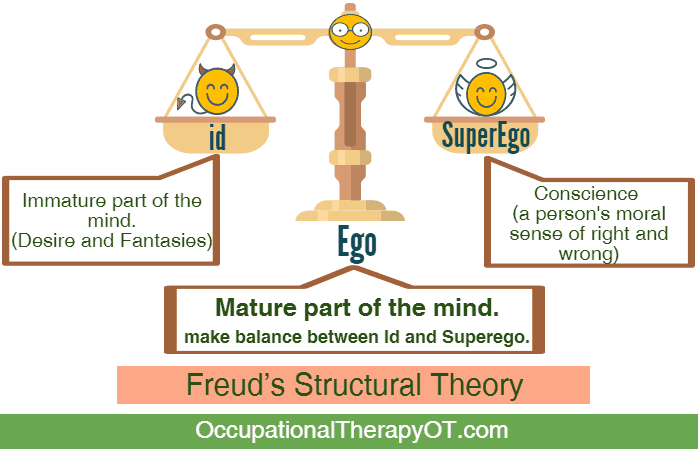
Functions of the ego
The ego’s primary function is to control instinctual drives and balance the id and superego. According to Kaplan and Sadock, the ego has other functions too.
1. Object relations
The ego helps develop mutually satisfying relationships (object relations) between the person and their peers and family. These depend on establishing trust in others, and they support social interaction and relationships.
2. Defensive functions
This is one of the ego’s critical functions. The ego uses defence mechanisms to stop the person being overwhelmed by anxiety arising from conflicting drives and superego demands. A defence mechanism is an unconscious attempt to protect oneself from anxiety. Although it’s unconscious, its effect can be seen in behaviour.
| Defence | What happens | Example |
|---|---|---|
| Denial | Refusing to accept a painful reality | After a heart attack, a man insists he's fine and skips rehab |
| Repression | Pushing distressing thoughts out of awareness | Having no memory of a frightening event |
| Projection | Seeing your own unacceptable feelings in others | "My colleague is always angry with me" when you are angry with them |
| Displacement | Redirecting feelings to a safer target | Shouting at your sibling after being criticised at work |
| Rationalisation | Giving a logical-sounding excuse | "I didn't want that job anyway" after not getting it |
| Intellectualisation | Focusing on facts to avoid feelings | Discussing statistics about a diagnosis instead of the fear |
| Reaction formation | Acting the opposite of what you feel | Being overly sweet to someone you strongly dislike |
| Regression | Returning to an earlier stage of behaviour | A child who was toilet trained starts wetting again when a new baby arrives |
| Undoing | Trying to 'cancel out' a thought or act | Buying an expensive gift after an argument |
| Identification and introjection | Taking on the qualities or values of another person | A teenager copying a coach's habits and beliefs |
| Isolation of affect | Separating a memory from its feelings | Describing a serious accident calmly, with no emotion |
3. Reality testing
The ego also controls awareness of reality. Reality testing is directly related to internal perception and the external world. Many people experiencing psychosis are unable to distinguish between reality and their own inner world.
4. Psychic conflict
Psychic conflict is most simply defined as an internal struggle between the wish to express sexual or aggressive impulses, or both, and the internal prohibition against expressing them. This conflict may create anxiety. It is like a clash between the id and the superego, regulated by the ego. In the psychodynamic frame of reference, the therapist looks for the main conflict causing anxiety and tries to help resolve it.
Function–dysfunction continua (areas of concern)
In this part of the frame of reference, occupational therapists focus on dysfunction that comes from conflicts over the expression of instinctual drives.
Dysfunction or anxiety may appear when a person cannot find a way to express and satisfy their drives within socially acceptable norms. Anxiety arises from unresolved unconscious conflicts. The conflict areas must be assessed to develop a result-oriented intervention plan.
Evaluation: behaviours indicative of function and dysfunction
The psychodynamic frame of reference guides occupational therapists to find the conflicts underlying behaviour. Because behaviour varies, it is crucial to observe changes in it carefully. The nature of the conflicts that produce dysfunction (anxiety or symptoms) is identified through various techniques.
Projective activities are generally used by occupational therapists to understand a person’s behaviour. The therapist identifies symptoms by exploring and interpreting the nonverbal symbols produced in unstructured projective activities. The person is encouraged to use unstructured media such as paints, clay and collage to express internal feelings, experiences, fantasies and personal symbols.
| Projective assessment | What the person does |
|---|---|
| Azima Battery | Free pencil drawings (including a person) and a clay model |
| B.H. Battery (Hemphill) | Mosaic tile and finger-painting tasks |
| Goodman Battery | A series of art tasks from structured to unstructured |
| Magazine Picture Collage | Chooses and arranges magazine pictures, then talks about them |
Observations are explored with the person and interpreted within the whole team's assessment, never on their own.
Postulates regarding change and intervention
After identifying the cause of conflict and anxiety, the therapist can plan the right approach. First, it is important to recognise the unconscious content producing symptoms and bring it into consciousness. The goal is to resolve the conflict and help the person learn new, more satisfying behaviour with conscious insight.
This approach looks simple and promising, but building insight is very challenging. A person may become aggressive or uncooperative. Early sessions should take place in an environment that is safe, supportive and empathic; it would be very difficult to assess and treat someone in an unsupportive environment.
The therapist works closely with the psychiatrist or psychologist, helping the person learn new behaviours through experiences in selected activities. Activities are also chosen to show how well the ego can integrate new information, organise and solve problems.
-
Safe relationship
Build trust through therapeutic use of self.
-
Expression
Projective or creative activity lets feelings come out.
-
Exploration
Talk about what was made and how it felt to make it.
-
Insight
Link the feelings to current conflicts and behaviour.
-
New behaviour
Practise more satisfying ways of acting in task groups and daily life.
Grading the structure of an activity
Most structured ↑
-
Task group with a shared goalStructured
Planning and cooking a group meal; roles and communication are practised.
-
Structured craftStructured
Following clear steps, e.g. a tile trivet or leather work.
-
Themed creative taskSemi-structured
A collage on 'my week' or 'what calms me'.
-
Free expressionUnstructured
Free painting, clay or drawing with no set topic.
Least structured
Unstructured media invite more expression; structured tasks give more safety and organisation. The OT chooses the level the person can manage.
Task groups
Task groups are commonly used by occupational therapists. They help people learn more self-satisfying and acceptable behaviour and communication skills in a supportive social setting. Fidler’s task-oriented groups use a shared activity, such as planning an outing or making a group mural, so that members can see and talk about how they work and relate together.
Therapeutic use of self
In this approach, the therapist builds a therapeutic relationship with the person, including understanding, neutrality or empathy, and care. The therapist accepts the person as they are and builds good rapport. This is a key skill in mental health OT, and especially important when working with someone experiencing psychosis.
Later developments: ego psychology and object relations theory
Later psychodynamic thinkers moved the focus from drives to relationships and the ego’s adaptive role:
- Ego psychology (Anna Freud, Heinz Hartmann): the ego’s strengths and defences help people adapt to reality
- Object relations theory (Melanie Klein, Donald Winnicott): early relationships with caregivers shape how we relate to people and the world. Winnicott’s idea of the transitional object (like a child’s comfort blanket) is often linked to how activities and objects can be meaningful.
- In OT, Gail Fidler emphasised how people communicate feelings through activities and objects, and how the therapist’s relationship and the activity together can promote change.
Mosey’s analytical frame of reference (1970) is one of her “three frames of reference for mental health”, alongside the developmental and acquisitional frames.
Explorative vs supportive approaches
| Explorative | Supportive | |
|---|---|---|
| Aim | Bring conflicts into awareness, gain insight | Strengthen the ego and healthy defences; cope better |
| Who it suits | People who are more stable and want deeper change | People who are acutely unwell or have long-term difficulties |
| Activities | Less structured, projective and expressive | Structured, familiar, success-oriented |
| Group type | Usually closed groups | Often open, structured groups |
Psychodynamic vs other mental health frames
| Psychodynamic | Cognitive-behavioural | MOHO | |
|---|---|---|---|
| Focus | Unconscious conflict, relationships, feelings expressed through activity | Thoughts, feelings and behaviour | Motivation, routines, roles, capacity |
| Tools | Projective activity, task groups, therapeutic use of self | Activity scheduling, graded exposure, problem solving | OPHI-II, MOHOST, graded occupation |
| Evidence | Mixed and limited in OT | Stronger for anxiety and depression | Growing, with many assessments |
Read the cognitive-behavioural and MOHO guides.
Another case example
Neha, 34, has recurrent depression and finds it hard to talk about her feelings. In an expressive art group, she paints a small, dark house alone at the edge of the page. With the OT, she explores the painting and connects it to feeling isolated since moving cities. Over several sessions, through a task group planning a shared mural, she practises asking others for help, a new way of relating that she then tries with a colleague.
Test yourself: psychodynamic frame
0 / 3 correct
-
Which part of the mind works on the reality principle?
Show answer
B. The ego mediates between the id's drives and reality, using the reality principle.
-
Saying 'I didn't want that job anyway' after rejection is…
Show answer
B. Rationalisation gives a logical-sounding excuse to protect against painful feelings.
-
Which approach strengthens healthy defences rather than exploring conflict?
Show answer
B. Supportive approaches strengthen the ego and healthy defences.
Summary
The psychodynamic frame of reference sees behaviour as shaped by unconscious drives and conflicts between the id, ego and superego. Occupational therapists use projective activities to understand those conflicts, and activity, task groups and therapeutic use of self to help people gain insight and build more satisfying ways of living. Read more about OT in mental health, and other frames of reference:
- Occupational therapy frames of reference
- Biomechanical frame of reference
- Developmental frame of reference
- Model of Human Occupation (MOHO)
- Rehabilitative frame of reference
References
- Boyt Schell BA, Gillen G, eds. Willard and Spackman’s Occupational Therapy. Wolters Kluwer.
- Bruce MA, Borg B. Psychosocial Frames of Reference: Core for Occupation-Based Practice. SLACK.
- Fidler GS, Fidler JW. Occupational Therapy: A Communication Process in Psychiatry. Macmillan; 1963.
- Sadock BJ, Sadock VA, Ruiz P. Kaplan and Sadock’s Synopsis of Psychiatry. Wolters Kluwer.
- Hemphill BJ, ed. The Evaluative Process in Psychiatric Occupational Therapy. SLACK.
- Mosey AC. Three Frames of Reference for Mental Health. SLACK; 1970.
- Winnicott DW. Playing and Reality. Tavistock; 1971.
Frequently asked questions
What is the psychodynamic frame of reference in OT?
Who developed the psychodynamic frame of reference in occupational therapy?
What are projective activities in occupational therapy?
What is therapeutic use of self?
Is the psychodynamic frame of reference still used today?
What is the object relations frame of reference?
What is the difference between psychodynamic and psychoanalytic?
What are explorative and supportive approaches?
Written by
Payal Mehta, OT
Payal Mehta is a practising occupational therapist and co-founder of Occupational Therapy OT. She writes on pediatrics, sensory integration, and mental-health practice.
All articles by Payal →This article is for general education and is not a substitute for individualized assessment or treatment by a licensed occupational therapist. Always seek the guidance of a qualified professional for specific concerns.