Model of Human Occupation (MOHO): Concepts, Assessments and a Case Example
MOHO explained: volition, habituation, performance capacity, environment, the MOHOST and other assessments, Remotivation, MOHO vs PEO and CMOP-E, and a quiz.


The Model of Human Occupation (MOHO) in occupational therapy is based on theories and assumptions given by Mary Reilly. MOHO was originally built on the occupational behaviour model developed by Reilly, and was introduced to the occupational therapy profession by Gary Kielhofner and Janice Burke in 1980.
The model has developed continuously since then. It is often taught as a frame of reference, although Kielhofner described it as a conceptual model of practice. Reilly’s work and Kielhofner’s MOHO share the same base, but with different perspectives.
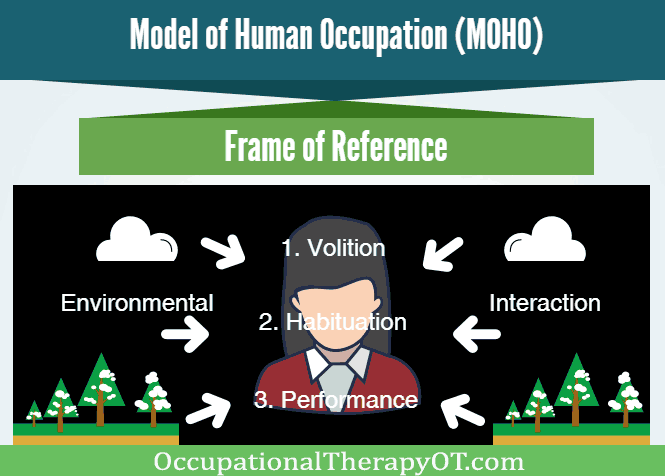
Mary Reilly’s occupational behaviour model
MOHO is heavily based on the principles of the occupational behaviour model. In that model, occupational behaviour means occupational roles. Reilly’s model reinforced the principles of habit training, along with the work–play–rest continuum, applied to occupational roles such as worker, student, preschooler and homemaker.
Gary Kielhofner’s Model of Human Occupation
Kielhofner was a student of Mary Reilly. He modified her concepts and proposed general open systems theory as the baseline for MOHO, and introduced MOHO to occupational therapy.
The human open system
In this structural framework, Kielhofner considered the individual as an open system: one that grows, develops and changes through ongoing interaction with the external environment. The cycle of interaction with the environment has four phases.
Input
Information enters the system.
Throughput
The system converts and absorbs the information, making it meaningful by adapting to it.
Output
The external action or behaviour that results.
Feedback
The results modify or control the next cycle.
This ongoing cycle is responsible for self-maintenance and self-change.
Example: a man returning to cooking after a stroke notices his tea is too weak (input), realises he lifted the teabag out too soon because his grip tired (throughput), adjusts by resting his arm on the counter next time (output), and enjoys a better cup (feedback), which encourages him to cook again.
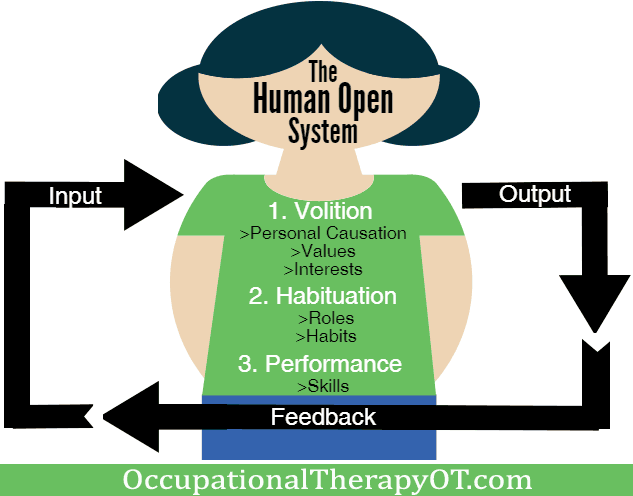
The three components of MOHO
In the early versions of MOHO, the open system had three subsystems in a hierarchy, with volition at the top. In later editions, Kielhofner described them as working together, each influencing the others, with the environment always part of the picture. “Performance” became performance capacity.
Volition
Motivation: causation, values, interests
Habituation
Habits and roles
Performance capacity
Abilities for doing
1. Volition
Volition is directly related to a person’s motivation and voluntary involvement in occupation. It also refers to the inborn human urge to explore and master the environment. Volition depends on internal thoughts and beliefs, broken down into:
- Personal causation: a person’s sense of their own ability and effectiveness. When someone takes part in an occupation, they consider whether they have the skills for it to go well.
- Values: a person’s internal beliefs about what is good, right and worth doing.
- Interests: what a person finds enjoyable and satisfying, based on prior experience.
2. Habituation
Habituation is responsible for organising behaviour into routines and patterns. Its function is to maintain behaviour. It is based on occupational roles and habits.
- Roles are a set of connected behaviours, obligations and norms that people take on in social situations, such as parent, worker, student or friend.
- Habits are routines of behaviour, repeated regularly, that tend to happen automatically and follow social norms.
3. Performance capacity
Performance capacity consists of the basic abilities for action. It includes the objective physical and mental abilities (the musculoskeletal, neurological, cardiopulmonary and cognitive systems) and the person’s subjective, lived experience of their body. Kielhofner called this the “lived body”: how it feels to do things with a body that has changed.
The environment
The environment includes the physical space and objects, the social groups around a person, and the occupational forms (the expected ways of doing things) in their culture. It can offer opportunities, resources, demands and constraints. The same wheelchair ramp, family attitude or job demand can open up occupation for one person and close it for another.
Dimensions of doing
MOHO describes doing at three levels, from the smallest to the largest.
Broadest ↑
-
Occupational participationRole
Engaging in work, play and daily living as part of one's life, e.g. being a parent.
-
Occupational performanceTask
Doing a whole task, e.g. preparing the family's breakfast.
-
Occupational skillsAction
Goal-directed actions within a task: motor, process, and communication and interaction skills, e.g. reaching for a pan, sequencing steps, asking for help.
Smallest
Over time, participation builds occupational identity (who I am and want to be) and occupational competence (living that identity). Together they make up occupational adaptation.
Function–dysfunction continua
MOHO is based on occupational functioning and satisfaction. When someone is unable to perform their occupational roles, identifying the causes is important to help them overcome the difficulty.
In the function–dysfunction continua, areas of concern related to occupational roles are described for assessment and intervention planning. Occupational function is based on exploration, competence and achievement. Occupational dysfunction is based on inefficiency, incompetence and helplessness. Occupational dysfunction is where the occupational therapist works, rooting out the causes of non-involvement in occupation.
| Level | Function | Dysfunction |
|---|---|---|
| 1 | Exploration: curiosity, trying new things in a safe setting | Inefficiency: the first level of dysfunction; dissatisfaction with performance even in meaningful activity |
| 2 | Competence: practising until skills meet the demands of the environment | Incompetence: major loss or limitation of skills, with feelings of failure that limit occupation and daily routine |
| 3 | Achievement: skills and habits allow full participation in roles | Helplessness: total or near-total disruption of roles and performance, with feelings of ineffectiveness, anxiety, depression or all three |
MOHO assessments
Assessing occupational function is important for setting meaningful goals. After setting goals, the OT plans intervention according to the person’s needs. MOHO has one of the largest families of theory-based assessments in occupational therapy.
The Occupational Circumstances Assessment Interview and Rating Scale (OCAIRS) can be used as an initial screening of occupational function. It focuses on the person’s values, interests, roles, habits and skills, and most importantly whether they are satisfied with how they perform their activities. But assessment isn’t limited to one tool.
| Assessment | Type | What it tells you |
|---|---|---|
| Occupational Performance History Interview (OPHI-II) | Semi-structured interview with rating scales | Life history, occupational identity, competence and the impact of environment |
| Model of Human Occupation Screening Tool (MOHOST) | Observation and information gathering | A quick overview of volition, habituation, skills and environment; useful when a person can't do a long interview |
| Occupational Self Assessment (OSA) | Self-report | The person's own view of their competence and what matters most to them; good for setting client-led goals |
| OCAIRS | Interview with rating scale | Screening of occupational participation |
| Role Checklist | Self-report | Past, present and future roles and how much each is valued |
| Interest Checklist | Self-report | Strength of interest in a range of activities, past and present |
| Volitional Questionnaire (VQ) | Observation | Motivation in people who can't easily self-report, e.g. dementia or severe mental illness |
| Worker Role Interview (WRI) | Interview | Psychosocial and environmental factors in return to work |
| Assessment of Communication and Interaction Skills (ACIS) | Observation | Communication and interaction skills during occupation |
| Short Child Occupational Profile (SCOPE) | Observation and report | Volition, habituation, skills and environment in children |
Postulates regarding change and intervention
After screening and assessment, the therapist understands the cause of occupational dysfunction, the reason the person isn’t taking part in their occupational roles.
The therapist’s job is to find out where the problem lies: in volition, habituation, performance capacity or the environment. For example, if the problem is in performance capacity, perhaps a skill impairment after a musculoskeletal or neurological injury, the therapist will focus on skill training, and the primary goal will be returning to the person’s occupations.
Occupational therapists remediate occupational dysfunction by:
- Providing an occupation for the person to engage in as therapy
- Counselling and problem solving with the person to identify and change a maladaptive occupational lifestyle
- Improving the fit between the person and their environment to make engagement in occupation easier
MOHO also emphasises that the client does the changing. The therapist supports change through what MOHO calls therapeutic strategies: validating, identifying, giving feedback, advising, negotiating, structuring, coaching, encouraging and providing physical support.
A case example using MOHO
Arjun, 34, is a software engineer who has been on leave for four months with depression. He spends most of the day in bed, has stopped seeing friends and says, “I’m useless at everything now.”
| MOHO component | What the OT finds | Assessment used |
|---|---|---|
| Volition | Low personal causation ("I'm useless"); still values being a provider; former interests in cricket and cooking | OSA, Interest Checklist |
| Habituation | Sleep–wake routine lost; worker and friend roles dropped | Role Checklist, OPHI-II |
| Performance capacity | Fatigue, poor concentration, feels his body is "heavy" | MOHOST, interview |
| Environment | Lives alone; supportive manager; cricket club nearby | OPHI-II environment scale |
Problem 1Disorganised daily routine
GoalArjun will follow a balanced daily routine five days a week within 4 weeks.
- Gets up by 8 a.m. and eats breakfast on 5 of 7 days
- Plans one productive, one pleasurable and one social activity each day using a weekly planner
Problem 2Low personal causation
GoalArjun will report increased confidence in his abilities on the OSA within 6 weeks.
- Cooks a simple meal twice a week and records what went well
- Names one success at the end of each session
Problem 3Loss of worker role
GoalArjun will begin a graded return to work within 10 weeks.
- Completes 1 hour of work-like tasks at home daily
- Agrees a phased return plan with his manager
MOHO assessments in more detail
The MOHOST
The Model of Human Occupation Screening Tool (MOHOST) is one of the most widely used MOHO tools, especially in mental health and inpatient settings. The OT gathers information from observation, the person, family and records, then rates 24 items across six areas:
| MOHOST section | What it looks at |
|---|---|
| Motivation for occupation | Appraisal of ability, expectation of success, interest, choices |
| Pattern of occupation | Routine, adaptability, roles, responsibility |
| Communication and interaction skills | Non-verbal skills, conversation, vocal expression, relationships |
| Process skills | Knowledge, timing, organisation, problem solving |
| Motor skills | Posture and mobility, coordination, strength and effort, energy |
| Environment | Space, resources, social groups, occupational demands |
Each item is rated on a four-point scale: facilitates, allows, inhibits or restricts occupational participation.
Choosing a MOHO assessment
| If the person… | Consider |
|---|---|
| Can talk about their life story | OPHI-II (interview) |
| Can self-report and you want client-led goals | OSA (Occupational Self Assessment) |
| Can't do a long interview, or you need a quick overview | MOHOST |
| Has limited verbal skills, e.g. dementia or severe mental illness | Volitional Questionnaire (VQ) |
| Is a child | SCOPE, Pediatric Volitional Questionnaire, Child OSA |
| Is returning to work | Worker Role Interview (WRI), Work Environment Impact Scale (WEIS) |
MOHO-based interventions
- Remotivation Process (de las Heras and colleagues): for people with very low motivation, moving through exploration, competency and achievement stages
- Graded occupational engagement: small, achievable activities that build personal causation
- Role and routine building: weekly planners, gradual return to valued roles
- Environmental changes: adapting space, social supports and occupational demands
- Work rehabilitation using the Worker Role Interview and graded return to work
MOHO in different settings
| Setting | How MOHO is used | Example |
|---|---|---|
| Mental health | Rebuilding volition, routines and roles | OSA to set goals; weekly routine plan; graded return to a hobby |
| Physical rehab and stroke | Understanding how disability changes identity and roles | Exploring a person's role as a cook and planning graded success |
| Pediatrics | Children's motivation, play and routines | SCOPE; play-based activities that build interest and competence |
| Older adults and dementia | Preserving identity through familiar occupations | Volitional Questionnaire; meaningful activity based on past roles |
| Work | Return to work after illness or injury | Worker Role Interview; workplace adjustments |
MOHO vs other models
| MOHO | PEO | CMOP-E | |
|---|---|---|---|
| Focus | Why and how people choose, organise and perform occupations | Fit between person, environment and occupation | Spirituality, performance and engagement |
| Strength | Large family of standardised assessments | Simple and easy to explain | Client-centred goals with the COPM |
| Best for | Motivation, roles, routines | Environment changes; any setting | Client-led priorities |
Read more in our guide to OT models of practice.
Test yourself: MOHO
0 / 4 correct
-
Which MOHO component organises behaviour into habits and roles?
Show answer
B. Habituation organises behaviour into routines, habits and roles.
-
Which assessment is best for someone with dementia who can't self-report?
Show answer
C. The VQ observes motivation, so it suits people with limited verbal skills.
-
Personal causation is part of…
Show answer
B. Volition includes personal causation, values and interests.
-
The three stages of the Remotivation Process are…
Show answer
B. The Remotivation Process moves through exploration, competency and achievement.
Summary
MOHO explains how motivation, habits and roles, and performance capacity work together with the environment to shape what people do. It gives occupational therapists a clear way to understand occupational dysfunction, a wide range of assessments, and practical strategies to help clients rebuild meaningful lives. Read more:
- Occupational therapy frames of reference
- Biomechanical frame of reference
- Developmental frame of reference
- Rehabilitative frame of reference
- Psychodynamic frame of reference
References
- Kielhofner G, Burke JP. A model of human occupation, part 1. Conceptual framework and content. American Journal of Occupational Therapy. 1980;34(9):572–581.
- Taylor RR, ed. Kielhofner’s Model of Human Occupation: Theory and Application. 5th ed. Wolters Kluwer.
- Reilly M. Occupational therapy can be one of the great ideas of 20th century medicine. American Journal of Occupational Therapy. 1962;16:1–9.
- Pendleton HM, Schultz-Krohn W, eds. Pedretti’s Occupational Therapy: Practice Skills for Physical Dysfunction. Elsevier.
- Boyt Schell BA, Gillen G, eds. Willard and Spackman’s Occupational Therapy. Wolters Kluwer.
- de las Heras CG, Llerena V, Kielhofner G. Remotivation Process: Progressive Intervention for Individuals with Severe Volitional Challenges. MOHO Clearinghouse, University of Illinois at Chicago.
- Parkinson S, Forsyth K, Kielhofner G. The Model of Human Occupation Screening Tool (MOHOST). MOHO Clearinghouse.
- MOHO-IRM, University of Illinois Chicago.
Frequently asked questions
What is the Model of Human Occupation in simple terms?
Who developed MOHO?
What are the three components of MOHO?
What assessments are used with MOHO?
Is MOHO a model or a frame of reference?
Where is MOHO used?
What is the MOHOST?
What is the Remotivation Process?
How is MOHO used in mental health?
Written by
Payal Mehta, OT
Payal Mehta is a practising occupational therapist and co-founder of Occupational Therapy OT. She writes on pediatrics, sensory integration, and mental-health practice.
All articles by Payal →This article is for general education and is not a substitute for individualized assessment or treatment by a licensed occupational therapist. Always seek the guidance of a qualified professional for specific concerns.