Occupational Therapy Activities for Stroke Patients: 30 Evidence-Based Ideas
OT activities for stroke recovery: daily living practice, arm and hand activities, thinking and vision tasks, home ideas and what the evidence says.

After a stroke, everyday tasks like getting dressed, making a cup of tea or writing a shopping list can suddenly become hard. Occupational therapy helps stroke survivors relearn these activities and get back to the life they want. This guide explains what OT for stroke involves and gives 30 practical activity ideas, with the evidence behind them.
What does the evidence say?
| Approach | What it involves | Evidence |
|---|---|---|
| Occupational therapy for daily activities | Practising self-care, home and community activities with an OT | A Cochrane review (Legg et al.) found OT improves people's ability to carry out daily activities after stroke and reduces deterioration. |
| Task-oriented training | Repeated practice of real, meaningful tasks, made gradually harder | Widely recommended in stroke guidelines as a core approach. |
| Constraint-induced movement therapy (CIMT) | Restraining the stronger arm so the affected arm is used intensively in tasks | A Cochrane review of 42 studies found it can improve arm function for suitable patients. |
| Mirror therapy | Moving the stronger arm while watching its reflection, so it looks like the affected arm is moving | A 2018 Cochrane review of 62 studies found moderate improvements in movement and daily activities. |
Areas OT works on after stroke
- Self-care: dressing, washing, toileting, eating and grooming
- Arm and hand function: reaching, grasping, releasing and coordination
- Thinking skills: attention, memory, planning and problem solving
- Vision and perception: visual field loss, neglect of one side, spatial difficulties
- Fatigue management: pacing and energy conservation
- Home and community: safety, adaptive equipment, transport and returning to work or hobbies
- Mood and confidence: meaningful activity and gradual return to roles. Read more: OT for depression.
30 occupational therapy activities for stroke patients
| Activity | What it builds |
|---|---|
| 1. Putting on a shirt using one-handed techniques | Independence in dressing; affected arm goes in first |
| 2. Washing face and brushing teeth at the sink | Standing balance, sequencing, grooming |
| 3. Making a hot drink (with supervision) | Planning, safety, bilateral hand use |
| 4. Buttering toast with a non-slip board | One-handed kitchen skills |
| 5. Folding towels and laundry | Both hands working together, reaching |
| 6. Wiping a table in large circles | Shoulder movement, weight shifting |
| 7. Setting the table | Reaching, carrying, sequencing |
| 8. Practising transfers (bed, chair, toilet) with the therapist | Safety and independence |
| 9. Putting on socks with a sock aid | Adaptive equipment use |
| 10. Sorting medicines into a pill organiser | Fine motor and thinking skills |
| Activity | What it builds |
|---|---|
| 11. Reaching to place cups on a shelf | Shoulder and elbow range, reaching |
| 12. Squeezing therapy putty or a soft ball | Grip strength |
| 13. Picking up coins, pegs or beans | Pinch and fine motor control |
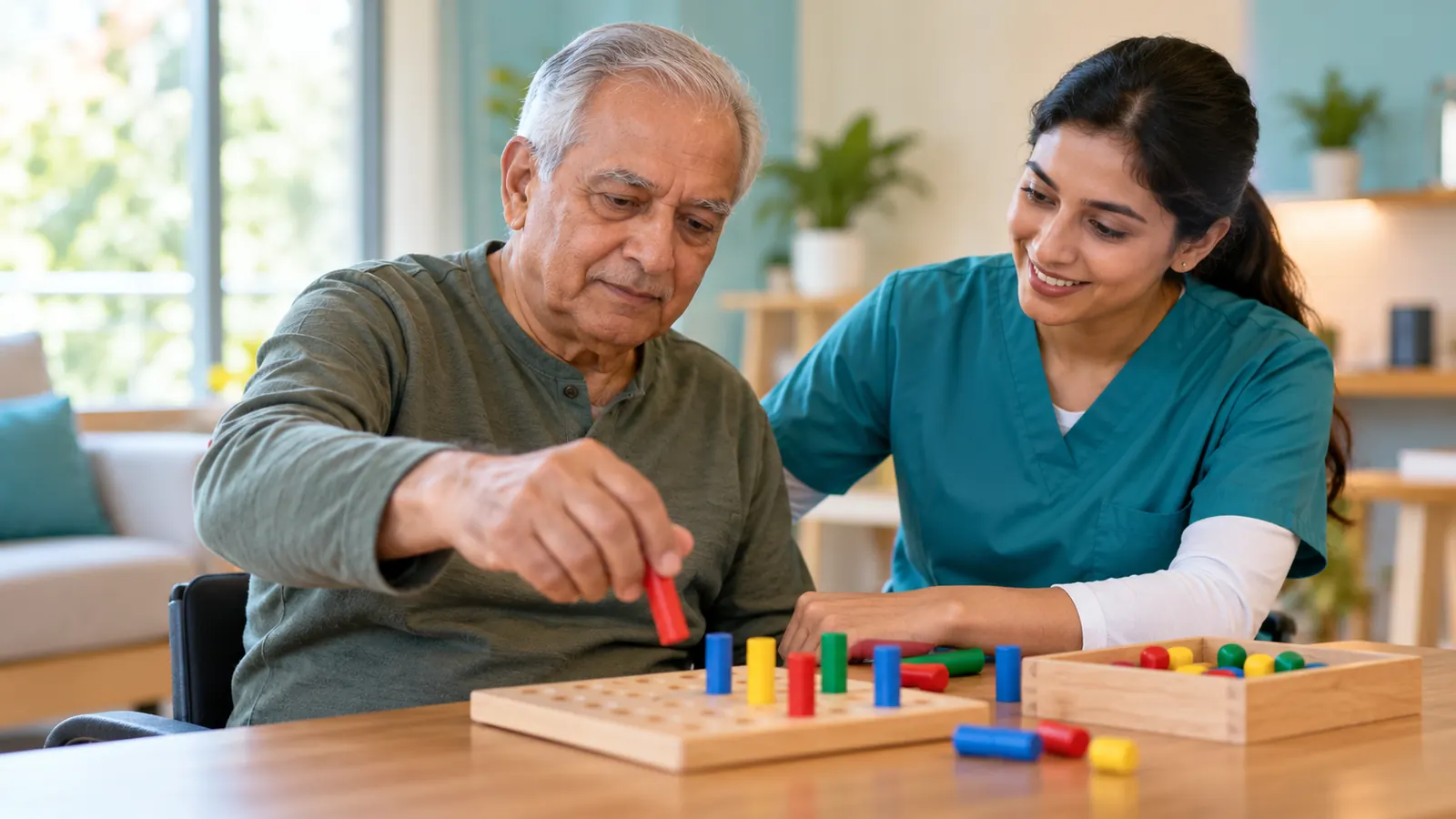
| 14. Stacking cones or blocks | Grasp and release, coordination |
| 15. Turning pages of a book or magazine | Finger isolation |
| 16. Pegboard games | Precision and speed |
| 17. Rolling dough or a ball under the hand | Wrist and forearm movement |
| 18. Handwriting practice: shapes, then words | Writing for daily life |
| 19. Typing or using a tablet | Finger movement and communication |
| 20. Mirror therapy (with therapist guidance) | Arm movement; evidence-based adjunct |
| Activity | What it builds |
|---|---|
| 21. Card games (e.g. Uno, rummy) | Attention, memory, hand use |
| 22. Jigsaw puzzles | Visual perception, problem solving |
| 23. Word searches and spot-the-difference | Visual scanning, attention |
| 24. Scanning a room to find items on the affected side | Visual neglect strategies |
| 25. Following a simple recipe | Sequencing and planning |
| 26. Planning a shopping list and budget | Executive function |
| 27. Gardening in raised beds or pots | Meaningful leisure, standing tolerance |
| 28. Painting or crafts | Fine motor, mood, creativity |
| 29. Using a calendar and phone reminders | Memory strategies |
| 30. Short community outings (café, shop) | Confidence, community mobility |
How OT grades activities
-
Seated
Practise grasping and moving a cup at the table.
-
Cold drink
Pour cold water from a light jug.
-
With adaptations
Kettle tipper, non-slip mat, one-handed technique.
-
Hot drink, supervised
Full task with the therapist nearby.
-
Independent
Making a drink safely at home.
Problem 1Needs help to dress the upper body
GoalWill put on a front-opening shirt independently using one-handed techniques within 4 weeks.
- Places the affected arm in the sleeve first with verbal cues
- Completes buttons using a button hook
Problem 2Can't prepare simple meals
GoalWill prepare a sandwich and a cold drink safely with supervision within 6 weeks.
- Uses a non-slip board and adapted knife
- Follows a written 5-step sequence
Adaptive equipment that helps
| Task | Equipment |
|---|---|
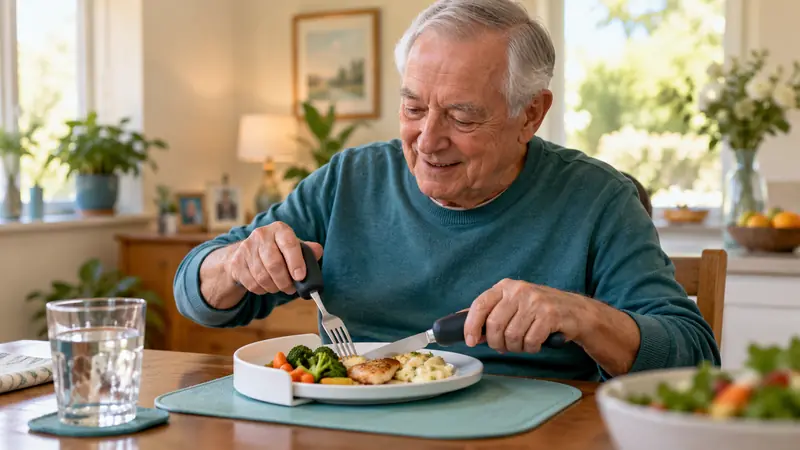
| Eating | Plate guard, non-slip mat, rocker knife, built-up cutlery. See adaptive equipment for eating. |
| Dressing | Button hook, sock aid, long-handled shoehorn, elastic laces |
| Bathing | Tub transfer bench, grab bars, long-handled sponge, hand-held shower |
| Kitchen | One-handed cutting board, kettle tipper, jar opener |
| Writing | Built-up pens, writing slope, tablet with large keys |
Summary
Occupational therapy helps stroke survivors regain independence in the activities that matter to them. The most effective approach is repeated practice of real, meaningful tasks, supported by evidence-based techniques like constraint-induced movement therapy and mirror therapy, plus adaptive equipment and family support. Read more about the rehabilitative frame of reference, the biomechanical frame of reference and what occupational therapists do.
Related guides: Activities of daily living checklist, OT for Parkinson’s.
Theory behind this: the OT approaches in this guide draw on motor learning and task-oriented training, neurodevelopmental (NDT, Bobath, Brunnstrom) and the rehabilitative frame.
References
- Legg LA, Lewis SR, Schofield-Robinson OJ, Drummond A, Langhorne P. Occupational therapy for adults with problems in activities of daily living after stroke. Cochrane Database of Systematic Reviews. 2017;7:CD003585.
- Thieme H, Morkisch N, Mehrholz J, et al. Mirror therapy for improving motor function after stroke. Cochrane Database of Systematic Reviews. 2018;7:CD008449.
- Corbetta D, Sirtori V, Castellini G, Moja L, Gatti R. Constraint-induced movement therapy for upper extremities in people with stroke. Cochrane Database of Systematic Reviews. 2015;10:CD004433.
- Pendleton HM, Schultz-Krohn W, eds. Pedretti’s Occupational Therapy: Practice Skills for Physical Dysfunction. Elsevier.
Frequently asked questions
What does an occupational therapist do for stroke patients?
What activities help stroke recovery?
What is task-oriented training?
Does mirror therapy work after stroke?
How long does occupational therapy last after a stroke?
What exercises can stroke patients do at home?
Written by
Deepam Pawar, OT
Deepam Pawar is an occupational therapist and co-founder of Occupational Therapy OT. He focuses on clinical frameworks, assessment, and evidence-based practice.
All articles by Deepam →This article is for general education and is not a substitute for individualized assessment or treatment by a licensed occupational therapist. Always seek the guidance of a qualified professional for specific concerns.