Adaptive Equipment for Eating: An OT's Guide to Utensils, Plates and Cups
Adaptive eating equipment explained by an OT: built-up and weighted utensils, rocker knives, plate guards, scoop dishes and adapted cups.

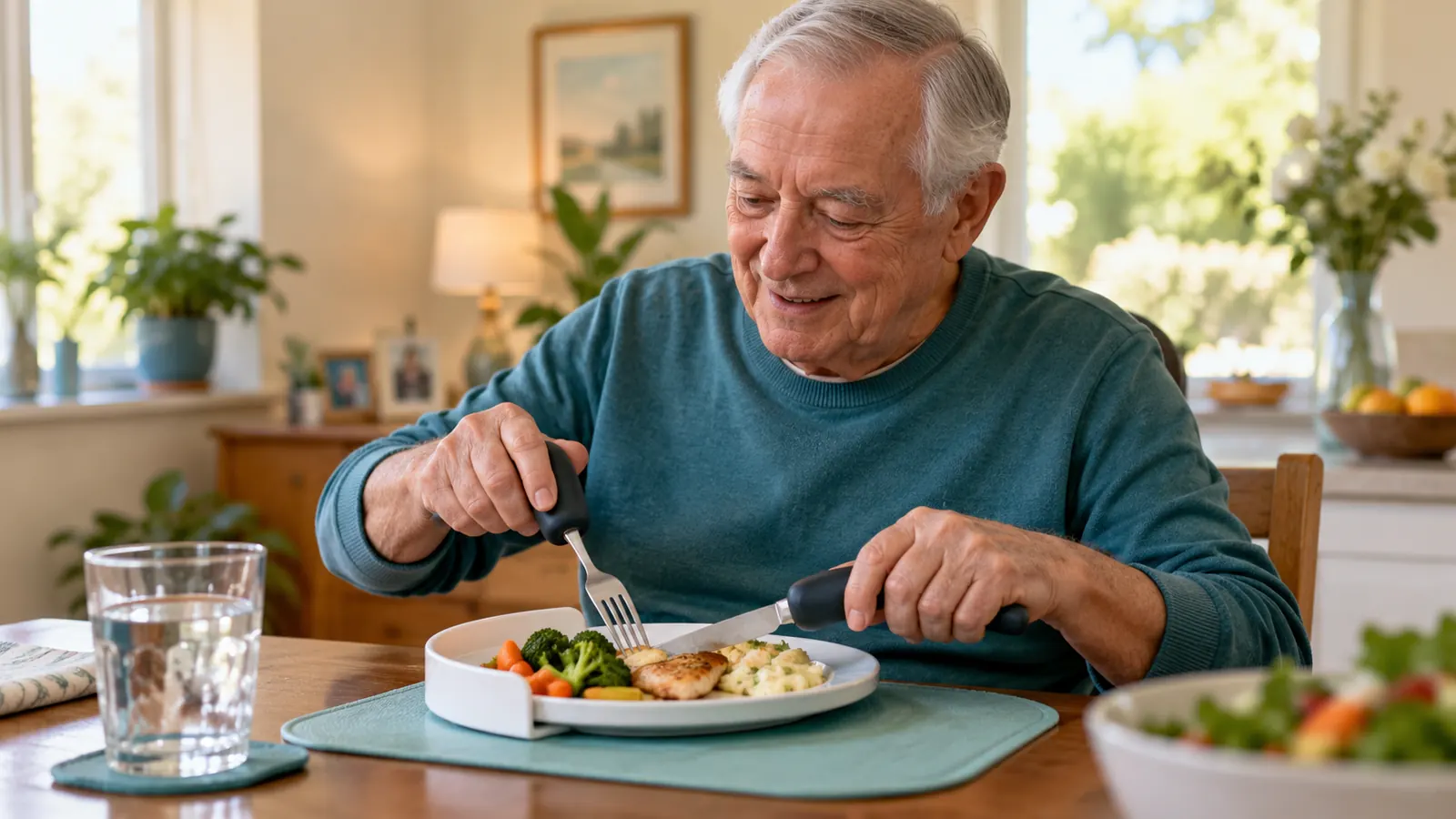
Eating independently is about more than nutrition: it’s about dignity, enjoyment and sharing meals with others. When an illness, injury or disability makes using cutlery or cups hard, adaptive eating equipment can help. Occupational therapists assess eating and recommend the right tools and techniques.
Who benefits from adaptive eating equipment?
- People with weak grip or arthritis
- People with tremor, such as in Parkinson’s disease or essential tremor
- People who can use only one hand, for example after a stroke
- People with limited reach or joint movement
- People with coordination difficulties, such as cerebral palsy or multiple sclerosis
- People with visual or cognitive difficulties, including dementia
- Children learning to feed themselves, especially those with motor difficulties. See OT for children and hand strengthening activities.
Choose by the problem
-
Weak grip
- Arthritis
- Weak hands
- Can't hold thin handles
Built-up or lightweight handles, utensil cuffs
-
Tremor
- Shaking spills food
- Parkinson's or essential tremor
Weighted utensils and cups, non-slip mat, lidded cup
-
One hand
- After stroke
- Amputation or injury
Rocker knife, plate guard, scoop dish, non-slip mat
-
Limited reach
- Stiff shoulder or elbow
- Can't bring food to mouth
Angled or long-handled utensils, raised plate
An OT can assess and trial options before you buy.
Types of adaptive eating equipment
| Equipment | What it does | Good for |
|---|---|---|
| Built-up handle utensils | Thick, often foam or rubber handles that are easier to grip | Weak grip, arthritis, hand pain |
| Foam tubing | Slips over ordinary cutlery to thicken the handle | A cheap, flexible option |
| Weighted utensils | Heavier handles that steady the hand | Some people with tremor |
| Angled or bendable utensils | The head is angled to reach the mouth more easily | Limited wrist, elbow or shoulder movement |
| Long-handled utensils | Extra length for reaching | Limited reach |
| Utensil cuff or universal cuff | Strap that holds the utensil in the hand | Very weak or no grip |
| Rocker knife | Curved blade cuts with a rocking motion | One-handed eating |
| Combination utensils (e.g. knife-fork) | Two tools in one | One-handed eating |
| Electronic stabilising spoon | Moves to counteract tremor | Moderate tremor |
| Equipment | What it does | Good for |
|---|---|---|
| Plate guard | Clips onto a plate edge so food can be pushed against it | One-handed eating, coordination difficulties |
| Scoop dish or high-sided bowl | Raised curved edge helps scoop food onto a spoon | One hand, tremor, limited control |
| Non-slip mat | Stops plates and bowls sliding | Almost everyone who needs equipment |
| Suction bowls | Stick to the table | Children, tremor |
| Contrasting colour plates | Make food easier to see | Low vision, dementia |
| Divided plates | Separate foods, reduce overload | Dementia, sensory needs |
| Equipment | What it does | Good for |
|---|---|---|
| Two-handled cup | Easier and more stable to hold | Weak grip, tremor |
| Lidded cup with spout | Reduces spills | Tremor, coordination difficulties |
| Weighted cup | Steadier base and handle | Tremor |
| Nosey (cut-out) cup | Drink without tipping the head back | Limited neck movement; sometimes advised for swallowing difficulties |
| Long straws and straw holders | Drink without lifting the cup | Limited arm movement |
Simple changes that help
- Sit upright at a table, with feet supported
- Use a non-slip mat under the plate
- Cut food in advance, or choose softer foods if advised
- Reduce distractions: TV off, fewer items on the table
- Allow plenty of time, and use smaller, more frequent meals if tiring
- Use contrasting colours for plates and placemats
- Rest the elbow on the table for stability if there’s a tremor
How an occupational therapist helps
An occupational therapist assesses posture, arm and hand movement, coordination, vision, thinking skills and the eating environment. They may trial equipment, teach techniques such as one-handed cutting, recommend seating changes, and coach family members or carers. They work with speech-language therapists, dietitians and doctors when swallowing or nutrition is a concern. Read more about the biomechanical frame of reference and the rehabilitative frame of reference, which guides compensatory approaches like this.
Summary
Adaptive eating equipment can restore independence and dignity at mealtimes. Choose equipment based on the specific difficulty, start with simple changes like a non-slip mat and plate guard, and ask an occupational therapist to assess and recommend the right tools.
Related guides: OT for Parkinson’s, Trigger finger exercises.
References
- Pendleton HM, Schultz-Krohn W, eds. Pedretti’s Occupational Therapy: Practice Skills for Physical Dysfunction. Elsevier.
- AARP. Caregiving items that make mealtime easier.
- Parkinson’s Foundation. Eating and swallowing: practical tips and occupational therapy.
- American Speech-Language-Hearing Association. Adult dysphagia: overview.
Frequently asked questions
What is adaptive equipment for eating?
Which utensils are best for weak grip or arthritis?
Which eating aids help with tremor or Parkinson's?
What is a rocker knife?
Who can recommend adaptive eating equipment?
Written by
Deepam Pawar, OT
Deepam Pawar is an occupational therapist and co-founder of Occupational Therapy OT. He focuses on clinical frameworks, assessment, and evidence-based practice.
All articles by Deepam →This article is for general education and is not a substitute for individualized assessment or treatment by a licensed occupational therapist. Always seek the guidance of a qualified professional for specific concerns.