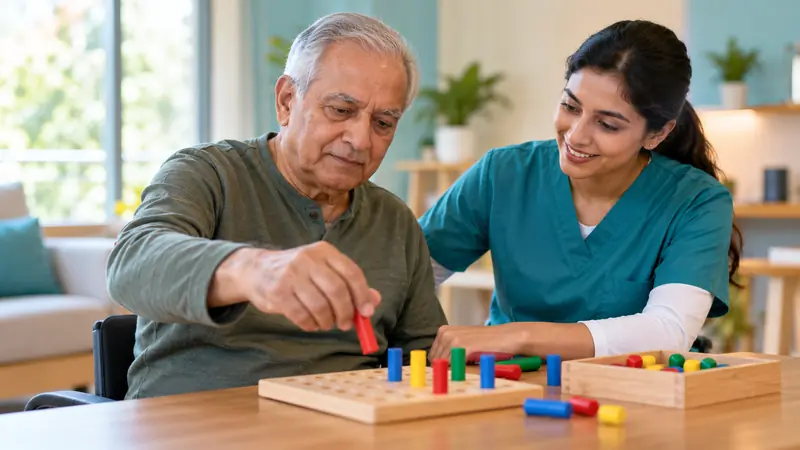
Occupational Therapy Activities for Dementia: 35 Ideas by Stage
Meaningful occupational therapy activities for people with dementia, matched to early, middle and late stages, with evidence on OT programs and tips for carers.


When someone is living with dementia, days can feel long, confusing or empty. Meaningful activity, matched to what the person can still do and enjoys, can lift mood, reduce distress and help them feel useful and connected. Occupational therapists specialise in finding and adapting these activities.
What the evidence says
| Program | What it involves | Findings |
|---|---|---|
| COTiD (Community Occupational Therapy in Dementia) | About 10 home OT sessions over 5 weeks: training the person to use aids and strategies, and carers in coping and supervision | A 2006 BMJ randomised trial (Graff et al.) found improved daily functioning, mood and quality of life, and better carer competence; the program was cost-effective. |
| Tailored Activity Program (TAP) | About 8 home sessions over 4 months: personalised activities based on preserved abilities, past roles and interests, with carer training | Randomised trials (Gitlin et al.) found reduced behavioural symptoms and carer burden. |
Results can vary between countries and services; later UK trials of COTiD found smaller effects.
How to choose the right activity
-
Know the person
Past jobs, roles, hobbies, routines, culture and what they enjoy.
-
Know their abilities now
What they can still do well: movement, attention, senses.
-
Simplify
Fewer steps, clear instructions, one step at a time.
-
Set up for success
Quiet space, good light, materials ready, no 'wrong' way.
-
Watch and adjust
If they're bored, add challenge; if stressed, simplify.
Activities by stage
| Activity | Why it helps |
|---|---|
| 1. Cooking a familiar recipe together | Keeps skills and roles; follow a picture recipe |
| 2. Gardening and potting plants | Purpose, outdoors, movement |
| 3. Walking a familiar route | Exercise, routine, orientation |
| 4. Crosswords, word games and quizzes | Cognitive stimulation at the right level |
| 5. Jigsaw puzzles (100–300 pieces) | Visual skills, focus |
| 6. Making a life story book | Identity, memories, conversation |
| 7. Card games and board games | Social connection, thinking |
| 8. Painting, drawing or crafts | Creativity, self-expression |
| 9. Using a calendar and memory board | Supports independence |
| 10. Joining a dementia-friendly group or choir | Social connection |
| 11. Helping with household finances, with support | Valued role |
| 12. Hobbies they've always done, adapted | Continuity and enjoyment |
| Activity | Why it helps |
|---|---|
| 13. Folding laundry or towels | Familiar, repetitive, useful |
| 14. Setting the table | Purpose and routine |
| 15. Sorting objects (buttons, cutlery, socks) | Calming, success-focused |
| 16. Simple baking: stirring, kneading, decorating | Sensory and familiar |
| 17. Watering plants | Easy, purposeful |
| 18. Looking at photo albums together | Reminiscence |
| 19. Listening to and singing favourite music | Mood, memory, connection |
| 20. Large-piece puzzles (12–50 pieces) | Achievable challenge |
| 21. Sanding wood or polishing | Repetitive, linked to past roles |
| 22. Simple chair exercises | Movement and strength |
| 23. Arranging flowers | Sensory, creative |
| 24. Dusting or wiping surfaces | Purpose, movement |
| 25. Rummage box of themed items (tools, sewing, office) | Exploration linked to past roles |
| Activity | Why it helps |
|---|---|
| 26. Hand massage with lotion | Comfort and connection |
| 27. Listening to familiar music | Music memory often remains |
| 28. Holding soft or textured objects (twiddle muff) | Calming touch |
| 29. Brushing hair gently | Comfort and care |
| 30. Smelling familiar scents (flowers, baking) | Sensory memories |
| 31. Looking at pictures of nature or family | Gentle engagement |
| 32. Sitting outdoors in fresh air and sunlight | Mood and orientation |
| 33. Gentle movement to music | Comfort, circulation |
| 34. Being read to | Familiar voices and rhythm |
| 35. Simply sitting together and holding hands | Presence matters |
Adapting the environment
- Reduce clutter and noise so it’s easier to focus
- Use contrast: coloured plates on a plain tablecloth, coloured toilet seats
- Label cupboards and doors with words and pictures
- Keep a routine with activities at similar times each day
- Improve lighting to reduce confusion and falls
- Remove hazards and consider safety devices for cookers and taps
- Make eating easier with contrasting plates and adapted cutlery. See adaptive equipment for eating.
Summary
Meaningful, well-matched activity is one of the most powerful tools in dementia care. Occupational therapists build on the person’s history, preserved abilities and interests, simplify tasks, adapt the home and coach carers. Evidence from programs like COTiD and TAP shows this approach can improve daily life for both the person and their family. Read more about OT for depression, the Model of Human Occupation, occupational therapy in mental health and what occupational therapists do.
Related guides: Activities of daily living checklist, OT for Parkinson’s.
Theory behind this: the OT approaches in this guide draw on Allen’s cognitive disability frame and cognitive levels and the rehabilitative frame.
References
- Graff MJL, Vernooij-Dassen MJM, Thijssen M, et al. Community based occupational therapy for patients with dementia and their care givers: randomised controlled trial. BMJ. 2006;333(7580):1196.
- Gitlin LN, Winter L, Burke J, et al. Tailored activities to manage neuropsychiatric behaviors in persons with dementia and reduce caregiver burden: a randomized pilot study. American Journal of Geriatric Psychiatry. 2008;16(3):229–239.
- Wenborn J, O’Keeffe AG, Mountain G, et al. Community occupational therapy for people with dementia and family carers (COTiD-UK) versus treatment as usual (Valuing Active Life in Dementia [VALID]) study: a single-blind, randomised controlled trial. PLoS Medicine. 2021;18(1).
- Alzheimer’s Association. Activities.
Frequently asked questions
What activities do occupational therapists use for dementia?
How does occupational therapy help people with dementia?
What is the Tailored Activity Program (TAP)?
What is COTiD?
What activities are good for late-stage dementia?
Written by
Payal Mehta, OT
Payal Mehta is a practising occupational therapist and co-founder of Occupational Therapy OT. She writes on pediatrics, sensory integration, and mental-health practice.
All articles by Payal →This article is for general education and is not a substitute for individualized assessment or treatment by a licensed occupational therapist. Always seek the guidance of a qualified professional for specific concerns.