Rehabilitative Frame of Reference in Occupational Therapy (with Examples)
The rehabilitative frame of reference: compensation, assistance levels, adaptive equipment, energy conservation, cases by condition, comparisons and a quiz.

Rehabilitation is the action of restoring someone’s health or normal life through training and therapy after an illness or injury. Before going deep into the rehabilitative frame of reference (also called the rehabilitation frame of reference), it’s important to understand the meaning of rehabilitation.
The term rehabilitation means a return to ability, that is, the return to the fullest physical, mental, social, vocational and economic usefulness that is possible for the individual. It means the ability to live and work with remaining capabilities. Therefore the focus in the treatment program is on abilities rather than on disabilities. (Hopkins)
The aim of rehabilitation is to regain function or to compensate for deficits. Therapists can use many different approaches in rehabilitation, such as the biomechanical frame of reference and the developmental frame of reference. Read more: occupational therapy frames of reference.
What is the rehabilitative frame of reference?
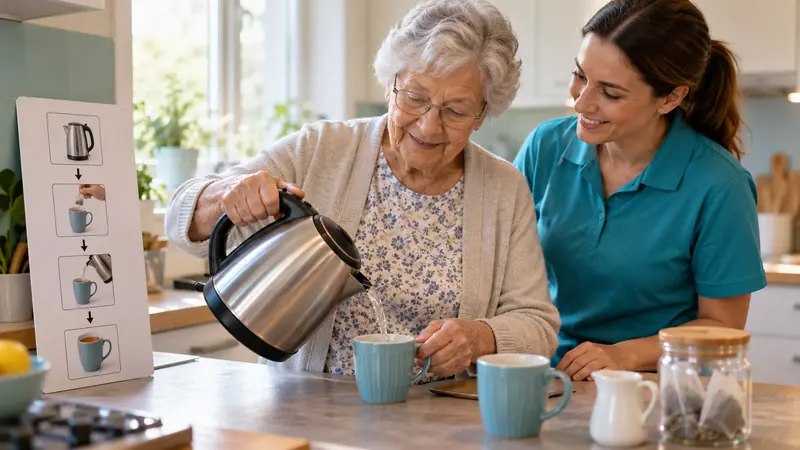
From the occupational therapy point of view, rehabilitation means compensating for an underlying deficit that cannot be remediated, in daily routine tasks and occupations.
The rehabilitative frame of reference requires that the client is part of the rehabilitation team. Rehabilitation programs should take place in the environment that is most natural to the client. The therapist must be creative in coming up with compensatory strategies and environmental modifications.
Biomechanical vs rehabilitative frame of reference
| Biomechanical | Rehabilitative | |
|---|---|---|
| Main aim | Restore the impairment | Compensate for the impairment |
| Focus | Performance components: range, strength, endurance | Performance areas: self-care, work, leisure |
| Best when | Recovery is still possible | Recovery has plateaued, or the condition is permanent or progressive |
| Typical goal | Wrist extension to 60° | Dresses independently using a button hook |
| Methods | Exercise, graded activity, splinting, edema control | Adaptive equipment, new techniques, environmental modification, education |
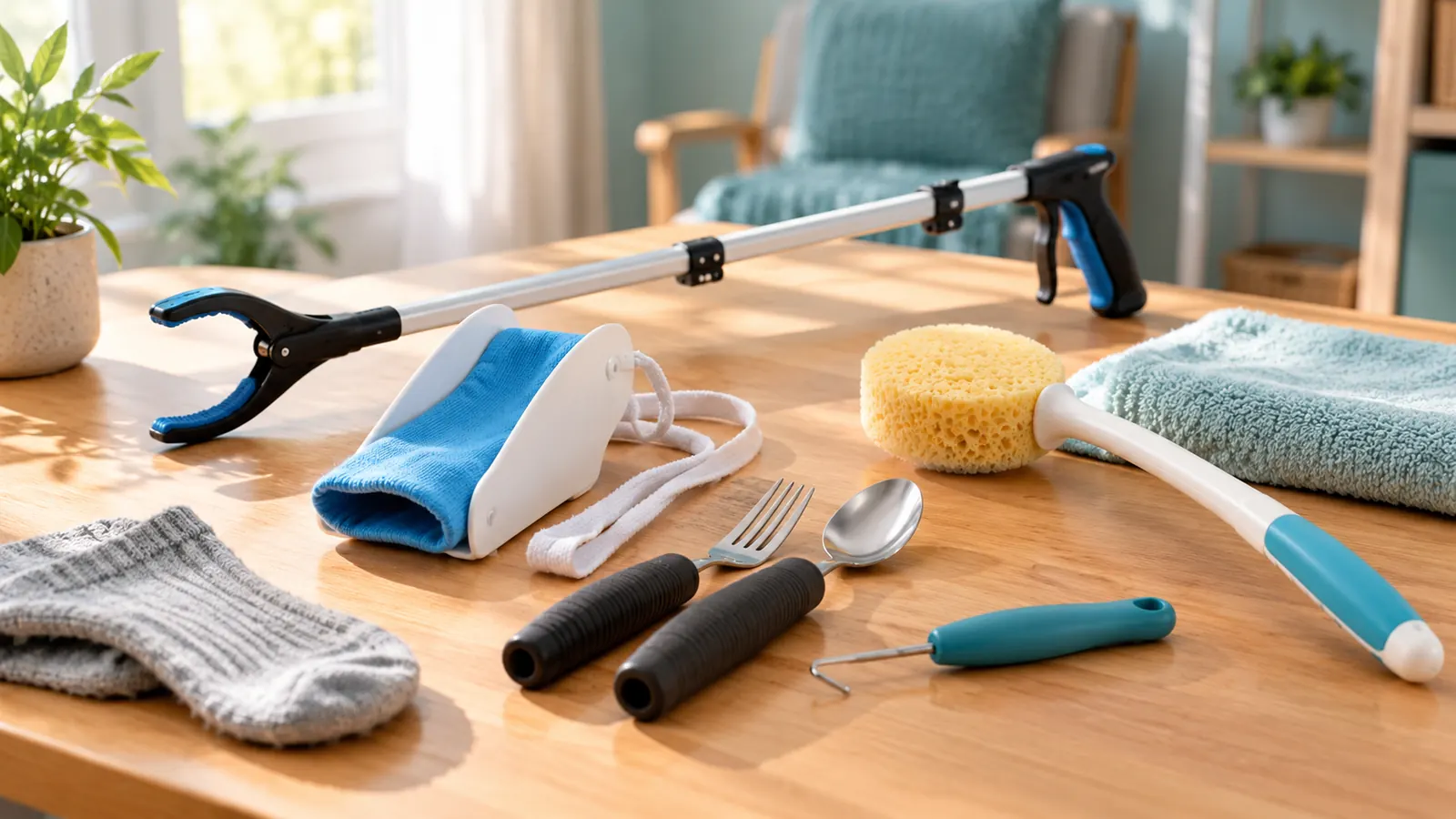
| Example: hip replacement | Strengthening hip muscles | Long-handled reacher and sock aid to follow hip precautions |
Theoretical base
In the rehabilitative frame of reference, theory suggests several assumptions that form its base:
- A person can regain independence through compensation.
- Motivation is a basic requirement for independence. Motivation is based on values, roles and interests.
- Environmental factors also play an important role in independence, such as financial status and family support.
- A minimum of emotional and cognitive skills is needed to make independence possible, because the person must learn and remember new methods.
Function–dysfunction continua (domains of concern)
In this approach, the occupational therapist focuses on performance areas more than on performance components. The aim of the occupational therapy program is to minimise disability barriers to role performance. From the OT perspective, activities of daily living (ADL), work and leisure are the most important domains, where the OT works to bring independence and successfully rehabilitate the patient.
- ADL can be divided into self-care and home care. A wide range of skills is needed for ADL such as eating, dressing, bathing, homemaking and childcare. Home care tasks are often called instrumental activities of daily living (IADL).
- Work tasks depend on the person’s occupational roles.
- Leisure activities, like watching TV, gardening, or playing guitar or piano, also need independence, so a person can take a leisure break when they need one without help from others.
Evaluation: behaviours indicative of function and dysfunction
The occupational therapist assesses the patient’s capabilities and decides how to overcome the effects of disability. Many assessment tools measure the level of assistance a person needs during an activity, such as bed mobility, bowel and bladder management, skin care and communication. Commonly used tools include the Barthel Index, the Functional Independence Measure (FIM) or the Section GG items used in US post-acute care, the Canadian Occupational Performance Measure (COPM) and home safety assessments.
Most independent ↑
-
Independent
Does the task safely, with no device, help or extra time.
-
Modified independent
Needs a device, extra time or safety consideration.
-
Supervision
Needs someone nearby to cue or watch, no hands-on help.
-
Minimum assistanceMin A
Does 75% or more of the task.
-
Moderate assistanceMod A
Does 50–74% of the task.
-
Maximum assistanceMax A
Does 25–49% of the task.
-
DependentTotal A
Does less than 25% of the task.
Most dependent
In work evaluation, work behaviours such as work tolerance, work conditioning and grip strength are evaluated and noted. Similarly, leisure skills are recorded using interest checklists for adults and play evaluations for children.
Postulates regarding change
These postulates identify the links between present problems and functional outcomes. It is essential to identify the stage-specific cause of the dysfunction, because it helps the therapist decide the best rehabilitation approach.
| Example | |
|---|---|
| Present problem | Dependence in bed mobility |
| Stage-specific cause | Flaccid paraplegia |
| Functional outcome | Bed mobility with minimum physical assistance and minimum verbal cues |
Postulates regarding intervention
These postulates link functional outcomes with specific adaptive devices, modifications and procedures.
The methods of the rehabilitative approach are often used in combination with biomechanical or sensorimotor approaches. First, biomechanical or sensorimotor principles can be applied during rehabilitation activities to reinforce the restoration of sensorimotor and cognitive components. Second, the treatment program often focuses on performance areas and performance components at the same time. Restoring sensorimotor, cognitive and psychosocial functions is combined with improving function in performance areas.
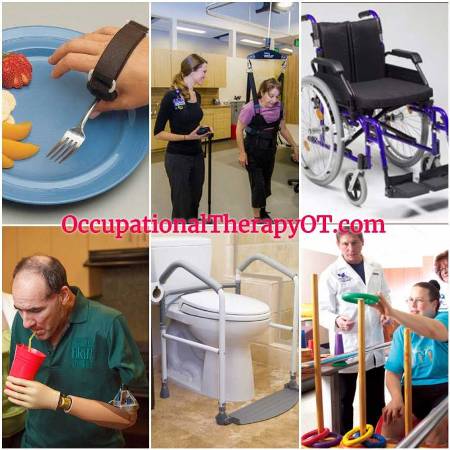
The treatment methods of the rehabilitative approach include (Dutton):
| Method | Examples |
|---|---|
| Self-care evaluation and training | One-handed dressing, adapted bathing and toileting routines |
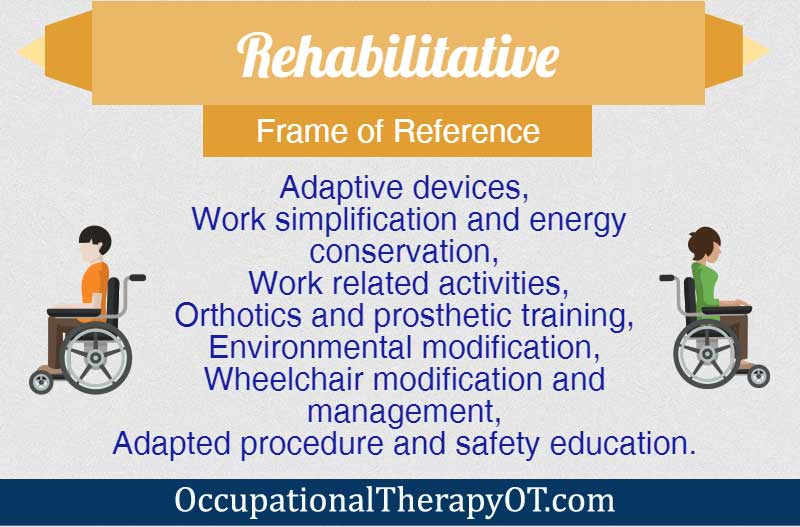
| Assistive and adaptive devices | Reacher, sock aid, long-handled sponge, button hook, built-up or angled cutlery, plate guard |
| Adaptive clothing | Velcro fastenings, elastic shoelaces, front-opening garments |
| Homemaking and childcare | One-handed cutting board, perching stool, adapted baby-care techniques |
| Work simplification and energy conservation | Planning, pacing, prioritising and positioning (see below) |
| Work-related activities | Workstation adaptation, graded return-to-work plans |
| Orthotic and prosthetic training | Donning and doffing, skin checks, using a prosthesis in daily tasks |
| Environmental and architectural adaptation | Grab bars, ramps, raised toilet seat, tub transfer bench, widened doorways |
| Wheelchair modification and management | Seating and pressure care, transfers, propulsion, maintenance |
| Ambulatory devices | Safe use of walkers and canes during daily tasks, e.g. carrying items with a walker tray |
| Community transportation | Car transfers, adapted driving referral, using public transport |
| Adapted procedures and safety education | Hip precautions, fall prevention, skin protection when sensation is reduced |
| Assistive technology | Voice assistants, smart-home controls, adapted phone and computer access |
Energy conservation: the four Ps
-
Plan
Spread heavy tasks across the week; gather everything before starting.
-
Pace
Work slowly and steadily; rest before you're exhausted.
-
Prioritise
Do what matters most; delegate or drop the rest.
-
Position
Sit when you can; keep items between hip and shoulder height.
A case example
Meera, 58, had a stroke three months ago. Her right arm has improved but still has limited fine movement, and she lives with her husband in a two-storey house. Her priorities are dressing herself, cooking for the family and getting back to her temple group.
| Goal | Rehabilitative strategies |
|---|---|
| Dressing independently | One-handed techniques (affected arm in the sleeve first), front-opening blouses, elastic-waist trousers, slip-on shoes |
| Cooking simple meals | Perching stool, non-slip mat, one-handed cutting board, lightweight pans, planning meals to reduce trips |
| Bathing safely | Tub transfer bench, grab bars, long-handled sponge, hand-held shower |
| Community participation | Car transfer training, energy conservation on outing days, practising the route with her husband |
Rehabilitative frame in common conditions
| Condition | Common compensatory strategies |
|---|---|
| Stroke | One-handed dressing (affected arm first), rocker knife and plate guard, one-handed kitchen tools, tub bench |
| Hip replacement (posterior approach) | Following hip precautions: reacher, sock aid, long-handled shoehorn and sponge, raised toilet seat, high chair |
| Cervical spinal cord injury | Universal cuffs, adapted utensils, tenodesis grasp for picking up light objects, wheelchair skills, environmental controls |
| Rheumatoid arthritis | Joint protection, built-up handles, jar openers, energy conservation |
| COPD and heart failure | Energy conservation (plan, pace, prioritise, position), sitting for tasks, breathing techniques |
| Parkinson's disease | Cueing, button hooks, weighted cutlery, lidded cups, shower chair |
| Low vision | Contrast, lighting, large print and talking devices, tactile markers |
See adaptive equipment for eating for more examples.
Rehabilitative vs occupational adaptation
| Rehabilitative | Occupational adaptation | |
|---|---|---|
| Focus | Teaching specific compensatory methods | Strengthening the person's own adaptive process |
| Therapist role | Teacher and equipment expert | Facilitator of self-evaluation |
| Outcome | Independence in specific tasks | Better adaptation to new challenges |
See the occupational adaptation guide.
Test yourself: rehabilitative frame
0 / 3 correct
-
The rehabilitative frame of reference mainly aims to…
Show answer
B. It helps people regain independence through compensation.
-
A person does 60% of a task with hands-on help. This is…
Show answer
B. Moderate assistance: the person does 50–74% of the task.
-
Which is NOT one of the 'four Ps' of energy conservation?
Show answer
D. The four Ps are plan, pace, prioritise and position.
Summary
The rehabilitative frame of reference focuses on what a person can do. When a deficit can’t be remediated, the occupational therapist helps the person regain independence in self-care, work and leisure through compensation, adaptive equipment, environmental modification and education, with the client as an active member of the team. Read more:
- Occupational therapy frames of reference
- Biomechanical frame of reference
- Model of Human Occupation (MOHO)
- Psychodynamic frame of reference
Related guides: OT activities for stroke patients, Adaptive equipment for eating, Activities of daily living checklist, OT for Parkinson’s.
References
- Pendleton HM, Schultz-Krohn W, eds. Pedretti’s Occupational Therapy: Practice Skills for Physical Dysfunction. Elsevier.
- Hopkins HL, Smith HD, eds. Willard and Spackman’s Occupational Therapy. J.B. Lippincott.
- Dutton R. Clinical Reasoning in Physical Disabilities. Williams & Wilkins.
- Boyt Schell BA, Gillen G, eds. Willard and Spackman’s Occupational Therapy. Wolters Kluwer.
Frequently asked questions
What is the rehabilitative frame of reference in OT?
What is the difference between the rehabilitative and biomechanical frames of reference?
What are examples of compensatory strategies in OT?
Who benefits from the rehabilitative frame of reference?
What are the levels of assistance in OT?
What are examples of the rehabilitative frame of reference?
When should you use the rehabilitative frame instead of the biomechanical frame?
What is the goal of the rehabilitative frame of reference?
Written by
Payal Mehta, OT
Payal Mehta is a practising occupational therapist and co-founder of Occupational Therapy OT. She writes on pediatrics, sensory integration, and mental-health practice.
All articles by Payal →This article is for general education and is not a substitute for individualized assessment or treatment by a licensed occupational therapist. Always seek the guidance of a qualified professional for specific concerns.