Biomechanical Frame of Reference in Occupational Therapy (with Examples)
The biomechanical frame of reference: principles, assessments, grading, pediatric positioning, worked cases, biomechanical vs NDT and rehab, and a quiz.

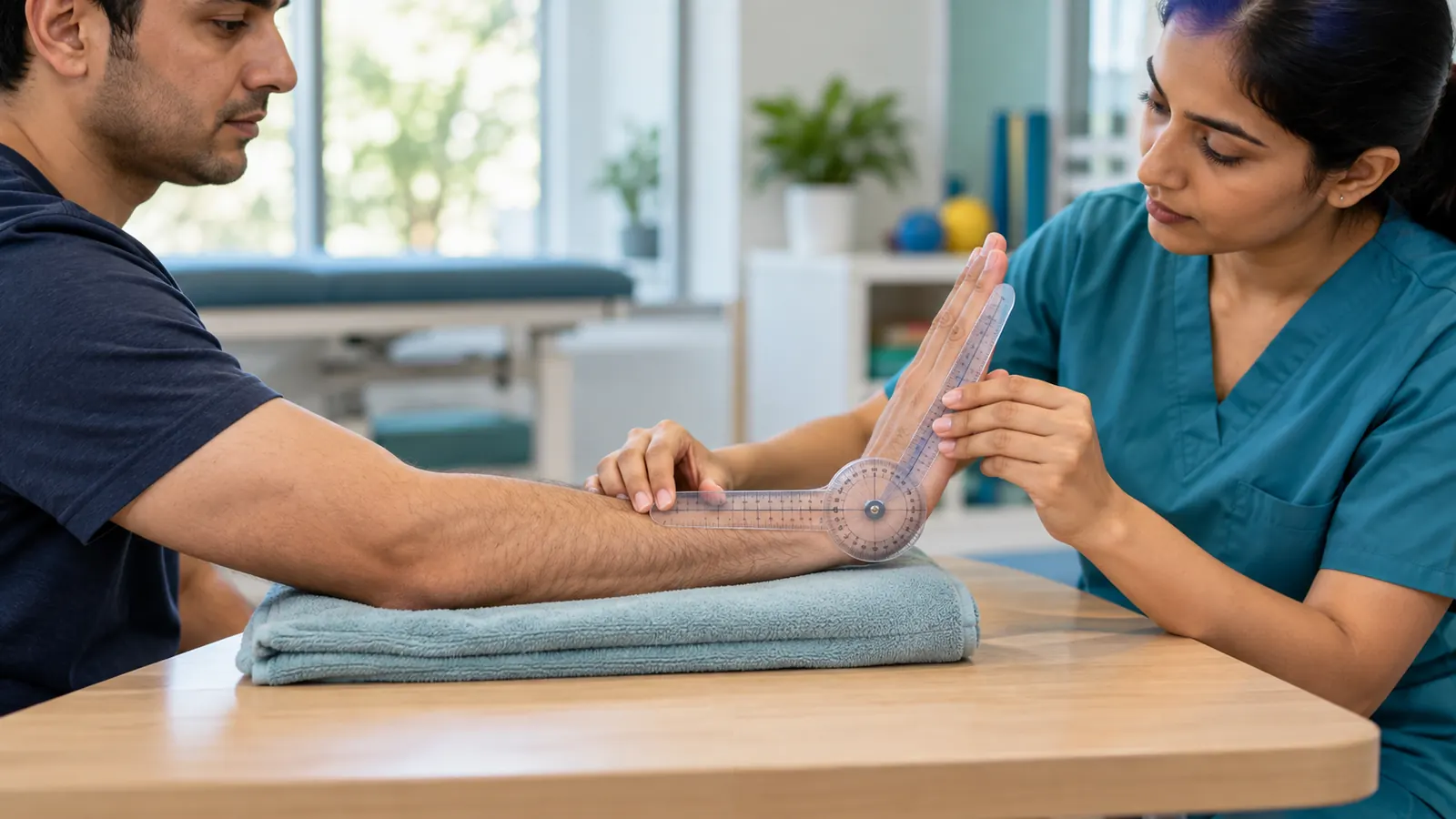
Occupational therapists use the biomechanical frame of reference in orthopaedic cases, burns and patients with limited range of motion and strength. The biomechanical frame of reference is based on joint range of motion, muscle strength and endurance, with an intact central nervous system.
It helps to understand the basic terminology of a frame of reference before reading about a specific one. If you are not familiar with the term, we suggest reading our guide to occupational therapy frames of reference first.
Occupational therapists use frames of reference to guide their practice. An OT uses purposeful activities to treat clients: activities that have purpose and meaning in the person’s life. The OT develops methods to combine purposeful activities with treatment goals.
Analysis of joints and muscles during an activity is the base of the biomechanical frame of reference. This analysis helps the OT plan treatment and check progress towards goals.
Who is the biomechanical frame of reference for?
| Good fit | Not a good fit on its own |
|---|---|
| Fractures (e.g. distal radius, humerus) | Stroke with spasticity or poor movement control |
| Hand and tendon injuries, nerve repairs | Cerebral palsy, traumatic brain injury affecting motor control |
| Burns and scar contracture | Severe cognitive impairment that prevents following a program |
| Rheumatoid arthritis and osteoarthritis | Progressive conditions where loss can't be reversed (use the rehabilitative frame) |
| Amputation, deconditioning after ICU or surgery, cardiac and respiratory conditions |
Theoretical base
The biomechanical frame of reference has four assumptions (Dutton):
- Purposeful activity can treat loss of range of motion (ROM), strength and endurance.
- Function follows: after ROM, strength and endurance are regained, the patient regains function.
- Rest and stress: first the body must rest to heal itself; then the peripheral structures must be stressed to regain range, strength and endurance.
- An intact central nervous system: the frame suits patients who may have limited range, strength and endurance but can still perform smooth, isolated movements.
Function–dysfunction continua
This part of the biomechanical frame of reference focuses on the areas of concern:
- Structural stability
- Passive range of motion
- Low-level endurance
- Edema control
- Strength
- High-level endurance
The occupational therapist addresses these areas when using the biomechanical frame in the treatment plan.
End of treatment ↑
-
High-level endurance
Sustained activity for work, sport and full daily routines.
-
Strength
Graded resistance once tissues tolerate load.
-
Range of motion
Passive, then active-assisted, then active movement.
-
Edema control and low-level endurance
Started early, with many repetitions at low resistance.
-
Structural stability
Bone and soft-tissue healing comes first, e.g. a fracture in a cast.
Start of treatment
Structural stability is the primary area of concern. Only after it is achieved can the therapist stress peripheral structures, for example with muscle stretching. In a fracture, bone and soft-tissue healing count as structural stability. High-level endurance is addressed at the end of treatment. Low-level endurance training can start alongside low-resistance activities to build repetition. Edema control is usually started early, because swelling limits movement.
Evaluation: behaviours indicative of function and dysfunction
The occupational therapist can assess each area of concern. In a biomechanical evaluation, the OT uses tools such as:
| Area | Assessment tools | What the OT records |
|---|---|---|
| Range of motion | Goniometer | Active and passive ROM in degrees; end feel |
| Strength | Manual muscle testing, hand dynamometer, pinch gauge | Muscle grade 0–5; grip and pinch force compared with the other hand and norms |
| Edema | Volumeter, tape measure (circumference), figure-of-eight method | Swelling in millilitres or centimetres over time |
| Endurance | MET tables, cardiac step charts, perceived exertion (Borg) scale, repetitions or time to fatigue | How long and how hard the person can work |
| Skin and scar | Observation, palpation, scar scales | Colour, temperature, adherence, sensitivity |
| Pain and function | Pain rating scale, functional questionnaires | How symptoms affect daily tasks |
Along with these formal tests, the OT also uses clinical observation, including the skin’s appearance, end feel during range of motion and grip. After formal and informal assessment, the OT sets objectives and goals for the patient.
Postulates regarding change
Postulates regarding change identify the links among the presenting problem, biomechanical goals and functional outcome.
Example: a writer fell on his right hand and fractured his radius.
| Example | |
|---|---|
| Present problem | Loss of joint range of motion |
| Biomechanical goals | Forearm supination 70°, forearm pronation 70°, wrist extension 70° |
| Functional outcome | Able to hold a pen and write with the wrist extended and forearm pronated |
In this example the patient doesn’t care about a 10–15° improvement in wrist extension; he is much more concerned about being able to write for long periods. For context, research on functional range of motion suggests most daily tasks need roughly 50° each of forearm pronation and supination (Morrey and colleagues), so goals should reflect what the person’s own occupations require.
Postulates regarding intervention
Postulates regarding intervention link the biomechanical goals with therapeutic activities.
| Example | |
|---|---|
| Measurable biomechanical goals | Forearm supination 70°, forearm pronation 70°, wrist extension 70° |
| General treatment methods | Heat, manual stretch and splinting, which increase the elasticity of the skin, lengthen collagen fibres and position the joints in a functional position |
| Functional activities | Writing tasks, then typing, turning pages and other work tasks |
Both the general methods and the functional activities help the OT achieve a better client-oriented result. Physical agent modalities such as heat should only be used by therapists trained and permitted to use them, with checks for sensation and circulation.
Principles of intervention
| Goal | Principles and methods | Activity example |
|---|---|---|
| Increase range of motion | Passive, active-assisted and active movement; gentle sustained stretch; static-progressive or dynamic splints | Reaching to place cups on a higher shelf; wiping a table in wide arcs |
| Increase strength | Progressive resistance: more weight, resistance or holding time as strength grows | Kneading dough, then firmer putty; sanding with a weighted block |
| Increase endurance | Low resistance, many repetitions; gradually longer sessions | Folding laundry for 5, then 10, then 20 minutes |
| Reduce edema | Elevation, active movement, retrograde massage, compression garments | Elevated hand on a pillow while doing tabletop games |
| Prevent deformity and protect healing | Splinting in a functional or safe position, joint protection education | Resting splint at night after a tendon repair |
Grading an activity
One activity can be graded up as the patient improves. This keeps therapy meaningful while still challenging the body.
-
Start
Sanding a flat board, no added weight, 2 minutes.
-
Range
Tilt the board to an incline so the arm reaches further.
-
Resistance
Add a weighted sanding block.
-
Endurance
Increase to 10 minutes with short rests.
-
Function
Finish and paint a real piece, e.g. a shelf for home.
A case example from start to finish
Rohit, 42, is a journalist. Six weeks after a right distal radius fracture, his cast is removed. His wrist is stiff and swollen and he can’t write or type for more than a few minutes.
-
Weeks 0–6 (in cast)
Elevation and active movement of fingers, elbow and shoulder to prevent stiffness and swelling.
-
Week 6
Goniometry: wrist extension 35°, supination 40°. Grip 40% of left hand. Hand volume 30 ml more than left.
-
Weeks 6–9
Active and active-assisted wrist and forearm movement, retrograde massage, light functional tasks like turning a doorknob.
-
Weeks 9–12
Graded putty, light weights and resistive tasks once cleared by the surgeon.
-
Weeks 12+
Typing and writing practice building to full workdays; ergonomic workstation set-up.
In the biomechanical frame of reference, it’s easy to write measurable goals because it uses quantitative evaluation data such as degrees of range of motion. Other frames of reference may be used alongside it for better results, depending on the condition and the needs of the client. When a limitation can’t be fully restored, the OT moves to the rehabilitative frame of reference to compensate.
Biomechanical frame of reference in pediatrics
In pediatric OT, the biomechanical frame is often used for positioning for function (Colangelo and Shea, in Kramer and Hinojosa). Good posture and stability free the arms and hands for play, eating, communication and learning.
| Principle | Example |
|---|---|
| Stable base of support | Feet flat on the floor or a footrest; hips at about 90° |
| Pelvis first | A well-fitted seat and pelvic belt to keep the pelvis neutral |
| Trunk support | Lateral supports for a child with low tone |
| Head and arm position | Tray or slanted table so the head is upright and hands are free |
| Review regularly | Growth and changes in tone mean seating needs frequent checks |
More worked examples
| Client | Biomechanical problem | Goal and intervention |
|---|---|---|
| Priya, 30, burn to the dominant hand | Scar tightness limiting finger extension | Splinting at night, scar massage, active range in daily tasks (typing, cooking); goal: full grip for work |
| Mr Das, 68, after cardiac surgery | Low endurance | MET-graded activities from seated grooming to light housework; goal: shower independently without breathlessness |
| Anaya, 9, juvenile arthritis | Stiff wrists and fingers | Joint protection, warm-water range of motion, built-up pens; goal: write for a full lesson |
Biomechanical vs NDT vs rehabilitative
| Biomechanical | Neurodevelopmental (NDT) | Rehabilitative | |
|---|---|---|---|
| Nervous system | Intact CNS | CNS damage (tone and control) | Any |
| Aim | Restore range, strength, endurance | Improve movement quality | Compensate for lasting limits |
| Typical clients | Fractures, hand injuries, burns, arthritis | Stroke, cerebral palsy | SCI, progressive conditions, older adults |
| Example | Graded resistive putty | Handling at key points of control | Sock aid and reacher |
See the NDT and rehabilitative guides.
Test yourself: biomechanical frame
0 / 3 correct
-
The biomechanical frame is best suited to clients with…
Show answer
B. It assumes an intact CNS and limits in range, strength and endurance.
-
Which area of concern comes first in treatment?
Show answer
C. Structural stability (healing) must come first before stressing tissues.
-
A goniometer measures…
Show answer
B. Goniometry measures joint range of motion in degrees.
Summary
The biomechanical frame of reference helps people regain the range of motion, strength and endurance they need for daily occupations, as long as the central nervous system is intact. It follows the rest–stress principle, uses measurable assessments and always links biomechanical goals to a meaningful functional outcome. Read more:
- Occupational therapy frames of reference
- Developmental frame of reference
- Model of Human Occupation (MOHO)
- Rehabilitative frame of reference
- Psychodynamic frame of reference
Related guides: OT activities for stroke patients, Trigger finger exercises.
References
- Pendleton HM, Schultz-Krohn W, eds. Pedretti’s Occupational Therapy: Practice Skills for Physical Dysfunction. Elsevier.
- Dutton R. Clinical Reasoning in Physical Disabilities. Williams & Wilkins.
- Boyt Schell BA, Gillen G, eds. Willard and Spackman’s Occupational Therapy. Wolters Kluwer.
- Kramer P, Hinojosa J, Howe TH, eds. Frames of Reference for Pediatric Occupational Therapy. Wolters Kluwer.
- Morrey BF, Askew LJ, Chao EY. A biomechanical study of normal functional elbow motion. Journal of Bone and Joint Surgery (Am). 1981;63(6):872–877.
- Colangelo CA, Shea M. A biomechanical frame of reference for positioning children for functioning. In: Kramer P, Hinojosa J, eds. Frames of Reference for Pediatric Occupational Therapy. Wolters Kluwer.
Frequently asked questions
What is the biomechanical frame of reference in OT?
When is the biomechanical frame of reference used?
What assessments are used in the biomechanical frame of reference?
What are the limitations of the biomechanical frame of reference?
What is the difference between the biomechanical and rehabilitative frames of reference?
What are the principles of the biomechanical frame of reference?
How is the biomechanical frame of reference used in pediatrics?
What are examples of the biomechanical frame of reference?
Written by
Deepam Pawar, OT
Deepam Pawar is an occupational therapist and co-founder of Occupational Therapy OT. He focuses on clinical frameworks, assessment, and evidence-based practice.
All articles by Deepam →This article is for general education and is not a substitute for individualized assessment or treatment by a licensed occupational therapist. Always seek the guidance of a qualified professional for specific concerns.