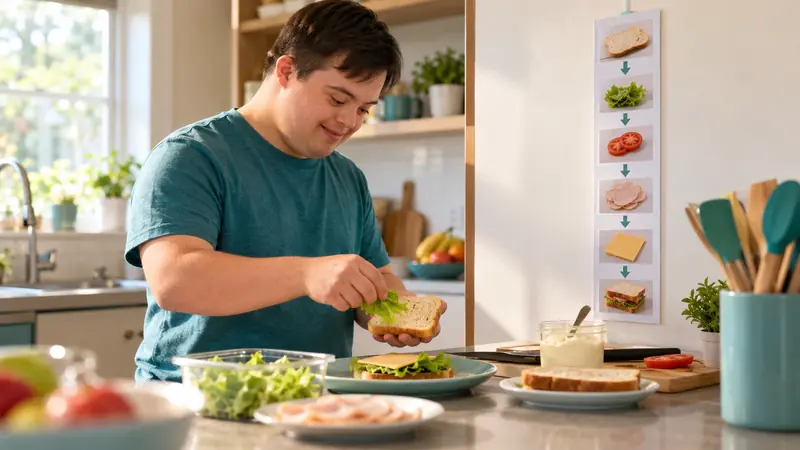
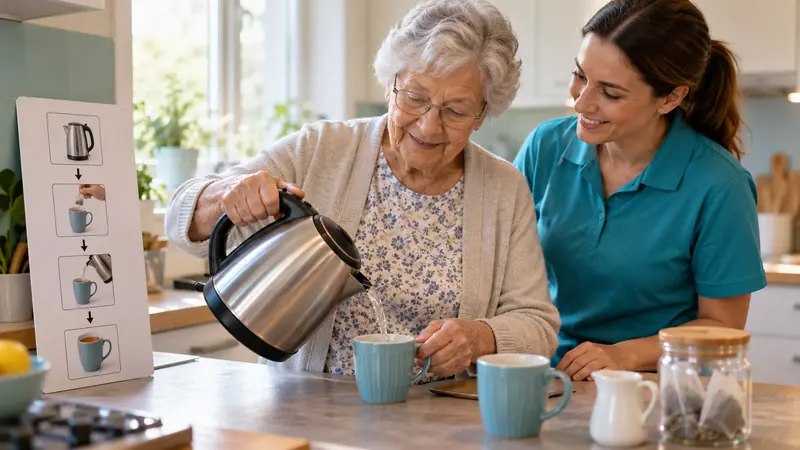
Motor Learning Frame of Reference: Motor Control, Skill Acquisition and Task-Oriented Practice
The motor learning frame of reference: Fitts and Posner's stages, practice schedules, KR vs KP feedback, task-oriented training, CO-OP and evidence.


Learning to ride a bike, relearning to dress after a stroke, mastering handwriting: all are motor skills learned through practice. The motor learning frame of reference (often grouped with motor control and motor skill acquisition) explains how this learning happens, and how therapists can make practice more effective.
See our frames of reference guide for the basics.
Motor control vs motor learning
| Motor control | Motor learning | |
|---|---|---|
| What it is | How the nervous system organises and controls movement | How motor skills are acquired and retained through practice |
| Key ideas | Systems theory: the person, task and environment interact to produce movement | Stages of learning, practice conditions, feedback, transfer |
| Question it answers | Why does this movement look the way it does? | How do we help this person learn the skill? |
Modern motor control theory sees movement as emerging from the interaction of the person, the task and the environment, not just from reflexes. This shift is behind task-oriented approaches in OT.
The three stages of motor learning
Skilled ↑
-
Autonomous stage3
The skill is automatic and consistent; the person can talk or think about other things while doing it.
-
Associative stage2
The person refines the movement; fewer errors; more consistent.
-
Cognitive stage1
The person works out what to do; lots of thinking, errors and variability.
Beginner
Match your teaching to the stage: more instruction and demonstration early, more practice and less feedback later.
Designing practice
| Practice choice | Option A | Option B | What usually works better for long-term learning |
|---|---|---|---|
| Order | Blocked (same task repeated) | Random (tasks mixed) | Random practice, once the basics are understood |
| Spacing | Massed (few, long sessions) | Distributed (shorter, more frequent) | Distributed practice |
| Whole or part | Part practice (one component) | Whole task | Whole-task practice, especially for continuous tasks; part practice for complex serial tasks, then link |
| Variability | Constant (same conditions) | Variable (different cups, heights, places) | Variable practice, for transfer to real life |
| Context | Clinic | Real environment | Practice in the real context when possible |
Feedback
| Type | Meaning | Example |
|---|---|---|
| Intrinsic | From the person's own senses | Feeling the cup tilt; seeing water spill |
| Extrinsic (augmented) | From the therapist, a video or a device | "Great, the cup stayed level" |
| Knowledge of results (KR) | About the outcome | "You reached the shelf 4 out of 5 times" |
| Knowledge of performance (KP) | About the movement pattern | "Keep your elbow closer to your body" |
Task-oriented approaches
-
Client goal
"I want to make a cup of tea."
-
Analyse
What's limiting performance: person, task or environment?
-
Practise the real task
Making tea in a kitchen, not a substitute exercise.
-
Grade
Change cup weight, kettle size, distance or speed.
-
Vary and transfer
Different mugs, different kitchens, at home.
Approaches built on motor learning include:
- Task-oriented training (e.g. Mathiowetz and Bass Haugen’s task-oriented approach)
- Motor relearning programme (Carr and Shepherd) for stroke
- Constraint-induced movement therapy (CIMT) for the affected arm after stroke and in cerebral palsy
- CO-OP (Cognitive Orientation to daily Occupational Performance): Goal–Plan–Do–Check, with strong evidence in DCD
- Goal-directed training in cerebral palsy
What does the evidence say?
- A Cochrane review of repetitive task training after stroke (French et al., 2016) found improvements in arm function, walking and daily activities.
- International DCD guidelines (Blank et al., 2019) recommend task-oriented approaches such as CO-OP and neuromotor task training.
- Task-specific approaches (CIMT, bimanual training, goal-directed training) have stronger evidence in cerebral palsy than NDT (Novak et al., 2013).
Case example
Mr Lee, 58, is 6 weeks post-stroke and wants to button his shirt for work.
- Cognitive stage: demonstration, verbal steps (“pinch, push, pull”), large buttons, lots of feedback
- Associative stage: practise on his own work shirts, varied button sizes, feedback only after several attempts
- Autonomous stage: buttoning while talking, at home in the morning, timed to see improvement
Quick self-check
0 / 3 correct
-
In which stage of motor learning is the skill automatic?
Show answer
C. In the autonomous stage the skill is automatic and consistent.
-
Which practice usually gives better long-term retention?
Show answer
B. Random practice tends to give better retention and transfer, once the basics are understood.
-
"Keep your elbow straighter" is an example of…
Show answer
B. Knowledge of performance is feedback about the movement pattern.
Summary
The motor learning frame of reference explains how motor skills are learned and how to structure practice and feedback so learning lasts. Match teaching to the stage of learning, use random, distributed, whole-task and varied practice, fade feedback, and practise real tasks in real contexts. Task-oriented approaches built on these principles have good evidence in stroke, DCD and cerebral palsy. Read more about motor planning activities and OT for stroke.
References
- Fitts PM, Posner MI. Human Performance. Brooks/Cole; 1967.
- Schmidt RA, Lee TD, Winstein CJ, Wulf G, Zelaznik HN. Motor Control and Learning: A Behavioral Emphasis. 6th ed. Human Kinetics.
- Radomski MV, Trombly Latham CA, eds. Occupational Therapy for Physical Dysfunction. Wolters Kluwer. (Chapter on the occupational therapy task-oriented approach.)
- French B, Thomas LH, Coupe J, et al. Repetitive task training for improving functional ability after stroke. Cochrane Database of Systematic Reviews. 2016;11:CD006073.
- Blank R, Barnett AL, Cairney J, et al. International clinical practice recommendations on developmental coordination disorder. Developmental Medicine & Child Neurology. 2019;61(3):242–285.
- Carr JH, Shepherd RB. A Motor Relearning Programme for Stroke. Heinemann.
Frequently asked questions
What is the motor learning frame of reference?
What are the stages of motor learning?
What is the difference between blocked and random practice?
What is knowledge of results vs knowledge of performance?
What is task-oriented training?
Written by
Deepam Pawar, OT
Deepam Pawar is an occupational therapist and co-founder of Occupational Therapy OT. He focuses on clinical frameworks, assessment, and evidence-based practice.
All articles by Deepam →This article is for general education and is not a substitute for individualized assessment or treatment by a licensed occupational therapist. Always seek the guidance of a qualified professional for specific concerns.