Motor Planning Activities for Kids: What Praxis Is and 30 OT Ideas
Motor planning (praxis) explained simply, signs of motor planning difficulties, and 30 OT activities for home, school and therapy.


Some children know exactly what they want to do on the climbing frame but can’t work out how to make their body do it. Others watch a dance move again and again and still can’t copy it. These children may have difficulty with motor planning.
What is motor planning (praxis)?
Motor planning, also called praxis, is the brain’s ability to come up with an idea for a movement, plan it, and carry it out. It’s how we learn new physical skills, and how we adapt movements to new situations.
-
Ideation
Having an idea of what to do: "I could climb over that."
-
Planning
Working out the steps and order: "Hands here, then this foot, then swing over."
-
Execution
Doing it, then adjusting from feedback: "I slipped; next time I'll grip tighter."
Motor planning depends on good body awareness from the proprioceptive, tactile and vestibular systems, as well as attention and memory.
Signs of motor planning difficulties
| Area | What you might see |
|---|---|
| New movements | Slow to learn new physical skills; needs many demonstrations |
| Play | Avoids playground equipment; plays with the same toys the same way |
| Self-care | Difficulty dressing, fastenings, using cutlery |
| Sport | Trouble with ball games, jumping jacks, skipping, swimming strokes |
| Copying | Difficulty imitating movements or gestures |
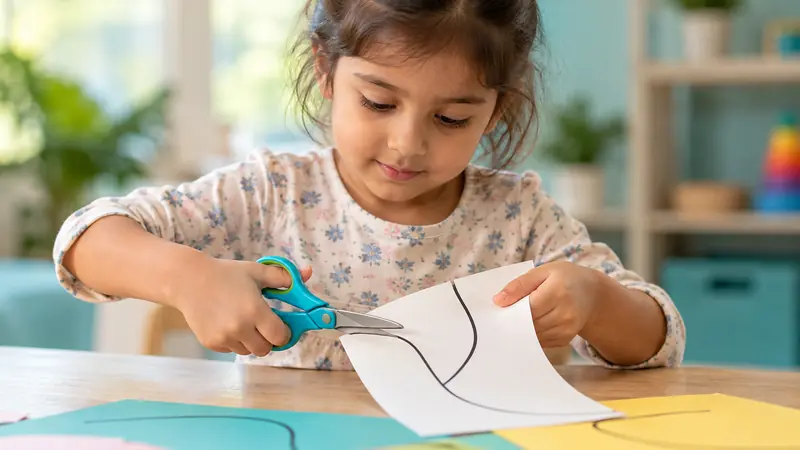
| School | Messy handwriting, difficulty with scissors, organising materials |
| Ideation | Unsure what to do with new toys or equipment; waits to be shown |
Motor planning difficulties are a core feature of dyspraxia (DCD) and are common in autism.
Grading motor planning activities
Harder ↑
-
Child invents the activity
"Make up your own obstacle course."
-
New sequence, no demo
Follow spoken instructions only.
-
New sequence with demonstration
Watch, then copy a new set of moves.
-
Familiar sequence, changed order
Same moves, new order.
-
Familiar sequence with demonstration
Practise a known routine with help.
Easier
30 motor planning activities
| Activity | Tip |
|---|---|
| 1. Obstacle course | Over, under, through; change the order each time |
| 2. Simon Says | Add two-step commands: "touch your nose, then jump" |
| 3. Animal walks | Bear, crab, frog, kangaroo, snake |
| 4. Copy-the-pose cards | Yoga or superhero poses |
| 5. Hopscotch | Start with two feet, then hopping |
| 6. Dance sequences | Teach 3 moves, then add one |
| 7. Ladder or rope walk | Step between rungs forwards, sideways, backwards |
| 8. Balloon keep-up | Keep it in the air while walking |
| 9. Musical statues with poses | Freeze in a named pose |
| 10. Climbing frame routes | "Take a different route today" |
| 11. Jumping patterns on floor spots | Feet together, apart, one foot |
| 12. Tunnel and crawl races | Change direction |
| Activity | Tip |
|---|---|
| 13. Rolling and catching a large ball | Then smaller balls |
| 14. Bean bag toss into hoops | Change distance |
| 15. Kicking to a target | Stop the ball first, then kick |
| 16. Balloon tennis | Slower than a ball |
| 17. Bouncing and catching | Count bounces |
| 18. Mini golf with a paper ball | Planning force and direction |
| Activity | Tip |
|---|---|
| 19. Build a block tower from a picture | Start with 3 blocks |
| 20. Lego from instructions | Step-by-step plans |
| 21. Copy a bead pattern | Visual sequence |
| 22. Paper folding (simple origami) | Follow steps |
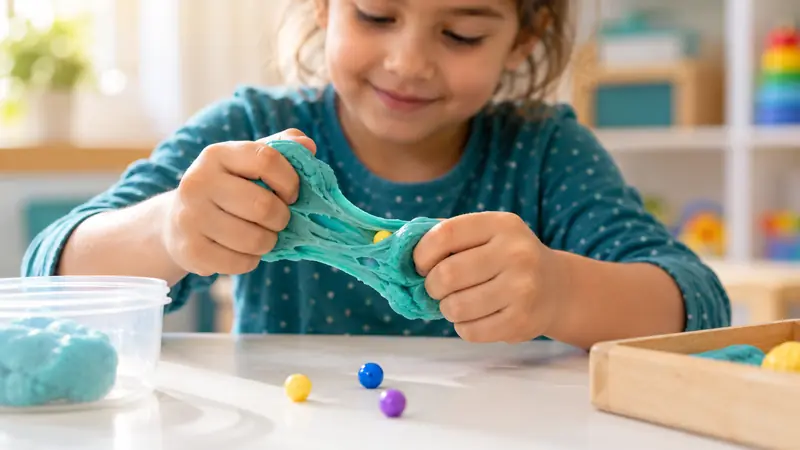
| 23. Playdough models from a photo | Snake, ball, snowman |
| 24. Lacing cards | Over–under pattern |
| 25. Drawing from step-by-step guides | Directed drawing |
| Activity | Tip |
|---|---|
| 26. Dressing in steps | Use a picture sequence |
| 27. Making a sandwich | Plan, gather, make, clean up |
| 28. Packing a school bag from a checklist | Planning and sequencing |
| 29. Laying the table | Where does each item go? |
| 30. Tidying up into labelled boxes | Sorting and carrying |
How occupational therapy helps
An occupational therapist assesses motor planning, coordination and sensory processing, sometimes using tests such as the Bruininks-Oseretsky Test of Motor Proficiency (BOT-2) or praxis tests. Therapy may combine:
- Task-oriented practice, such as the CO-OP approach (Goal–Plan–Do–Check), which has strong evidence for children with DCD
- Sensory-rich activities to build body awareness, using sensory integration principles where appropriate
- Grading and visual supports at home and school
Summary
Motor planning is the ability to think of, plan and carry out new movements. When it’s hard, children may seem clumsy or avoid new physical activities. Fun, graded activities like obstacle courses, Simon Says and building from models, together with clear strategies, help children learn. Read more about bilateral coordination and crossing the midline.
References
- Ayres AJ. Sensory Integration and the Child. 25th anniversary ed. Western Psychological Services.
- Bundy AC, Lane SJ, eds. Sensory Integration: Theory and Practice. 3rd ed. F.A. Davis.
- Blank R, Barnett AL, Cairney J, et al. International clinical practice recommendations on the definition, diagnosis, assessment, intervention, and psychosocial aspects of developmental coordination disorder. Developmental Medicine & Child Neurology. 2019;61(3):242–285.
- Polatajko HJ, Mandich A. Enabling Occupation in Children: The CO-OP Approach. CAOT Publications ACE.
Frequently asked questions
What is motor planning?
What are signs of motor planning difficulties?
What causes motor planning problems?
What are good motor planning activities for kids?
How do occupational therapists help with motor planning?
Written by
Payal Mehta, OT
Payal Mehta is a practising occupational therapist and co-founder of Occupational Therapy OT. She writes on pediatrics, sensory integration, and mental-health practice.
All articles by Payal →This article is for general education and is not a substitute for individualized assessment or treatment by a licensed occupational therapist. Always seek the guidance of a qualified professional for specific concerns.