Crossing the Midline: Why It Matters and 20 Fun Activities for Kids
What crossing the midline means, when children develop it, signs of difficulty, how it links to handwriting and hand dominance, and 20 OT-approved activities.

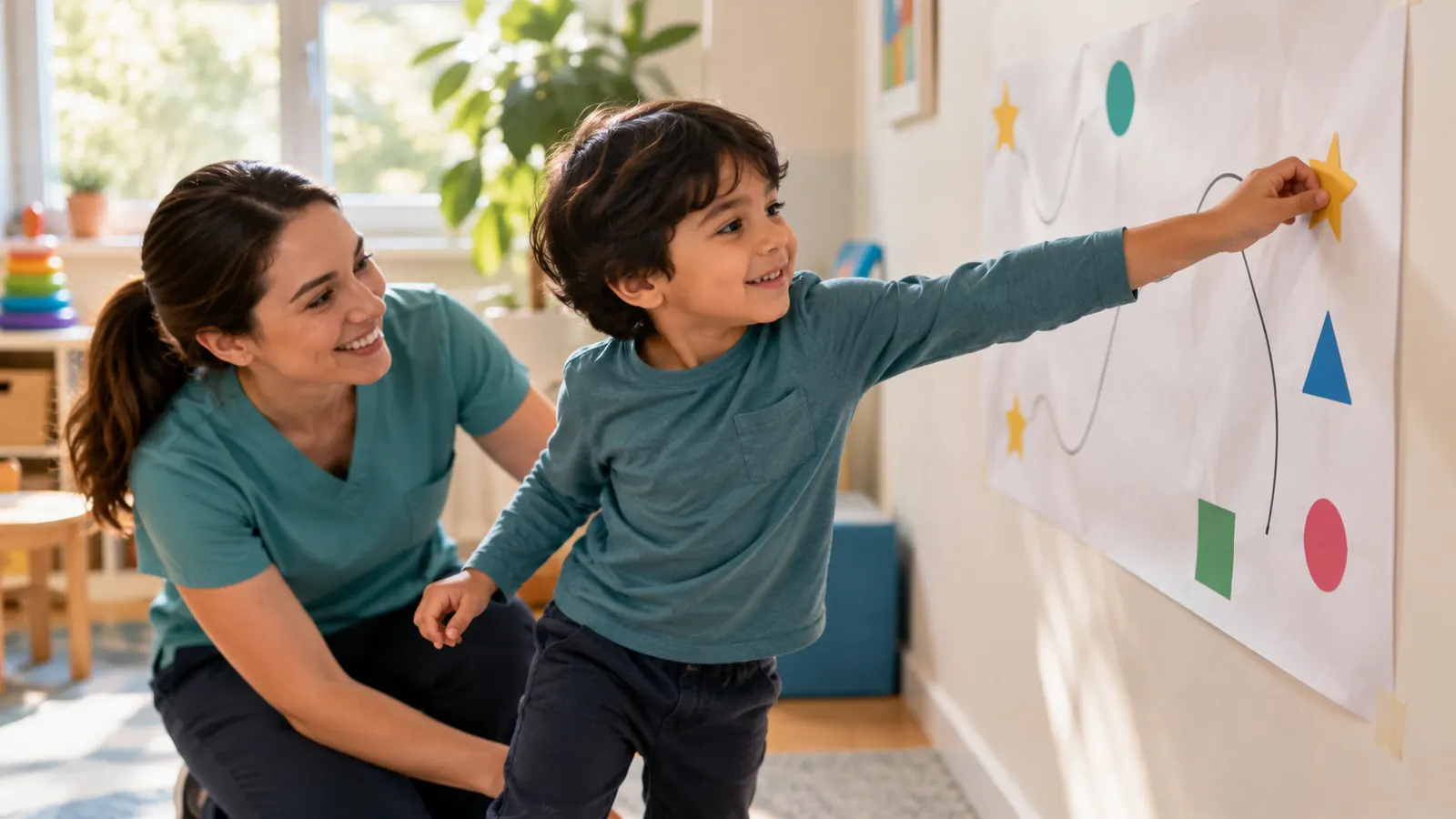
Imagine a line running down the middle of your body from your nose to your toes. Every time you reach your right hand over to your left side, you’re crossing the midline. It sounds simple, but it’s an important part of how children develop coordination, hand preference and school skills.
What is crossing the midline?
The midline is the imaginary line down the centre of the body. Crossing the midline means moving a hand, foot or the eyes across that line to work on the opposite side, for example:
- reaching your right hand across to pick up a toy on your left
- touching your left knee with your right hand
- reading or writing a line from one side of the page to the other
- crossing your legs to put on a sock
It depends on the two sides of the brain communicating well and is closely linked with bilateral coordination.
When does it develop?
| Age (approximate) | What you might see |
|---|---|
| First months | Baby brings both hands together in the middle of the body |
| About 6–12 months | Reaches for toys, passes objects from one hand to the other |
| Toddlers | Starts reaching across the body occasionally |
| About 3–4 years | Begins crossing the midline more confidently in play and drawing |
| About 4–6 years | Hand preference settles; crossing midline is more automatic |
Children vary; these are rough guides only.
Why it matters
When a child reliably crosses the midline, they tend to use one dominant hand for skilled tasks. That hand then gets lots of practice and becomes more refined, which helps with:
- Handwriting: writing smoothly across the page without swapping hands
- Reading: tracking words across a line of text
- Self-care: putting on socks and shoes, washing, brushing hair
- Sports and play: batting, kicking, catching, dancing
Signs of difficulty crossing the midline
- Swaps hands halfway across when drawing or writing a line
- Turns the whole body instead of reaching across
- Uses the left hand for things on the left and the right hand for things on the right
- Hasn’t developed a clear hand preference by about age 6
- Has trouble tracking text across a page or copying from the board
- Seems clumsy with gross motor skills like skipping and ball games
20 crossing the midline activities
| Activity | How to play |
|---|---|
| 1. Cross-crawl marching | March and touch each hand to the opposite knee |
| 2. Figure-of-eight drawing | Draw big sideways 8s on a whiteboard or wall; trace with toy cars |
| 3. Ribbon or scarf dancing | Make big rainbows and figure-of-eights across the body |
| 4. Sticker reach | Put stickers on one side of the body; remove them with the opposite hand |
| 5. Toy pickup from one side | Place toys on the left; child picks up with the right hand and posts them on the right |
| 6. Windmills | Touch the right hand to the left foot, then switch |
| 7. Washing the car or window | Big side-to-side wiping |
| 8. Painting a rainbow on a big sheet | Arcs from one side to the other |
| 9. Hitting a balloon with a bat | Swing across the body |
| 10. Popping bubbles | Clap them on both sides of the body |
| 11. Simon Says with crossover moves | "Touch your left ear with your right hand" |
| 12. Road tracing | Drive a toy car along a long road taped across the floor or table |
| 13. Ball passing in a circle | Sit in a line and pass a ball behind or to the side |
| 14. Pouring | Pour water between cups set on opposite sides |
| 15. Yoga twists | Seated twists, reaching to the opposite side |
| 16. Lacing a long board | Threading across a wide lacing card |
| 17. Wiping the table | Big circles across the whole table |
| 18. Mirror drawing | Copy big shapes across a whiteboard |
| 19. Swimming front crawl | Natural crossing movement |
| 20. Clapping games | Patty-cake with crossover claps |
How occupational therapy helps
An occupational therapist assesses your child’s coordination, hand preference, motor planning and visual skills, and looks at how difficulties affect handwriting, self-care and play. The OT then builds crossing-the-midline practice into fun, meaningful activities and gives home and school ideas. Read more about occupational therapy for children.
Summary
Crossing the midline is a key step in coordination that supports hand dominance, handwriting, reading, self-care and sport. It develops gradually through the preschool years. If your child often swaps hands, turns their whole body, or struggles with tracking across a page, try these activities and talk to an OT if concerns continue.
References
- Case-Smith J, O’Brien JC. Occupational Therapy for Children and Adolescents. Elsevier.
- Bundy AC, Lane SJ, eds. Sensory Integration: Theory and Practice. 3rd ed. F.A. Davis.
- Kramer P, Hinojosa J, Howe TH, eds. Frames of Reference for Pediatric Occupational Therapy. Wolters Kluwer.
Frequently asked questions
What does crossing the midline mean?
At what age do children cross the midline?
What are signs of difficulty crossing the midline?
Why is crossing the midline important?
How can I help my child cross the midline?
Written by
Payal Mehta, OT
Payal Mehta is a practising occupational therapist and co-founder of Occupational Therapy OT. She writes on pediatrics, sensory integration, and mental-health practice.
All articles by Payal →This article is for general education and is not a substitute for individualized assessment or treatment by a licensed occupational therapist. Always seek the guidance of a qualified professional for specific concerns.