Cutting Activities for Preschoolers: Scissor Skills by Age and 30 Fun Ideas
How scissor skills develop by age, how to teach cutting, the right scissors, and 30 OT cutting activities for preschoolers, with free practice sheets.

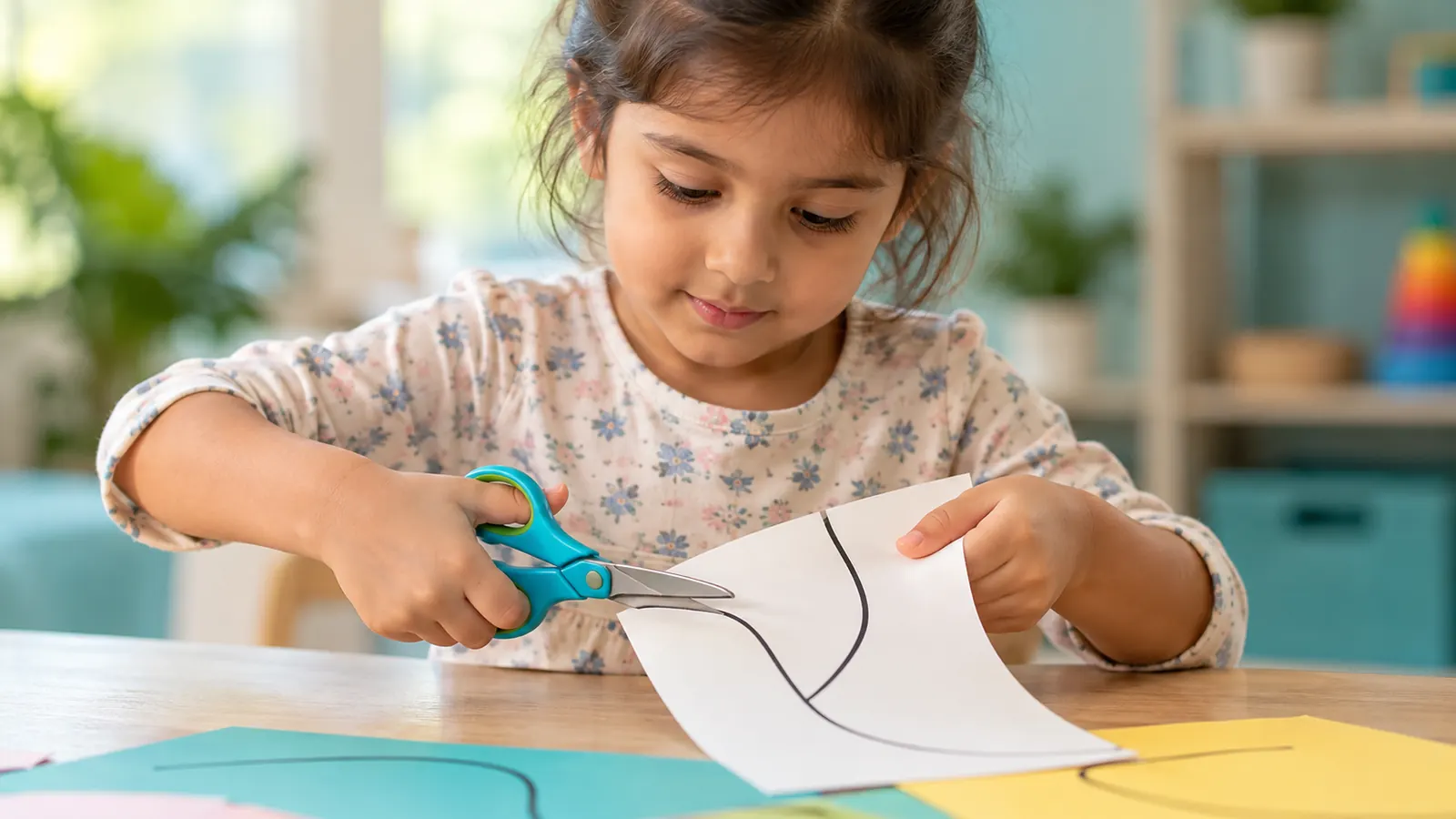
Cutting with scissors is a big step for preschoolers. It builds hand strength, coordination and confidence, and it’s a skill children use every day at school. This guide explains how scissor skills develop, how to teach them, and 30 fun cutting activities to try.
Scissor skills by age
- About 2 years
- Shows interest in scissors
- Opens and closes scissors with two hands or with help
- About 2½–3 years
- Snips the edge of paper or card
- Holds scissors with one hand, often thumb not yet on top
- About 3–4 years
- Cuts a strip of paper in two
- Cuts along a thick straight line (within about ½ inch)
- Helper hand begins to hold the paper
- About 4–5 years
- Cuts curved lines
- Cuts out a circle
- Turns the paper with the helper hand
- About 5–6 years
- Cuts out a square and triangle with corners
- Cuts out simple pictures
- Cuts more accurately along thinner lines
Ages are approximate and vary between children.
What cutting needs
- Hand strength to open and close the scissors. See hand strengthening activities.
- Finger separation: thumb and fingers working separately
- Bilateral coordination: one hand cuts while the helper hand holds and turns the paper
- Hand–eye coordination to follow the line
- Posture and shoulder stability, so the arm and hand are steady
How to teach cutting
-
Right scissors
Small, blunt-tip, the right hand (true left-handed scissors for lefties).
-
Thumbs up
Thumb in the small hole, pointing to the ceiling; fingers in the big hole.
-
Elbow in
Keep the cutting elbow close to the body.
-
Helper hand
The other hand holds the paper, thumb on top, and turns it.
-
Open, shut
'Open big, close' like a crocodile mouth.
-
Start easy
Snipping thick strips before long lines and curves.
30 cutting activities for preschoolers
| Activity | Why it helps |
|---|---|
| 1. Cut playdough 'snakes' | Very easy to cut; builds open–close |
| 2. Snip drinking straws into 'beads', then thread them | Stiff material, great reward |
| 3. Snip card strips into confetti | Short, single snips |
| 4. Give a paper monster a 'haircut' | Snip the fringe on a drawn face |
| 5. Cut cooked spaghetti | Fun, soft resistance |
| 6. Snip the edges of a paper plate to make a sun | Rotation practice |
| 7. Cut grass or herbs in the garden (supervised) | Real-world cutting |
| 8. Snip junk mail or old cards | Stiffer paper is easier |
| 9. Cut pipe cleaners | Very satisfying snips |
| 10. Snip strips for a collage | Then glue them down |
| Activity | Why it helps |
|---|---|
| 11. Cut thick straight lines on card | Start with lines ½ inch wide |
| 12. Make a paper chain from cut strips | Clear goal and reward |
| 13. Cut 'roads' for toy cars | Motivating theme |
| 14. Cut coupons or tickets for pretend play | Short straight lines |
| 15. Cut along highlighted lines on old magazines | Visual guide |
| 16. Cut fringe on paper to make a party blower | Repeated short lines |
| 17. Cut strips to make a paper 'octopus' | Fun craft |
| 18. Zigzag lines: shark teeth or crown | Changing direction |
| 19. Cut along lines on a cereal box | Thicker card is easier |
| 20. Cut tickets in a line, then 'sell' them | Pretend play |
| Activity | Why it helps |
|---|---|
| 21. Cut wavy lines: 'snakes' or 'ocean waves' | Gentle curves |
| 22. Cut out large circles to make a caterpillar | Turning the paper |
| 23. Cut a spiral snake | Continuous turning |
| 24. Cut out paper pizza slices | Straight and curved lines |
| 25. Cut squares for a paper quilt | Corners |
| 26. Cut triangles to make a fish or Christmas tree | Angles |
| 27. Cut out pictures from catalogues | Real shapes |
| 28. Make a paper bag puppet with cut-out features | Small shapes |
| 29. Cut out a simple mask | Combined skills |
| 30. Cut and paste a simple story sequence | Cutting plus thinking |
Choosing scissors
| Type | Best for |
|---|---|
| Small blunt-tip child scissors | Most preschoolers |
| Spring-loaded or self-opening scissors | Children with weak hands or difficulty opening scissors |
| Loop scissors | Children who can't yet separate fingers; squeeze with the whole hand |
| True left-handed scissors | Left-handed children (blades reversed so they can see the line) |
| Training scissors with an extra handle | Hand-over-hand learning with an adult |
When to ask an occupational therapist
Talk to an OT if your child:
- can’t open and close scissors by around age 4
- still can’t cut a straight line by about age 5
- gets very frustrated or avoids cutting
- has weak hands, poor coordination, or other fine motor difficulties
The OT will check hand strength, coordination and visual-motor skills, and suggest the right scissors, activities and grading. Read more about fine motor skills and pediatric OT goals for scissor skills.
Summary
Scissor skills develop step by step, from snipping to straight lines to curves and shapes. Start with easy materials, teach “thumbs up” with a helper hand, practise little and often with fun activities, and keep it safe.
References
- Case-Smith J, O’Brien JC. Occupational Therapy for Children and Adolescents. Elsevier.
- Cwm Taf Morgannwg University Health Board, Children’s Occupational Therapy (NHS Wales). Developing scissor skills.
- Centers for Disease Control and Prevention. CDC’s developmental milestones.
Frequently asked questions
At what age should a child be able to use scissors?
How do you teach a preschooler to cut with scissors?
What can preschoolers practise cutting on?
Why does my child struggle with cutting?
What are the best scissors for preschoolers?
Written by
Payal Mehta, OT
Payal Mehta is a practising occupational therapist and co-founder of Occupational Therapy OT. She writes on pediatrics, sensory integration, and mental-health practice.
All articles by Payal →This article is for general education and is not a substitute for individualized assessment or treatment by a licensed occupational therapist. Always seek the guidance of a qualified professional for specific concerns.