Toe Walking Exercises for Kids: 15 Stretches and Games to Try at Home
Simple toe walking exercises for kids: calf stretches, heel walking, squats and sensory games, how often to do them, plus a printable chart.

Toe walking is common in young toddlers, and most children walk heel-down by age 2 or 3. If your child is still on tiptoes, a doctor or physiotherapist may recommend exercises. This page brings together simple toe walking exercises and games you can do at home.
For causes, warning signs and treatment options, read our main guide to toe walking in children.
What the exercises aim to do
-
Stretch
Lengthen tight calf muscles and the Achilles tendon.
-
Strengthen
Build the muscles at the front of the shin that lift the foot.
-
Practise
Make heel-down walking feel normal through play and daily routines.
Stretches
| Stretch | How to do it | Tip |
|---|---|---|
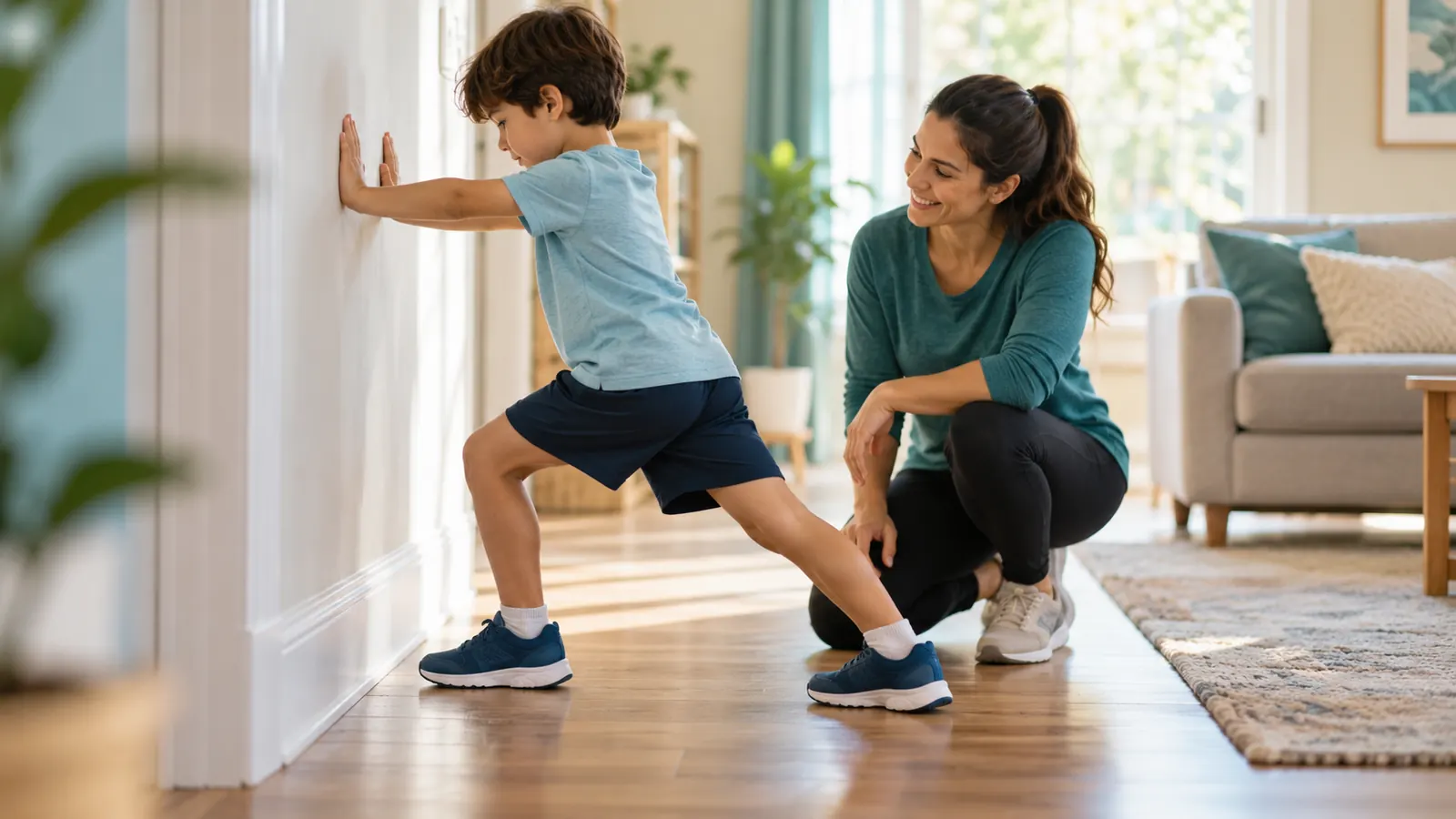
| 1. Wall calf stretch | Hands on the wall, one foot back, heel flat, back knee straight. Lean forward until the calf stretches. | Hold 20–30 seconds, 3 times each leg |
| 2. Step stretch | Stand with the front of the feet on a bottom step, hold the rail, let the heels drop slowly. | Supervise; hold the rail |
| 3. Long-sitting stretch | Sit with legs straight; loop a towel around the feet and gently pull the toes towards the body. | Great during TV time |
| 4. Parent-assisted stretch | Child lies on their back; gently bend the foot up towards the shin with the knee straight. | Only if your therapist has shown you how |
Stretches should feel like a gentle pull, never pain.
Strengthening and heel-down games
| Exercise or game | How to do it |
|---|---|
| 5. Penguin walk | Walk on the heels with toes lifted, like a penguin. |
| 6. Duck walk in a squat | Squat low with flat feet and waddle a few steps. |
| 7. Squat to pick up toys | Pick toys off the floor with heels down, then stand to post them in a box. |
| 8. Sit-to-stand | Stand up from a low stool slowly, with feet flat, 10 times. |
| 9. Walking uphill or up ramps | Grassy hills and ramps make heel-down walking easier. |
| 10. Slow toe raises and lowering | Rise onto the toes, then lower the heels very slowly to the floor. |
| 11. Toe tapping | Seated with heels on the floor, tap the toes up and down to music. |
| 12. Marble pick-up | Pick up marbles or pom-poms with the toes and drop them in a bowl (supervise small items). |
| 13. Dinosaur stomps | Stomp with flat feet around the room. |
| 14. Balance on a line | Walk along a tape line heel-to-toe. |
| 15. Pushing a laundry basket | Push a weighted basket with heels down: a heavy work bonus. |
Sensory activities for the feet
Some children toe walk because they dislike the feeling of the floor, or they seek extra input through their calves. Sensory activities can help:
- Barefoot play on grass, sand and different textured mats
- A sensory path of foam, bubble wrap, carpet squares and rubber mats
- Foot squishing in a tub of dry rice, beans or pasta (supervise small items)
- Deep pressure massage of the feet with lotion
- Proprioceptive input: jumping, stomping and carrying heavy items
Read more about tactile activities and proprioceptive activities.
A sample daily routine (10 minutes)
| Time | Activity |
|---|---|
| Morning | Wall calf stretch: 3 × 30 seconds each leg |
| After school | Penguin walk and dinosaur stomps race (3 minutes) |
| Play time | Squat-and-pick-up toy tidy-up (2 minutes) |
| Evening | Long-sitting towel stretch during TV (3 × 30 seconds) |
When exercises aren’t enough
If calf muscles are very tight or toe walking continues despite exercises, a doctor or physiotherapist may suggest serial casting, ankle-foot orthoses (braces), botulinum toxin injections or, rarely, surgery to lengthen the Achilles tendon. An occupational therapist can help when sensory preferences or autism play a part.
Summary
Toe walking exercises combine stretching, strengthening and heel-down play. Short, daily, fun practice works best. Check with a doctor before starting, especially for older children or one-sided toe walking, and follow your therapist’s program.
References
- Nemours KidsHealth. Toe walking.
- AboutKidsHealth (The Hospital for Sick Children). Idiopathic toe walking.
- Engström P, Tedroff K. The prevalence and course of idiopathic toe-walking in 5-year-old children. Pediatrics. 2012;130(2):279–284.
Frequently asked questions
What exercises help toe walking?
How often should my child do toe walking exercises?
Can toe walking be corrected with exercises?
Should I tell my child to stop walking on their toes?
When should I see a professional about toe walking?
Written by
Payal Mehta, OT
Payal Mehta is a practising occupational therapist and co-founder of Occupational Therapy OT. She writes on pediatrics, sensory integration, and mental-health practice.
All articles by Payal →This article is for general education and is not a substitute for individualized assessment or treatment by a licensed occupational therapist. Always seek the guidance of a qualified professional for specific concerns.