Tactile Activities: Sensory Touch Play for Kids (OT Guide)
An occupational therapist explains the tactile system, signs of touch sensitivity or seeking, and 30+ tactile activities for home, school and therapy.

Why tactile activities matter
Tactile activities can be an important part of a sensory diet or a fine motor skills program. They are very helpful for problems with hand and finger awareness, attention and fine motor planning.
What is the tactile system?
The tactile system gives us our sense of touch. The sense of touch is important for growth and development, as well as for survival.
The tactile system receives information about touch from receptor cells in the skin. These receptors are all over the body and give information about light touch, vibration, pressure, temperature and pain. The tactile system provides information needed for every activity of daily life, including eating, toileting, dressing, combing, household chores, schoolwork and work.
The touch system has two jobs. A protective job warns us about anything that might be harmful, like a spider on the arm or a hot pan. A discriminative job tells us exactly what we are touching, like finding a key in a pocket without looking. In tactile dysfunction, these two jobs are out of balance.
Tactile dysfunction
Like children with vestibular dysfunction, a child with tactile dysfunction may be hypersensitive or hyposensitive to touch, or may have problems with tactile discrimination. Some children over-register or under-register touch input, and this creates problems in daily routines. Tactile difficulties are one of the patterns we describe in sensory processing disorder.
- Tactile defensiveness (over-responsive). The child interprets harmless light touch as potentially dangerous. These children may seem anxious or aggressive, or unwilling to take part in home and school activities.
- Hypo-responsive to touch. The child has a low arousal level and may not register some touch input. This poor response can get in the way of daily living, and body awareness and motor planning may be affected.
- Touch seeker. Some children seek out excessive amounts of touch. They crave touch sensations and try to touch everything around them.
The tactile system is very important for developing other skills, such as gross and fine motor skills. Tactile activities can be used to improve how the child modulates touch.
Signs of tactile dysfunction
| Over-responsive to touch | Under-responsive to touch | Seeks extra touch |
|---|---|---|
| Rubs off kisses or casual touches; pushes others away to avoid closeness | Seems unaware of touch unless it is intense; little reaction to pain; gets hurt without realising | Touches objects and people constantly, with 'in your face' behaviour |
| Instantly and intensely shows a fight-or-flight or flight-or-freeze response to harmless touch | Doesn't realise they have dropped something | Seeks messy experiences, often for a long time |
| Dislikes messy activities such as cooking, painting, chalk or tape | Has poor body awareness | Rubs or bites their own skin; twirls hair; prefers being barefoot |
| Bothered by certain clothing, sock seams, shoes and tags | Doesn't notice whether clothes are on straight or the face is messy | Chews non-food objects such as fingernails, collars, cuffs, toys and pencils |
| Avoids some foods (rice, chunky peanut butter, lumpy mashed potato, vegetables) because of texture | May hurt other people or pets without understanding their pain | |
| Dislikes swimming, bathing, tooth brushing or haircuts |
Tactile activities
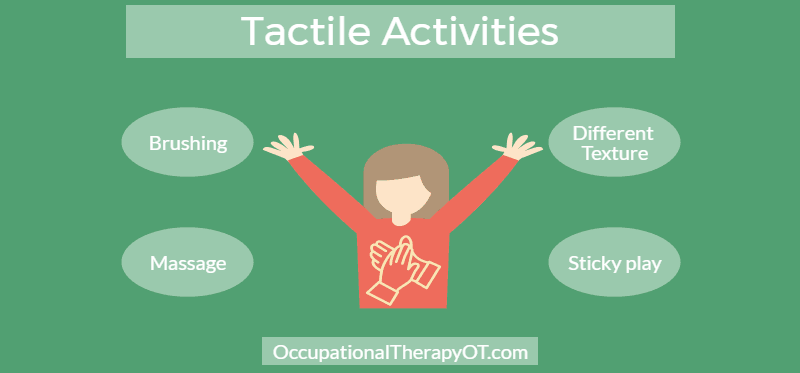
Tactile activities in occupational therapy sensory integration help the child modulate touch sensations. Choose activities for the child’s pattern: sensitive children start with dry, firm, predictable input; seekers need lots of rich, varied input.
| Goal | Activities |
|---|---|
| Calming deep pressure | Body massage with lotion; firm 'pizza' massage on the back (rolling the dough, adding toppings); being rolled up in a blanket like a burrito; squishing between pillows |
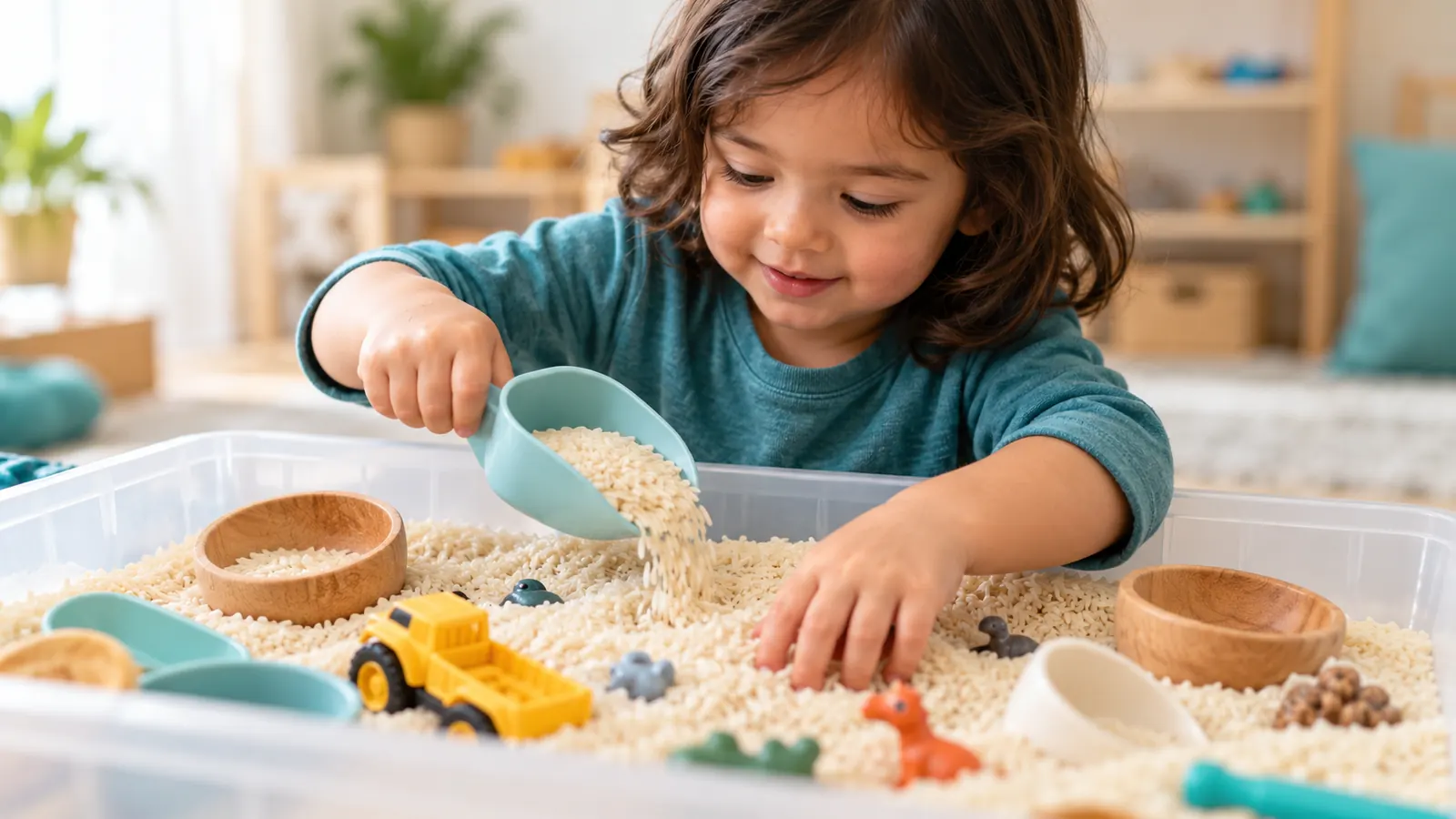
| Exploring texture through play | A tactile box or sensory bin with cornmeal, oatmeal, rice, beans, sand or water and different textured items; daily access to dry sensory materials; toys hidden in the bin |
| Learning to feel with the fingers | Treasure hunt: small objects hidden in play dough or therapy putty to find with the fingers; matching and sorting textured items in a tactile box; feely bags (guess the object without looking) |
| Messy play | Painting outdoors with water; a paint roller in the bathtub; soap crayons; shaving foam to draw in or blow; drawing in sand or salt |
| Body awareness | Face and body paint, temporary tattoos or stickers; 'high fives' throughout the day; blindfold games such as pin the tail on the donkey |
| Resistive hand play | Therapy tubing and putty; balloons or rubber gloves filled with corn, flour or rice; wheelbarrow walking over different surfaces |
| Brushing and erasing | Drawing on hands or legs with crayons or washable chalk, then wiping it off with different textures |
Introducing a new texture to a sensitive child
-
Look
The child watches you play with the texture.
-
Use a tool
They touch it with a spoon, brush or toy first.
-
Fingertip
One finger, briefly, with a towel nearby to wipe.
-
Whole hand
Hands in, as part of a game they enjoy.
Never force a child to touch something. Let them move at their own pace, and praise every small step.
Generally, proprioceptive activities, tactile activities and vestibular activities are used together in sensory integration therapy for children with ADHD and autism.
Related guides: Sensory seeking behavior, Sensory toys.
References
- Smith SA, Press B, Koenig KP, Kinnealey M. Effects of sensory integration intervention on self-stimulating and self-injurious behaviors. American Journal of Occupational Therapy. 2005;59(4):418–425.
- Yack E, Sutton S, Aquilla P. Building Bridges Through Sensory Integration. Future Horizons; 2003.
- Kranowitz CS. The Out-of-Sync Child: Recognizing and Coping with Sensory Processing Disorder. Penguin; 2005.
- Larkey S. Practical Sensory Programmes for Students with Autism Spectrum Disorders. Jessica Kingsley Publishers; 2007.
Frequently asked questions
What are tactile activities?
What is tactile defensiveness?
How do I help a child who is sensitive to touch?
What are tactile activities for toddlers?
Why does my child touch everything?
Written by
Deepam Pawar, OT
Deepam Pawar is an occupational therapist and co-founder of Occupational Therapy OT. He focuses on clinical frameworks, assessment, and evidence-based practice.
All articles by Deepam →This article is for general education and is not a substitute for individualized assessment or treatment by a licensed occupational therapist. Always seek the guidance of a qualified professional for specific concerns.