Sensory Integration: Theory, Therapy and How It Helps Children
An occupational therapist explains sensory integration: Ayres' theory, the 8 senses, how SI therapy works, what a session looks like and what research shows.


Sensory integration and occupational therapy
Sensory integration therapy is an integral part of occupational therapy. Occupational therapists practise sensory integration (SI) mostly with children. Sensory integration itself is nothing but a developmental process that everyone goes through.
Ayres’ theory in brief
The theory of sensory integration was developed by A. Jean Ayres (Ayres 1972, 1979, 1989), who was an occupational therapist. The theory assumes that adequate processing and integration of sensory information is an important foundation for adaptive behaviour.
Ayres believed that sensory integration plays an important part in taking part in meaningful, health-promoting activities. Occupational therapy using sensory integration is designed to improve sensory processing and integration as a basis for successful participation in daily occupations (Parham & Mailloux, 2001).
What is sensory integration?
Sensory integration is the normal neurological process of organising sensation for an effective response in daily life. We use sensation to survive, to satisfy our needs, to learn and to function.
Our brain receives sensory information from our body and our surroundings, interprets it, and organises, or “integrates”, a purposeful response. This integration lets us respond automatically, efficiently and comfortably to the specific sensory input we receive.
Think of crossing a busy road. Your eyes track traffic, your ears pick up a horn, your inner ear keeps you balanced as you step off the kerb, and your muscles and joints tell you where your feet are without looking. Your brain combines all of this in a fraction of a second, so you move safely and without effort. That is sensory integration at work.
The senses: more than five
The development of the sensory systems begins in the womb and continues throughout life. It is fastest in early childhood, which is why these early years are called the sensory-motor years. A child refines sensory processing through everyday childhood activities.
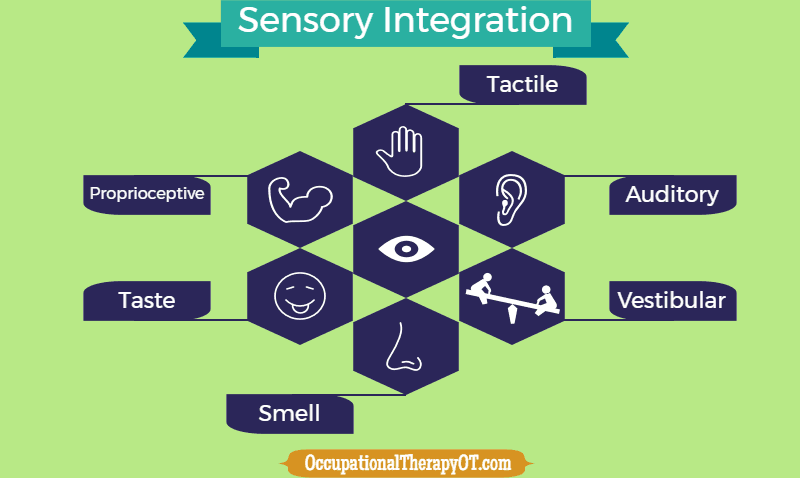
We all know the familiar senses: vision, hearing, smell, taste and touch. But there are other vital senses in our body: the vestibular and proprioceptive senses, and a sense of our inner body called interoception.
Ayres gave special weight to the tactile, vestibular and proprioceptive senses. Interoception has since been added by many clinicians.
- The tactile sense gives information through the surface of the skin. It tells us the texture, shape and size of an object or surface, and helps us tell two surfaces apart. Read more in tactile activities.
- The vestibular sense gives information about balance and movement. Its sense organs sit in the inner ear and tell us the position and movement of our head and body in space. Read more in vestibular activities.
- The proprioceptive sense gives information through our muscles and joints. It tells us how our joints are moving, whether they are bending or straightening, and how much force we are using. Read more in proprioceptive activities.
- Interoception tells us what is happening inside the body: hunger, thirst, a full bladder, a racing heart. Children who struggle here may not notice they need the toilet until it’s urgent, or may not recognise the body signs of anxiety.
How sensory integration works
Sensory input
The stimuli we receive from the sense organs are the sensory input. This input (movement, pressure, touch, vision, hearing, taste and smell) travels to the brainstem, much of it through the cranial nerves and spinal cord. Every piece of input has to be registered before it can be integrated.
Sensory registration
Registration happens when sensory input is noticed by the nervous system. After successful registration, the next step is sensory processing, or integration.
Sensory processing and integration
Sensory integration, the basis of sensory perception, is the ability to organise (integrate) sensory information. We perceive and learn through our senses, and sensory input comes before motor output. Sensory integration affects how efficiently the higher centres of the brain work once the information has been processed, and the brain’s output is more efficient when both hemispheres work together.
-
Registration
The nervous system notices the input: 'something touched my arm'.
-
Modulation
The brain turns the signal up or down so the response matches its importance.
-
Discrimination
The brain works out what, where and how much: 'a soft sleeve, on my left elbow'.
-
Integration and praxis
Information from several senses is combined to plan a movement or behaviour.
-
Adaptive response
A purposeful, well-judged action, which in turn gives new sensory feedback.

Ayres’ building blocks: the pyramid of learning
Many OTs explain sensory integration with a pyramid. Higher skills such as reading, writing and behaviour rest on the sensory foundation at the bottom. If the base is shaky, the top is shaky too.
-
Academic learning, daily living and behaviour
Reading, writing, self-care, attention, emotional regulation
-
Perceptual-motor skills
Eye-hand coordination, visual perception, purposeful activity
-
Sensory-motor development
Body awareness, posture, balance, motor planning, two-sided coordination
-
Sensory systems
Touch, movement, body position, sight, hearing, taste, smell
Adapted from Williams and Shellenberger's pyramid of learning, based on Ayres' work. The pyramid is a teaching model, not a strict developmental sequence.
What successful sensory integration makes possible
Sensory integration is a normal developmental process that helps us master many areas of development. Through typical sensory processing we learn to self-regulate, to control ourselves, to develop motor skills, and to build higher cognitive functions such as attention and memory.
| Area | Everyday functions that depend on sensory integration |
|---|---|
| Body and movement | Balance, muscle tone, postural stability, bilateral coordination, body awareness, body position, force (grading of movement), gravitational security, praxis and motor planning, gross motor skills |
| Learning | Academic skills, attention, auditory discrimination, visual discrimination, tactile discrimination, eye-hand coordination, fine motor skills, hand preference, speech and language skills |
| Emotional and social | Emotional security, self-esteem, self-regulation, social skills and healthy relationships with others |
Difficulty in these areas may be caused by sensory processing difficulties.
When sensory integration doesn’t go smoothly
Sensory processing disorder (SPD), previously called sensory integration dysfunction, occurs when the brain is unable to process the sensory information coming from the body or the environment efficiently. It can happen when the brain doesn’t receive the input, when the input it receives is inconsistent, or when the input is consistent but doesn’t integrate properly.

A child who avoids ordinary sensations or seeks excessive stimulation, whose behaviour feels out of control, or whose body won’t cooperate, may have a sensory processing difficulty. They receive the same sensations from the environment as other children, but they are unable to process them, so they give no response, or a different response.
Sensory difficulties often occur alongside ADHD, autism, cerebral palsy, Down syndrome and other conditions. The main patterns are:
- Sensory modulation difficulties: over-responsive or under-responsive to stimuli, or craving sensation.
- Sensory discrimination difficulties: trouble telling two or more stimuli apart.
- Sensory-based motor difficulties: problems with posture and movement patterns, or with planning new movements (dyspraxia).
We cover signs, causes and assessment in detail in our guide to sensory processing disorder.
What is sensory integration therapy?
Occupational therapists often use sensory integration therapy as an intervention. When sensory difficulties get in a child’s way, sensory integration-based occupational therapy (“OT/SI”) is often recommended. A sensory integration therapist or pediatric occupational therapist assesses the child’s sensory and motor skills and plans the intervention accordingly.
Sensory integration therapy uses sensory strategies to improve registration and processing and to help the child overcome sensory problems. The child is guided through activities that challenge their ability to respond to sensory input, so they make a successful, organised response. SI therapy includes vestibular, proprioceptive and tactile activities designed for the child’s specific developmental needs.
SI therapists focus on the automatic sensory processes inside a goal-directed activity, rather than instructing the child how to respond. The child is an active participant, which helps them become a more mature and efficient organiser of sensory information.
The key ingredients of Ayres Sensory Integration
Research on Ayres Sensory Integration uses a “fidelity measure” to check that therapy really follows Ayres’ principles. In plain language, good SI therapy:
| Principle | What it looks like in a session |
|---|---|
| Rich sensory opportunities | Swings, ramps, textured materials and heavy work, mostly touch, movement and body-position input |
| The just-right challenge | Each activity is a little harder than the child can easily manage, but achievable with effort |
| Child-led, therapist-guided | The child chooses and drives the play; the therapist shapes it towards the goal |
| Adaptive responses | The child succeeds at something new, such as climbing, catching or tolerating a texture |
| Postural, ocular and motor control | Activities build balance, eye control and coordination |
| Praxis and organisation | The child plans and sequences their own actions, such as building an obstacle course |
| A playful context | Fun keeps the child engaged; engagement drives change |
| Emotional safety | A trusting relationship; the child is never forced into frightening movement |
Based on Parham et al. (2011), the Ayres Sensory Integration fidelity measure.
What happens in a typical session
-
Arrive and settle
The child explores the room; the OT watches how they move and what they seek or avoid.
-
Movement and heavy work
Swinging, climbing, crashing into cushions, pushing heavy balls, with challenges adjusted moment by moment.
-
Skill play
Obstacle courses, catching while swinging, tactile games: sensory input linked to the child's goals.
-
Calm down and review
Slow rocking or deep pressure; the OT shares a home activity with the parent.
Sensory integration therapy is fun!
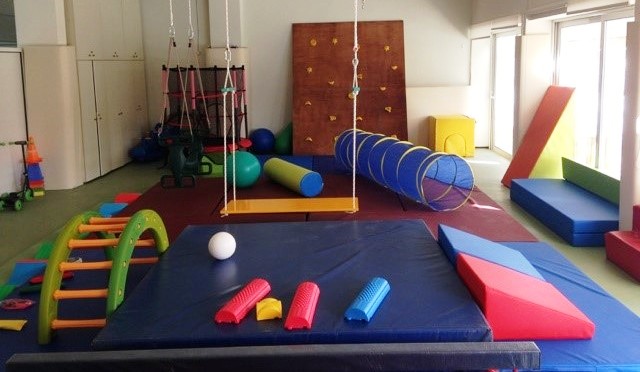
An occupational therapist using sensory integrative procedures always makes therapy fun for the child. The SI room is full of appealing equipment: ramps to slide down, platforms to swing on, bolsters to climb over, inner tubes to jump into and trapezes to swing from.
For the child, therapy is play, and it may look like play to the adult watching too. But working under the guidance of a trained professional lets the child achieve successes that probably wouldn’t happen in unguided play. In fact, many children with sensory integrative difficulties are unable to play productively in an organised way without special help.
Creating a playful atmosphere isn’t done just for fun. A child who is interested in the activities is more likely to benefit from therapy than a child who is bored or disengaged.
Sensory integration activities
Sensory integration therapy uses many kinds of activities. These can also become part of a child’s sensory diet, a planned daily schedule of sensory activities.
| Sense | Calming examples | Alerting examples |
|---|---|---|
| Vestibular (movement) | Slow, rhythmic, linear swinging or rocking | Bouncing on a trampoline, fast swinging, spinning (only if tolerated) |
| Proprioceptive (heavy work) | Pushing against a wall, carrying heavy books, firm hugs, being rolled in a blanket | Jumping, animal walks, tug of war, wheelbarrow walking |
| Tactile (touch) | Deep-pressure massage, a weighted lap pad (as advised by an OT), warm bath | Textured bins, finger painting, shaving foam play, cool water play |
What to expect from sensory integration therapy
When sensory integration therapy works well, the child can process complex sensory information automatically and more effectively than before. A child who was over- or under-responsive to sensory stimulation may improve. Many show better emotional adjustment and personal-social skills, and some show improvement in language or daily routine tasks.
Sensory integration is now also used in schools to support social behaviour, learning, self-discipline, and gross and fine motor skills.
What the research says
- Strongest evidence: a randomised controlled trial (Schaaf et al., 2014) and a systematic review (Schaaf et al., 2018) found that Ayres Sensory Integration, delivered by trained OTs with fidelity, improves individualised goals (measured with Goal Attainment Scaling) for autistic children aged about 4–12, and can reduce the amount of caregiver help needed with self-care.
- Mixed evidence: results for other conditions, and for loosely defined “sensory activities” that don’t follow Ayres’ principles, are less consistent.
- Professional guidance: the American Academy of Pediatrics (2012) advises that sensory-based therapies be one part of a full treatment plan, with clear goals and regular review of whether they are working.
Related guides: Interoception, Sensory seeking behavior, Sensory toys, Sensory overload.
Theory behind this: read our complete guide to OT frames of reference, including developmental and motor learning frames.
References
- Ayres AJ. Sensory Integration and Learning Disorders. Western Psychological Services; 1972.
- Parham LD, Mailloux Z. Sensory integration. In: Case-Smith J, ed. Occupational Therapy for Children. 4th ed. Mosby; 2001.
- Ottenbacher K. Sensory integration therapy: affect or effect. American Journal of Occupational Therapy. 1982;36(9):571–578.
- Case-Smith J, Bryan T. The effects of occupational therapy with sensory integration emphasis on preschool-age children with autism. American Journal of Occupational Therapy. 1999;53(5):489–497.
- Cohn ES. Parent perspectives of occupational therapy using a sensory integration approach. American Journal of Occupational Therapy. 2001;55(3):285–294.
- Watling RL, Dietz J. Immediate effect of Ayres’s sensory integration-based occupational therapy intervention on children with autism spectrum disorders. American Journal of Occupational Therapy. 2007;61(5):574–583.
- Parham LD, Roley SS, May-Benson TA, et al. Development of a fidelity measure for research on the effectiveness of the Ayres Sensory Integration intervention. American Journal of Occupational Therapy. 2011;65(2):133–142.
- Schaaf RC, Benevides T, Mailloux Z, et al. An intervention for sensory difficulties in children with autism: a randomized trial. Journal of Autism and Developmental Disorders. 2014;44(7):1493–1506.
- Schaaf RC, Dumont RL, Arbesman M, May-Benson TA. Efficacy of occupational therapy using Ayres Sensory Integration: a systematic review. American Journal of Occupational Therapy. 2018;72(1).
- American Academy of Pediatrics. Sensory integration therapies for children with developmental and behavioral disorders. Pediatrics. 2012;129(6):1186–1189.
- Larkey S. Practical Sensory Programmes for Students with Autism Spectrum Disorders. Jessica Kingsley Publishers; 2007.
- Kranowitz CS. The Out-of-Sync Child Has Fun: Activities for Kids with Sensory Processing Disorder. Revised ed. Penguin; 2003.
Frequently asked questions
What is sensory integration in simple words?
What is the difference between sensory integration and sensory processing?
What does a sensory integration therapy session look like?
Does sensory integration therapy work?
Who can benefit from sensory integration therapy?
How long does sensory integration therapy take?
Written by
Deepam Pawar, OT
Deepam Pawar is an occupational therapist and co-founder of Occupational Therapy OT. He focuses on clinical frameworks, assessment, and evidence-based practice.
All articles by Deepam →This article is for general education and is not a substitute for individualized assessment or treatment by a licensed occupational therapist. Always seek the guidance of a qualified professional for specific concerns.