Proprioceptive Activities: Heavy Work Ideas by Age and Setting
An occupational therapist explains proprioception, signs a child is seeking it, and 50+ heavy work activities for babies, toddlers, school, home and adults.


What is proprioception?
Proprioception is one of the most important senses of the body. It is the unconscious awareness of body position. It tells us the position of our body parts, their relation to each other, and their relation to other people and objects.
The receptors of the proprioceptive system are in the muscles, tendons, ligaments, joint capsules and connective tissue. We depend on this system to make sense of movement. When we hold something in our hand, the muscles and joints around the object tell us its shape and size.
The vestibular and proprioceptive systems are closely linked and share some functions. Together they let you walk down stairs in the dark, or catch a ball while running.
Try this: close your eyes and touch your nose. You can do it because proprioception tells you exactly where your hand is.
The role of proprioception in sensory integration therapy
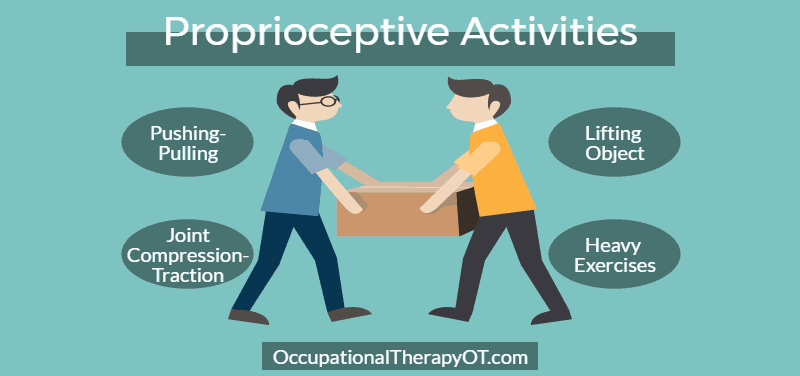
The proprioceptive system gives information about the unconscious awareness of our body. This awareness creates a body scheme, a map of the body in the brain, and the body scheme helps us develop motor planning abilities.
Occupational therapists use proprioceptive activities as a medium of intervention in sensory integration therapy, because they give sensory-rich proprioceptive input. Certain types of proprioceptive sensation help the brain regulate arousal (alertness). These sensations come from activities that make the muscles stretch and work hard.
Proprioceptive sensations rarely overload the nervous system, and some can have both calming and alerting effects, depending on the individual nervous system (Wilbarger 1991; Williams and Shellenberger 1994).
Proprioceptive dysfunction
Some kids don’t adequately receive or process information from their proprioceptive system. This results in poor body awareness and movement, which directly affects the child’s motor skills. It is one of the patterns of sensory processing disorder.
Children with proprioceptive dysfunction cannot position their bodies correctly in daily routines, like getting on a bicycle or stepping onto an escalator. They may struggle to play well, because frequent changes in movement are difficult for them, for example when catching and throwing a ball.
Proprioceptive under-registration (the proprioceptive seeker)
The brain is unlikely to over-register proprioception or be over-stimulated by it. Unfortunately, it is very common for children with sensory difficulties to under-register proprioception. This can affect many areas of development and greatly affect self-regulation. The brain thrives on proprioception in so many ways, so when a child doesn’t register it, many difficulties follow.
Signs of proprioceptive dysfunction
| Area | The child may… |
|---|---|
| Force and grading | Struggle to judge the force needed to hold or move things; write too lightly or press too hard; break toys; slam doors |
| Seeking input | Keep rocking their body; jump on beds; squeeze themselves between furniture; hide under heavy blankets; slap their feet when walking; pull on fingers and crack knuckles |
| Body awareness | Have a poor sense of body awareness; be unable to do familiar things without looking, such as getting dressed |
| Movement | Be stiff, uncoordinated and clumsy, falling and tripping frequently; lean, bump or crash into objects and people and invade others' space |
| Mouth | Chew cuffs, collars, pencils and other non-food objects; have oral-motor difficulties |
| Emotions and participation | Avoid ordinary movement experiences because they feel uncomfortable or inadequate; resist new challenges |
| Other senses | Also have problems with touch, or with balance and movement |
These signs are common in ADHD and autism.
Why heavy work helps
Proprioceptive activities help inhibit or prevent uncomfortable reactions to sensations. They are particularly important to include in sensory diets for children who are sensory defensive.
Proprioceptive activities are an excellent tool for calming, organising and self-regulating the nervous system. A short session of heavy work can have a positive effect that lasts well beyond the activity itself, which is why OTs schedule it before difficult parts of the day.
List of proprioceptive activities
| Type | Activities |
|---|---|
| Pushing and pulling | Pushing a weighted wagon, cart or wheelbarrow; tug of war with ropes, scarves or stretchy bands; pushing against a wall, another person or hands together; pulling apart resistant toys such as building bricks, snap beads and stretchy toys |
| Carrying and lifting | Carrying heavy items such as groceries, boxes and books; bean bag lifting; hiking with a backpack |
| Crawling, climbing and hanging | Crawling through tunnels or boxes on all fours; stair climbing and sliding down on the bottom; hanging from adult hands or a trapeze bar; climbing frames |
| Jumping and crashing | Jumping; crashing into a pile of cushions; roughhousing and play wrestling; squishing between pillows |
| Throwing, kicking and hitting | Catching and throwing a heavy ball, bean bags or cushions; kicking a soccer ball or big ball; hitting a punching bag or tetherball; batting balls with a plastic bat |
| Whole-body exercise | Push-ups, sit-ups and handstands; silly animal walks; wheelbarrow walking; scooter board activities; big ball activities; swimming and extra bath time; biking uphill; obstacle courses; body stretches |
| Hands | Pounding and rolling play dough or clay; therapy putty |
| Mouth | Biting, chewing and crunching resistive foods (age-appropriate, supervised); sucking thick drinks through a straw |
| Therapist-led | Joint compressions, massage, vibration and weighted vests, only as recommended and taught by an occupational therapist |
Proprioceptive activities by age and setting
| Age or setting | Ideas |
|---|---|
| Infants | Tummy-time push-ups; squeezing soft toys; massage; gentle bouncing on a lap |
| Toddlers | Pushing a walker, chair, their own stroller, the laundry or a grocery cart; carrying a backpack of toys and books; making smoothies and sucking them through a straw; crazy straws; blowing bubbles; pillow fights |
| Preschoolers | Bear walks; crab walks; leapfrog; door push-pull activities; pushing and lifting bean bags; garden activities such as digging and carrying watering cans; park activities |
| Classroom and school | Wheelbarrow walking; punching bags; therapy putty; tug of war; moving desks and stacking chairs; wall push-ups; carrying books to another class |
| At home | Unloading the washing machine and dryer; opening and closing the refrigerator door; bean bag lifting; pushing and pulling a chair; pillow fights; any of the activities above |
| Teens and adults | Weight lifting; household chores such as washing, cleaning and sweeping the floor; hammering (with supervision); gardening; swimming |
For more whole-body ideas, see our gross motor activities, and combine heavy work with vestibular and tactile activities for a balanced sensory diet.
Related guides: Sensory seeking behavior, Sensory toys, Heavy work activities, Proprioceptive activities before bed.
References
- Smith SA, Press B, Koenig KP, Kinnealey M. Effects of sensory integration intervention on self-stimulating and self-injurious behaviors. American Journal of Occupational Therapy. 2005;59(4):418–425.
- Williams MS, Shellenberger S. How Does Your Engine Run? A Leader’s Guide to the Alert Program for Self-Regulation. TherapyWorks; 1994.
- Yack E, Sutton S, Aquilla P. Building Bridges Through Sensory Integration. Future Horizons; 2003.
- Kranowitz CS. The Out-of-Sync Child: Recognizing and Coping with Sensory Processing Disorder. Penguin; 2005.
- Larkey S. Practical Sensory Programmes for Students with Autism Spectrum Disorders. Jessica Kingsley Publishers; 2007.
Frequently asked questions
What is proprioception in simple terms?
What are proprioceptive activities?
What are signs a child is seeking proprioceptive input?
Are proprioceptive activities calming?
What are proprioceptive activities for the classroom?
Are weighted vests and blankets safe?
Written by
Deepam Pawar, OT
Deepam Pawar is an occupational therapist and co-founder of Occupational Therapy OT. He focuses on clinical frameworks, assessment, and evidence-based practice.
All articles by Deepam →This article is for general education and is not a substitute for individualized assessment or treatment by a licensed occupational therapist. Always seek the guidance of a qualified professional for specific concerns.