Vestibular Activities: Movement Play for Sensory Needs (OT Guide)
An occupational therapist explains the vestibular system, gravitational insecurity and movement seeking, safety rules, and 30+ calming and alerting activities.


Why vestibular input matters
Vestibular stimulation can have a significant effect on the nervous system. Vestibular sensations also help the nervous system stay organised and balanced. Quick, fast movements tend to be alerting, and slow movements tend to be calming.
An occupational therapist suggests sensory diet activities after doing a sensory profile. A sensory diet should be followed under the therapist’s supervision for the first days. Before we go further, let’s look at the basics of the vestibular system and why it is so important.
What is the vestibular system?
The vestibular system gives us information about movement and gravity. It tells us about the body’s motion, its direction and its speed. Ayres suggested that the vestibular system has a critical role in modulating all the other sensory systems.
The vestibular receptors are in the inner ear: the semicircular canals sense turning movements, and the otolith organs sense straight-line movement and gravity. Together they sense changes in gravity and movement. They also work closely with the eyes, helping keep our vision steady while we move, and with the muscles that hold us upright.
| Type of movement | Examples | Usual effect |
|---|---|---|
| Linear (back and forth, side to side, up and down) | Swinging on a regular swing, rocking chair, bouncing on a ball or trampoline, gliding | Slow and rhythmic: calming. Fast: alerting. |
| Rotary (turning, spinning) | Sit-and-spin, swivel chair, tire swing, rolling | Very intense and alerting; easy to overload |
| Head position changes (upside down, inverted) | Hanging from monkey bars or a trapeze, somersaults, lying over a therapy ball | Strong and alerting; can be organising for some children |
Vestibular dysfunction
Some kids have difficulty processing information from the vestibular system. They can be hypo-responsive or hyper-responsive to vestibular sensations, or have mixed sensitivities. These are among the patterns of sensory processing disorder.
1. Gravitational insecurity (over-responsive)
Children who are hyper-responsive to vestibular input are fearful of any change in gravity and position. They don’t like standing in high places or on moving surfaces. These situations can trigger a sensory-defensive response and activate a “fright, flight or fight” reaction.
This over-reaction to movement can hold back development. It stops the child from physically exploring their environment, which may delay fine and gross motor skills.
2. Vestibular hyposensitivity (under-responsive or seeking)
At the opposite end, this child needs movement. They are always on the go and don’t seem able to sit still. Their nervous system may need a lot of movement to stay alert and organised, so they find it hard to stay in one place.
Slow rocking, linear motion and rhythmic movements have a calming effect on the nervous system and can decrease over-reactive responses to sensory input.
| Over-responsive child | Under-responsive or seeking child | |
|---|---|---|
| Playground | Avoids swings, slides and climbing equipment that involves movement | Swings very high, spins for a long time without getting dizzy |
| Balance | Avoids activities that need balance | Takes risks; may fall often because they move without caution |
| Stairs and lifts | Fearful going up and down stairs; uncomfortable in lifts and escalators | Jumps down several steps at a time |
| Feet off the ground | Hates being lifted or tipped back, for example for hair washing | Loves being thrown, tipped upside down and spun |
| Sitting | May sit very still and avoid moving | Can't sit still; rocks or tips the chair |
Because of vestibular dysfunction, these problems may also arise:
- An inconsistent response to sensory input
- Emotional instability
- An inappropriate arousal or alertness level
- Difficulty maintaining and shifting attention
- Difficulty with self-regulation
Safety first: important points about vestibular input
Vestibular activities
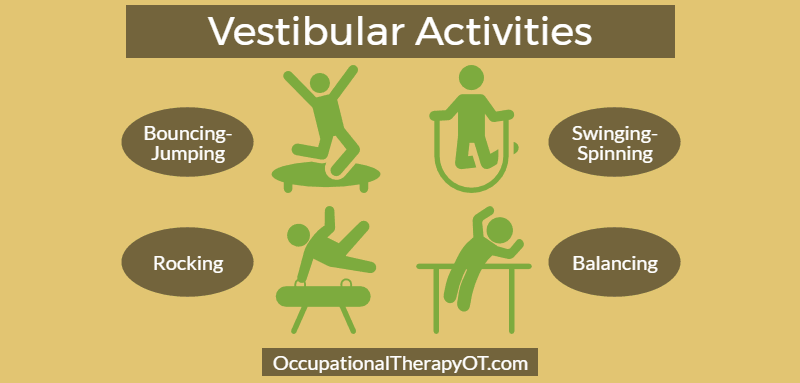
The activities below may help a child with vestibular difficulties. They are used in sensory integration therapy by occupational therapists, and many can be adapted for home and school.
| Activity | Alerting version | Calming version |
|---|---|---|
| Bouncing | Fast bouncing on a mini-trampoline or therapy ball | Slow, gentle bouncing on a therapy ball |
| Swinging | Fast or high swinging on a swing or hammock | Slow, rhythmic, linear swinging |
| Spinning | A swivel chair, scooter board or sit-and-spin (short bursts, OT-guided) | Gentle slow spinning in one direction only |
| Rocking | Rocking toy horse ridden fast | Rocking chair; rocking in a parent's arms |
| Climbing | Ladders, climbing frames, climbing furniture (safely) | Climbing slowly with pauses at the top |
| Upside down | Trapeze, monkey bars, hanging over a therapy ball | Not usually used for calming |
| Outdoor games | Hockey, football, ball catching, running games | Walking on a gentle slope; slow ball rolling |
| Sliding and rides | Slides, roller coasters, sledging | Gentle slides on a soft surface |
| Swimming | Jumping in, splashing games | Floating and slow swimming |
Vestibular activities at home
- Rocking in a rocking chair while reading together
- Rolling down a gentle grassy slope
- “Airplane” rides on an adult’s legs
- Swinging in a blanket held by two adults
- Lying on the tummy over a therapy ball and rolling forward to reach toys
- Wheelbarrow walking and dancing games
Equipment for vestibular activities
These are common pieces of equipment used by occupational therapists for vestibular dysfunction or vestibular sensory processing difficulties:
- Swing chairs and platform swings
- Swings and hammocks
- Therapy balls
- Trampolines
- Scooter boards
- Twizzlers and sit-and-spin toys
Vestibular activities are usually combined with proprioceptive and tactile activities in sensory integration therapy.
Related guides: Sensory seeking behavior, Sensory overload, Vestibular activities for babies.
References
- Ayres AJ. Sensory Integration and the Child. Western Psychological Services; 1979.
- Smith SA, Press B, Koenig KP, Kinnealey M. Effects of sensory integration intervention on self-stimulating and self-injurious behaviors. American Journal of Occupational Therapy. 2005;59(4):418–425.
- Yack E, Sutton S, Aquilla P. Building Bridges Through Sensory Integration. Future Horizons; 2003.
- Kranowitz CS. The Out-of-Sync Child: Recognizing and Coping with Sensory Processing Disorder. Penguin; 2005.
- Larkey S. Practical Sensory Programmes for Students with Autism Spectrum Disorders. Jessica Kingsley Publishers; 2007.
Frequently asked questions
What are vestibular activities?
Which vestibular activities are calming?
What is gravitational insecurity?
Is spinning good for kids with sensory needs?
What vestibular activities can I do at home?
Written by
Deepam Pawar, OT
Deepam Pawar is an occupational therapist and co-founder of Occupational Therapy OT. He focuses on clinical frameworks, assessment, and evidence-based practice.
All articles by Deepam →This article is for general education and is not a substitute for individualized assessment or treatment by a licensed occupational therapist. Always seek the guidance of a qualified professional for specific concerns.