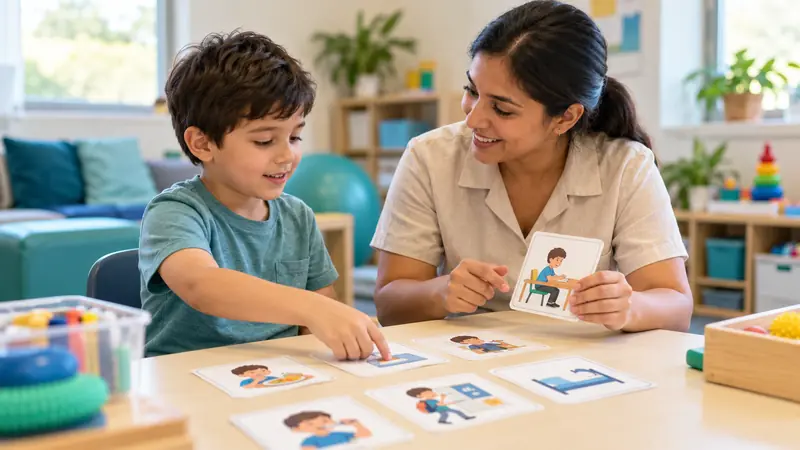
Heavy Work Activities for Kids: 50 OT Ideas for Home, School and Bedtime
What heavy work is, why it calms and focuses kids, and 50 OT heavy work activities for home, classroom, outdoors, toddlers and bedtime, with a free printable.


If your child is always crashing into the sofa, jumping off furniture, chewing their sleeves or struggling to settle for homework, heavy work may help. It’s one of the simplest and most useful tools occupational therapists recommend.
What is heavy work?
Heavy work is any activity that makes the muscles push, pull, lift, carry, climb, jump or squeeze against resistance. These activities give strong input to the proprioceptive system, the sense that tells us where our body is and how much force we’re using.
Why OTs recommend heavy work
- Calming and organising: many children feel calmer and more focused after heavy work.
- Meets sensory-seeking needs safely: sensory seekers get the input they crave without crashing into people or furniture.
- Builds strength: core, shoulder and hand strength support posture, handwriting and self-care.
- Body awareness: helps clumsy children understand where their body is in space.
- Fits into real life: many heavy work tasks are useful chores.
-
Morning
To help get organised for the day.
-
Before focus tasks
Before homework, reading or table work.
-
Transitions
Before moving to a new activity or place.
-
After school
To release the day's stress.
-
Before bed
Slow, calm heavy work to wind down.
50 heavy work activities
| Activity | Tip |
|---|---|
| 1. Carry the laundry basket | Make it a 'delivery job' |
| 2. Push a full laundry basket across the floor | Add a race or obstacle |
| 3. Carry shopping bags from the car | Give them a small, heavy bag |
| 4. Push the shopping trolley | Great in the supermarket |
| 5. Vacuum or sweep | Push-pull movement |
| 6. Move cushions to build a fort | Then crash into it |
| 7. Carry books back to the shelf | A stack of 5 is plenty |
| 8. Wipe the table or windows | Big, firm circles |
| 9. Knead bread or pizza dough | Real cooking heavy work |
| 10. Stir thick mixtures (cookie dough) | Harder than it looks |
| 11. Help carry the recycling | Weekly job |
| 12. Wall push-ups | 10 slow pushes |
| 13. Tug of war with a towel | With a parent or sibling |
| 14. Pillow fight with soft pillows | Set clear rules |
| 15. Wheelbarrow walking | Hold at the hips for younger kids |
| Activity | Tip |
|---|---|
| 16. Carry books to the library | Classroom helper role |
| 17. Stack or move chairs | End-of-day job |
| 18. Wipe tables | Spray bottle adds hand strength |
| 19. Erase the whiteboard | Big arm movements |
| 20. Push the book or lunch cart | Supervised |
| 21. Chair push-ups | Hands on the seat, lift the bottom |
| 22. Wall push-ups in the corridor | Before lining up |
| 23. Carry the lunch crate | Two children together |
| 24. Hand out heavy materials | Textbooks, PE equipment |
| 25. Sharpen pencils with a manual sharpener | Hand heavy work |
| 26. Use a hole punch or stapler | Hand strength |
| 27. Resistance band on chair legs | Quiet foot heavy work |
| Activity | Tip |
|---|---|
| 28. Climbing frames and monkey bars | Upper-body heavy work |
| 29. Digging in the garden or sandpit | Use a real spade |
| 30. Pushing a wheelbarrow | Add some soil or sand |
| 31. Raking leaves | Then jump in the pile |
| 32. Pulling a wagon with a friend inside | Turn-taking |
| 33. Swimming | Water gives resistance |
| 34. Trampoline jumping | One at a time, net and supervision |
| 35. Carrying watering cans | Watering plants |
| 36. Riding a bike or scooter uphill | Leg heavy work |
| 37. Animal walks on grass (bear, crab, frog) | Race to a finish line |
| 38. Rock climbing wall | Supervised |
| Activity | Tip |
|---|---|
| 39. Push a toy cart or small laundry basket | Load it with toys |
| 40. Crawl through tunnels | Or under chairs |
| 41. Climb soft-play steps | Supervised |
| 42. Squish playdough | Supervise small pieces |
| 43. Carry a small backpack with a soft toy | Short walks |
| 44. Help carry a light shopping bag | Real job, real pride |
| Activity | Tip |
|---|---|
| 45. Carry pillows and toys to bed | Part of the bedtime routine |
| 46. Pillow sandwich | Gentle, firm pressure; head always out |
| 47. Slow wall push-ups | Count slowly to 10 |
| 48. Therapy ball roll over the back | Slow, firm rolls while lying on the tummy |
| 49. 'Blanket burrito' | Wrap snugly; head always out |
| 50. Slow bear walk to the bedroom | Quiet and slow |
Oral and hand heavy work
Heavy work isn’t only for big muscles:
- Oral: drinking thick smoothies through a straw, crunchy and chewy snacks (apples, carrots, bagels), blowing bubbles or whistles, chewy tools recommended by an OT
- Hands: playdough and therapy putty, squeezing stress balls, spray bottles, clothes pegs, tearing paper. See hand strengthening activities.
Building heavy work into a sensory diet
Heavy work works best little and often, before a child becomes dysregulated. An occupational therapist can build heavy work into a personalised sensory diet, choosing activities and timing that suit your child, home and school.
Summary
Heavy work is pushing, pulling, carrying and squeezing against resistance. It gives strong proprioceptive input that many children find calming and organising, and it’s easy to fit into daily life. Try a few activities from this list at key times of day, and ask an OT to tailor a plan for your child.
Related guides: Proprioceptive activities before bed, Sensory diet for ADHD.
References
- Bundy AC, Lane SJ, eds. Sensory Integration: Theory and Practice. 3rd ed. F.A. Davis.
- Kranowitz CS. The Out-of-Sync Child. Revised ed. Perigee.
- Wilbarger P, Wilbarger J. Sensory Defensiveness in Children Aged 2–12. Avanti Educational Programs.
- Case-Smith J, O’Brien JC. Occupational Therapy for Children and Adolescents. Elsevier.
Frequently asked questions
What are heavy work activities?
Why is heavy work calming?
How long should heavy work activities last?
What are heavy work activities for the classroom?
What heavy work is good before bed?
Is heavy work good for toddlers?
Written by
Deepam Pawar, OT
Deepam Pawar is an occupational therapist and co-founder of Occupational Therapy OT. He focuses on clinical frameworks, assessment, and evidence-based practice.
All articles by Deepam →This article is for general education and is not a substitute for individualized assessment or treatment by a licensed occupational therapist. Always seek the guidance of a qualified professional for specific concerns.