Pediatric Occupational Therapy Goals: 60+ Examples by Skill Area and Age
A pediatric OT goal bank: how to write SMART and COAST goals, plus 60+ measurable examples for fine motor, handwriting, self-care, sensory and more.


Writing clear, measurable goals is one of the most important, and most time-consuming, parts of pediatric occupational therapy. This goal bank is written for OT students, new therapists, teachers and parents who want to understand what good goals look like. It explains how to write them, then gives 60+ examples by skill area and age.
What makes a good pediatric OT goal?
A strong goal answers five questions:
- Who is the goal for?
- What activity will the child do? (a real occupation, not just a skill in isolation)
- How well will they do it? (accuracy, time, quality)
- With how much help? (independently, with verbal cues, with physical help, with equipment)
- By when?
| Weak goal | Strong goal |
|---|---|
| Improve fine motor skills. | Within 12 weeks, Mia will button 3 large buttons on her coat independently on 4 of 5 opportunities. |
| Improve handwriting. | By the end of term, Sam will copy a 5-word sentence with correct letter formation and spacing, 80% legible, using lined paper. |
| Improve self-regulation. | Within 8 weeks, Ava will choose a calming strategy from her visual menu when upset, with one adult prompt, on 3 of 4 observed occasions. |
Two goal-writing formats
SMART goals
-
Specific
Exactly what the child will do.
-
Measurable
How it will be counted.
-
Achievable
Realistic for the child's level.
-
Relevant
Meaningful at home or school.
-
Time-bound
A clear target date.
COAST goals
COAST keeps the focus on occupation, which suits OT well (Gateley and Borcherding).
| Letter | Stands for | Example |
|---|---|---|
| C | Client | Leo |
| O | Occupation | will put on his shoes |
| A | Assist level | independently |
| S | Specific condition | with Velcro straps, seated on a bench |
| T | Timeline | within 6 weeks |
How to measure progress
- Trials or opportunities: “on 4 of 5 trials” or “on 3 of 4 school days”
- Accuracy: “with 80% accuracy” or “within ¼ inch of the line”
- Time: “within 10 minutes” or “for 15 minutes”
- Level of assistance: independent, supervision, verbal cue, gestural cue, minimal physical assistance
- Frequency of cues: “with no more than 2 verbal prompts”
Fine motor goals
| Age (approx.) | Example goal |
|---|---|
| 2 years | Will stack 6 one-inch blocks without them falling, on 3 of 4 trials, within 8 weeks. |
| 2–3 years | Will place 10 coins into a piggy bank slot using a pincer grasp, independently, within 6 weeks. |
| 3 years | Will string 5 large beads onto a stiff lace with minimal assistance, within 10 weeks. |
| 3–4 years | Will open and close 3 different containers (twist lid, snap lid, zip bag) independently, within 8 weeks. |
| 4 years | Will use tweezers to transfer 10 pom-poms between bowls in under 2 minutes, within 10 weeks. |
| 5 years | Will manipulate and fasten 3 medium buttons on a shirt independently on 4 of 5 opportunities, within 12 weeks. |
| School age | Will use a ruler to draw 3 straight lines with the helper hand stabilising the ruler, independently, within 8 weeks. |
Read more: fine motor skills by age and hand strengthening activities.
Scissor skill goals
| Age (approx.) | Example goal |
|---|---|
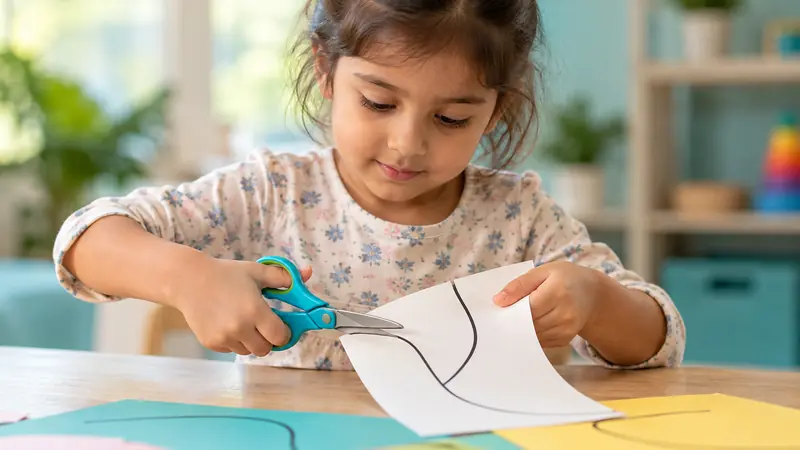
| 2½–3 years | Will open and close child-safe scissors to snip a strip of card, with hand-over-hand help fading to independent, within 8 weeks. |
| 3–4 years | Will cut a 6-inch strip of paper in two, holding scissors thumb-up, independently on 4 of 5 trials, within 10 weeks. |
| 4 years | Will cut along a 6-inch straight line staying within ½ inch, on 4 of 5 trials, within 10 weeks. |
| 4–5 years | Will cut out a 3-inch circle within ¼ inch of the line, turning the paper with the helper hand, within 12 weeks. |
| 5–6 years | Will cut out a square and a triangle with corners, within ¼ inch of the line, on 3 of 4 trials, within 12 weeks. |
Read more: cutting activities for preschoolers.
Visual-motor and handwriting goals
| Age (approx.) | Example goal |
|---|---|
| 3 years | Will imitate a vertical line, horizontal line and circle after a demonstration, on 3 of 4 trials, within 10 weeks. |
| 4 years | Will copy a cross (+) from a model independently on 4 of 5 trials, within 10 weeks. |
| 4–5 years | Will hold a crayon with a static or dynamic tripod or quadrupod grasp for 5 minutes of colouring with no more than 1 reminder, within 8 weeks. |
| 5 years | Will copy a square, diagonal lines and an X from a model, on 3 of 4 trials, within 12 weeks. |
| 5–6 years | Will write their first name with correct letter formation (top-to-bottom starts) and size, independently, on 4 of 5 trials, within 12 weeks. |
| 6–7 years | Will copy a 5-word sentence from near point with correct spacing between words, 80% legible, within one term. |
| 7–9 years | Will write a 3-sentence paragraph with letters on the line and consistent size, 80% legible, within one term. |
| 9+ years | Will type 15 words per minute with 90% accuracy using touch typing, within one school year. |
Read more: handwriting skills, pencil grasp development and visual perceptual skills.
Self-care goals
| Area | Example goal |
|---|---|
| Feeding (2–3 years) | Will scoop and bring a spoon to mouth with minimal spilling at 3 of 4 meals, within 8 weeks. |
| Feeding (5+ years) | Will use a knife to spread butter on bread independently on 4 of 5 opportunities, within 10 weeks. |
| Dressing (3 years) | Will pull down and pull up elastic-waist pants for toileting with supervision, within 8 weeks. |
| Dressing (4 years) | Will put on a jacket using the 'flip' method independently on 4 of 5 days, within 6 weeks. |
| Dressing (5–6 years) | Will zip a jacket, including connecting the zipper, with no more than 1 verbal cue, within 12 weeks. |
| Shoes (6–7 years) | Will tie shoelaces with a double knot independently on 3 of 4 trials, within 12 weeks. |
| Toileting | Will complete the toileting routine (pants down, wipe, pants up, flush, wash hands) using a visual sequence with no more than 2 prompts, within 10 weeks. |
| Hygiene | Will brush teeth for 2 minutes using a visual timer, with adult check only, on 5 of 7 days, within 8 weeks. |
Sensory processing and self-regulation goals
| Focus | Example goal |
|---|---|
| Recognising states | Will identify their zone or feeling (e.g. calm, worried, angry) using a visual chart when asked, on 4 of 5 opportunities, within 8 weeks. |
| Using strategies | Will choose and use a calming strategy from a visual menu when upset, with one adult prompt, on 3 of 4 occasions, within 10 weeks. |
| Sensory diet | Will complete 3 scheduled heavy work breaks during the school day with visual reminders, on 4 of 5 days, within 6 weeks. |
| Tolerance | Will participate in a messy play activity for 5 minutes with no more than mild distress, using a gradual exposure plan, within 12 weeks. |
| Noise | Will remain in the school assembly for 15 minutes using ear defenders, on 3 of 4 occasions, within one term. |
| Body awareness | Will notice and name a body signal (hungry, thirsty, needs toilet) when asked during the day, on 3 of 5 check-ins, within 10 weeks. See interoception. |
Read more: sensory processing disorder, sensory diet and sensory seeking behavior.
Gross motor and motor planning goals
| Age (approx.) | Example goal |
|---|---|
| 3 years | Will jump forward with two feet together over a line on 4 of 5 trials, within 8 weeks. |
| 4 years | Will complete a 5-step obstacle course after one demonstration, with no more than 1 verbal cue, within 10 weeks. |
| 5 years | Will catch a large ball thrown from 5 feet on 4 of 5 trials, within 10 weeks. |
| 5–6 years | Will hop on one foot 5 times in a row on each foot, within 12 weeks. |
| 6+ years | Will complete 10 jumping jacks with coordinated arms and legs, within 12 weeks. |
Read more: motor planning activities, bilateral coordination and gross motor skills.
Executive function and classroom goals
| Focus | Example goal |
|---|---|
| Routines | Will complete the morning arrival routine (hang bag, hand in folder, sit at desk) using a picture checklist, independently on 4 of 5 days, within 6 weeks. |
| Organisation | Will pack all items on an end-of-day checklist into their bag with 1 adult check, on 4 of 5 days, within 8 weeks. |
| Task initiation | Will begin a desk task within 1 minute of instruction using a first–then card, on 3 of 4 opportunities, within 8 weeks. |
| Attention | Will stay seated and engaged in a 10-minute table task using a wobble cushion, on 4 of 5 opportunities, within 10 weeks. |
Read more: executive function skills.
Play and social participation goals
Problem 1Plays alone; doesn't join peers
GoalWill take 3 turns in a simple board game with one peer and adult support, within 8 weeks.
- Waits for turn with a visual 'my turn' card
- Passes the dice to the peer when prompted
Problem 2Repeats the same play
GoalWill play with a new toy for 5 minutes, showing 2 different actions, within 10 weeks.
- Imitates an adult's play action
- Tries a second action independently
Summary
Good pediatric OT goals are functional, measurable and meaningful to the child and family. Use a format like SMART or COAST, choose a clear measure, and always individualise. Use the examples above as a starting point for your own goal writing. For autism-specific goals, see occupational therapy goals for autism.
Related guides: Self-regulation activities, Activities of daily living checklist.
References
- Gateley CA, Borcherding S. Documentation Manual for Occupational Therapy: Writing SOAP Notes. 4th ed. SLACK.
- American Occupational Therapy Association. Occupational Therapy Practice Framework: Domain and Process—Fourth Edition. 2020.
- Case-Smith J, O’Brien JC. Occupational Therapy for Children and Adolescents. Elsevier.
- Centers for Disease Control and Prevention. CDC’s developmental milestones.
- Doran GT. There’s a S.M.A.R.T. way to write management’s goals and objectives. Management Review. 1981;70(11):35–36.
Frequently asked questions
What is a good goal for pediatric occupational therapy?
How do you write a SMART goal in occupational therapy?
What is the COAST method for OT goals?
What are examples of occupational therapy goals for a 3-year-old?
What are school-based OT goals (IEP goals)?
Written by
Payal Mehta, OT
Payal Mehta is a practising occupational therapist and co-founder of Occupational Therapy OT. She writes on pediatrics, sensory integration, and mental-health practice.
All articles by Payal →This article is for general education and is not a substitute for individualized assessment or treatment by a licensed occupational therapist. Always seek the guidance of a qualified professional for specific concerns.