Handwriting Skills: Readiness, Common Problems and OT Tips That Work
How handwriting develops, pre-writing shapes by age, common problems like messy or slow writing, and OT strategies and activities that help.


Handwriting looks simple to adults, but for a child it’s one of the most complex tasks of the school day. It brings together hand control, eyesight, posture, memory and language, all at once. When one part isn’t ready, writing becomes slow, messy or tiring.
This guide explains how handwriting develops, what children need before they write letters, common problems, and how occupational therapy helps.
The building blocks of handwriting
Fine motor control
Finger strength and control
Visual perception
Seeing shapes, spaces and lines
Visual-motor integration
Eyes guiding the hand
Posture and stability
Core, shoulder, wrist
Memory and language
Recalling letters and words
- Fine motor skills: finger strength, in-hand manipulation and controlled small movements
- Visual perceptual skills: recognising shapes and letters, judging space and position
- Visual-motor integration: coordinating what the eyes see with what the hand does, needed to copy shapes and letters
- Postural stability: a stable trunk and shoulder give the hand a steady base
- Bilateral coordination: one hand writes while the other holds the paper
- Memory and language: remembering how letters are formed, spelling, and organising ideas
Pre-writing shapes by age
Before children learn letters, they learn to draw lines and shapes. The order is fairly predictable, and these shapes are the building blocks of letters.
- About 2 years
- Imitates a vertical line (|) after watching you
- About 2½–3 years
- Imitates a horizontal line (—)
- Copies a circle (the CDC lists 'draws a circle when you show how' at 3 years)
- About 4 years
- Copies a cross (+)
- About 4½–5 years
- Copies a square
- Copies diagonal lines (/ \)
- Copies an X
- About 5–6 years
- Copies a triangle
- Writes some letters in their name (CDC milestone at 5)
Ages are approximate, based on developmental norms used in visual-motor tests such as the Beery VMI and CDC milestones.
Pencil grasp: does it matter?
Children’s pencil grasp develops from a fisted grip to a mature finger grip between about 1 and 6 years. Read our full guide to pencil grasp development.
A 2012 study of 120 fourth-graders (Schwellnus et al., American Journal of Occupational Therapy) found that four mature grasps, the dynamic tripod, lateral tripod, dynamic quadrupod and lateral quadrupod, produced equally legible and fast handwriting. So a child doesn’t need a “perfect” tripod grip, as long as the grasp is comfortable, efficient and doesn’t cause pain or fatigue.
Common handwriting problems and what helps
| Problem | Possible reasons | What helps |
|---|---|---|
| Letters formed incorrectly (e.g. starting at the bottom) | Not explicitly taught; developed own habits | Teach consistent letter formation: start at the top; group letters by shape |
| Poor spacing between words | Visual-spatial difficulty; rushing | Finger or lollipop-stick spacers; graph paper; highlighted margins |
| Letters too big, small or floating off the line | Visual perception; motor control | Raised-line or highlighted paper; three-line paper; boxes for each letter |
| Very slow writing | Poor automaticity; motor planning; perfectionism | Short, frequent practice; copying familiar words; timed fun challenges; reduce copying demands |
| Hand hurts or tires quickly | Weak hand muscles; pressing too hard; awkward grasp | Hand strengthening play; grips; looser hold; breaks |
| Pressing too hard or too lightly | Proprioceptive feedback differences | Mechanical pencils (break if too hard); writing on a soft surface; carbon paper games |
| Mixing up b and d | Visual memory; directionality; normal until about 7 | Teach b and d with different starting strokes; use a visual cue |
| Messy when writing ideas but fine when copying | Language and working memory load | Plan ideas first; word banks; keyboarding or speech-to-text |
Setting up for success
-
Seat
Feet flat on the floor, hips and knees about 90°, table at elbow height.
-
Paper
Tilted slightly; right-handers tilt left, left-handers tilt right. Helper hand holds the paper.
-
Tool
A short pencil or crayon encourages a finger grip; try grips if needed.
-
Surface
A slanted board helps wrist position and posture.
-
Breaks
Short movement breaks keep the hand and body ready.
Tips for left-handed writers
- Tilt the paper to the right, and sit on the left of a right-handed child so elbows don’t bump.
- Encourage holding the pencil a little further up so they can see what they’ve written.
- Teach a straight wrist rather than a “hooked” wrist where possible.
Activities that build handwriting skills
| Skill | Fun activities |
|---|---|
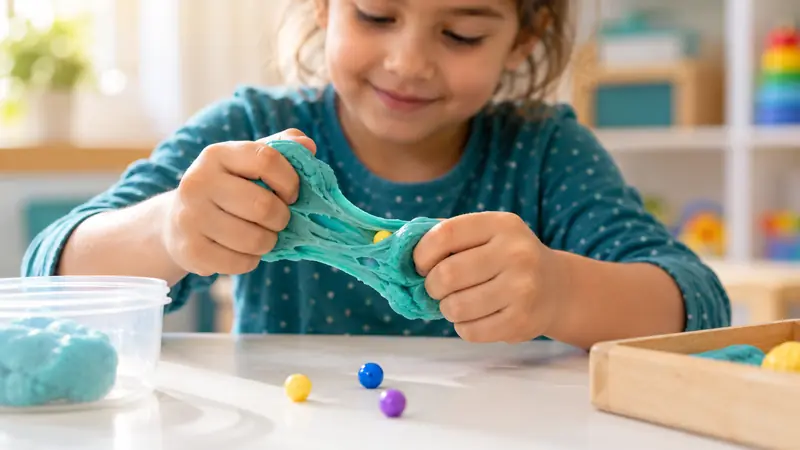
| Hand strength | Playdough, therapy putty, spray bottles, tongs and tweezers games, tearing paper, squeezing sponges |
| Finger control | Picking up small beads, coins into a piggy bank, pegboards, lacing cards |
| Pre-writing shapes | Drawing in sand or shaving foam, rainbow-writing shapes, roads for toy cars, chalk on vertical walls |
| Letter formation | Multisensory letters (play-dough letters, writing in salt trays, sky-writing), consistent verbal cues |
| Visual-motor | Dot-to-dots, mazes, copying block designs, tracing |
| Posture | Tummy-lying to draw, animal walks, wheelbarrow walks, climbing |
When to see an occupational therapist
Talk to your child’s teacher, doctor or a school-based OT if:
- your child can’t copy basic shapes by around age 5
- handwriting is much harder for them than for classmates
- writing is painful, or they avoid it strongly
- written work is far behind what they can say out loud
- they have a condition such as DCD/dyspraxia, ADHD or autism
The OT will assess fine motor, visual-motor and visual perceptual skills, posture and handwriting itself, often with standardised tests such as the Beery VMI. Intervention may include direct teaching of letter formation, multisensory practice, tool and paper adaptations, and, when handwriting remains a barrier, keyboarding or speech-to-text so the child can show what they know.
Summary
Handwriting is built on many foundation skills, and children are usually ready for letters once they can copy a cross, square, diagonals and a triangle. Legibility and speed matter more than a “perfect” grip. When handwriting is a struggle, an occupational therapist can find the root cause and help with practice, adaptations and alternatives.
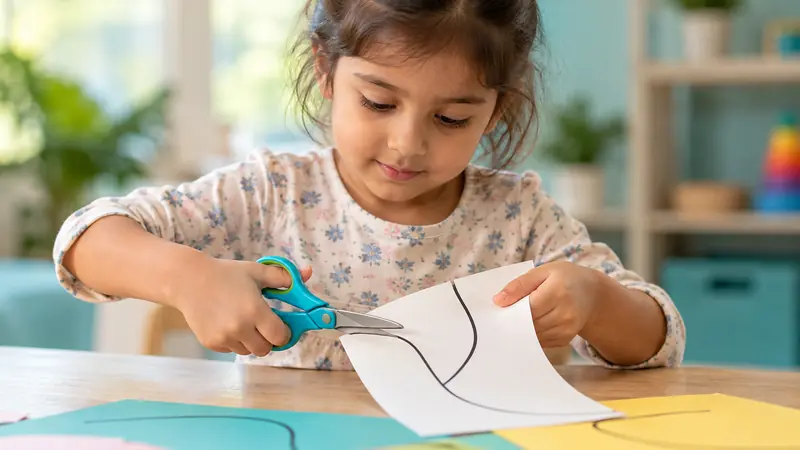
Related guides: Hand strengthening activities, Cutting activities for preschoolers.
References
- Schwellnus H, Carnahan H, Kushki A, Polatajko H, Missiuna C, Chau T. Effect of pencil grasp on the speed and legibility of handwriting in children. American Journal of Occupational Therapy. 2012;66(6):718–726.
- Beery KE, Beery NA. The Beery-Buktenica Developmental Test of Visual-Motor Integration (Beery VMI). 6th ed. Pearson.
- Centers for Disease Control and Prevention. CDC’s developmental milestones.
- Feder KP, Majnemer A. Handwriting development, competency, and intervention. Developmental Medicine & Child Neurology. 2007;49(4):312–317.
- Case-Smith J, O’Brien JC. Occupational Therapy for Children and Adolescents. Elsevier.
Frequently asked questions
At what age should a child start writing letters?
What are pre-writing skills?
Why is my child's handwriting so messy?
Can occupational therapy help with handwriting?
What is dysgraphia?
Written by
Payal Mehta, OT
Payal Mehta is a practising occupational therapist and co-founder of Occupational Therapy OT. She writes on pediatrics, sensory integration, and mental-health practice.
All articles by Payal →This article is for general education and is not a substitute for individualized assessment or treatment by a licensed occupational therapist. Always seek the guidance of a qualified professional for specific concerns.