Pencil Grasp Development: Stages by Age and How to Help (OT Guide)
The 4 stages of pencil grasp development from fisted grip to tripod, ages for each, which grasps work, warning signs and OT activities for a better grip.

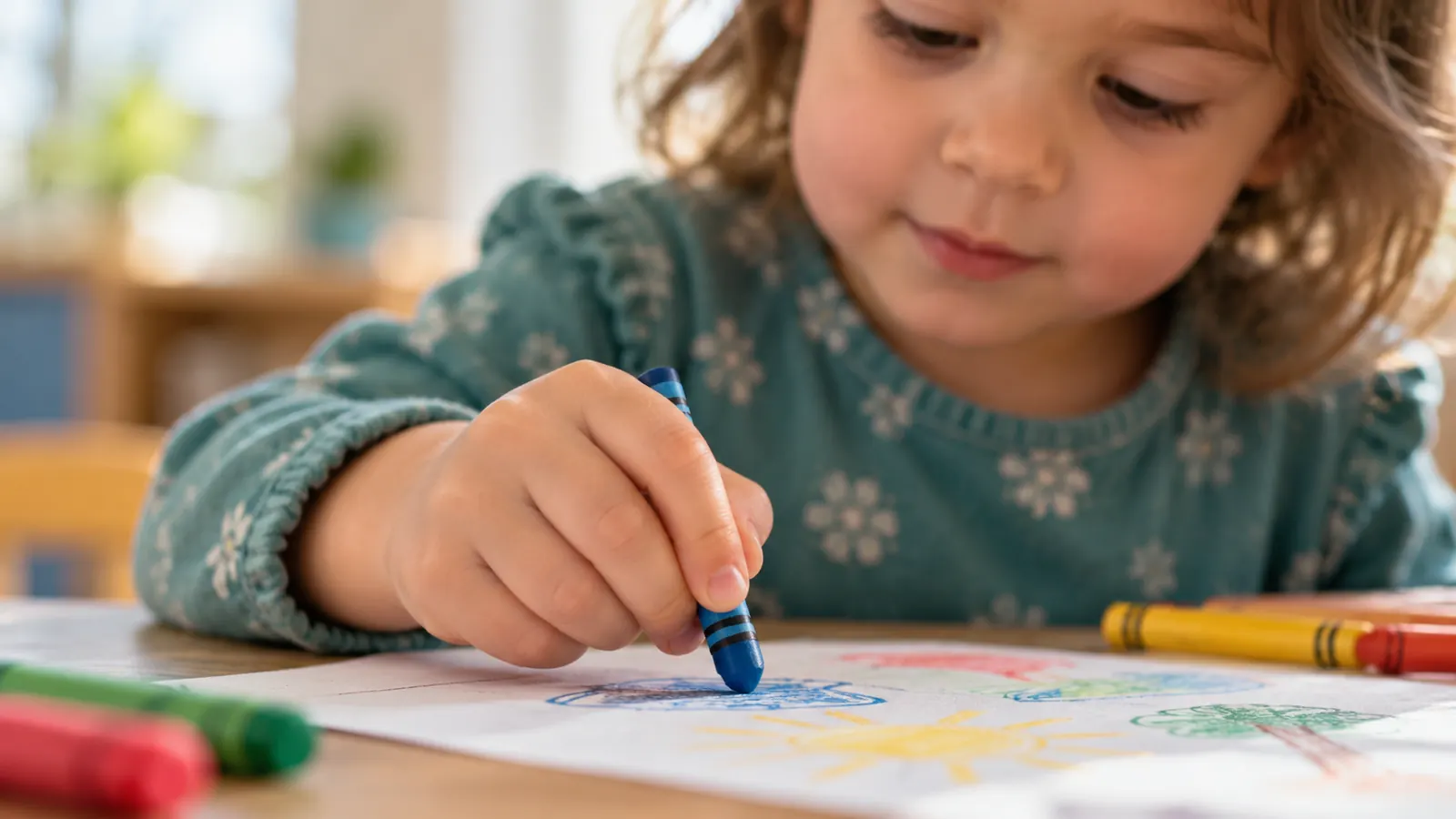
How a child holds a crayon changes a lot in the first six years. Many parents worry when their child’s grip looks “wrong”, but grasp develops in stages, and there’s more than one good way to hold a pencil.
The 4 stages of pencil grasp development
-
Palmar-supinate (fisted) grasp
The crayon is held in a fist, thumb up, and the whole arm moves from the shoulder.
-
Digital-pronate grasp
Palm faces down, fingers point towards the paper; movement comes from the elbow and shoulder.
-
Static tripod or quadrupod
Fingers hold the pencil, but the whole hand moves as one unit from the wrist.
-
Dynamic tripod or quadrupod
The fingers make the small movements while the wrist and forearm stay steady.
The ages are approximate (Schneck and Henderson, 1990), and children move through the stages at different speeds. The key change is from big arm movements to small finger movements as the shoulder, wrist and hand become stronger and more stable.
Mature grasps: more than one right way
| Grasp | What it looks like |
|---|---|
| Dynamic tripod | Pencil held between the thumb and index finger, resting on the side of the middle finger. Fingers move the pencil. |
| Lateral tripod | Like the tripod, but the thumb wraps over or rests against the side of the index finger. |
| Dynamic quadrupod | Thumb, index and middle finger hold the pencil, resting on the ring finger. |
| Lateral quadrupod | Like the quadrupod, with the thumb across the side of the index finger. |
When to look more closely
Consider an occupational therapy assessment if, after about age 5, your child:
- still uses a fisted or palm-down grip
- moves the whole arm to write or colour
- complains of pain or tiredness when writing
- grips extremely tightly or presses so hard the pencil breaks
- switches hands often mid-task (after hand preference would normally be settled, usually by around 6)
- finds handwriting much harder than their classmates do
Activities that build a better grasp
Grasp develops from strong, stable shoulders and hands, so focus on play that builds these, rather than repeatedly moving your child’s fingers into position.
| Goal | Activities |
|---|---|
| Shoulder and wrist stability | Drawing on an easel or paper taped to the wall, tummy-lying to colour, animal walks, wheelbarrow walking, climbing |
| Hand strength | Playdough and therapy putty, squeezing sponges in the bath, spray bottles, hole punches, clothes pegs |
| Separating the two sides of the hand | Holding a small pom-pom or folded tissue with the ring and little fingers while drawing; picking up small items with thumb, index and middle finger |
| Finger control | Tweezers and tongs games, picking up beads, Lite-Brite or pegboards, threading, coins into a slot |
| Encouraging a finger grip | Short crayons, broken chalk, golf pencils, small pieces of chalk, triangular crayons |
Do pencil grips help?
Pencil grips, such as triangular grips, crossover grips or “claw” grips, can help some children who have an awkward or tiring grasp. They work best alongside strengthening activities, and with guidance from an OT about which type suits your child.
Summary
Pencil grasp develops in four stages, from a fisted grip in toddlers to a mature finger grip by about age 4½ to 6. Several mature grasps work equally well, so comfort and function matter more than looks. Build grasp through playful strengthening activities and short tools, and ask an OT if there’s pain, fatigue or a very immature grip after age 5. Read more about fine motor skills.
Related guides: Hand strengthening activities.
References
- Schneck CM, Henderson A. Descriptive analysis of the developmental progression of grip position for pencil and crayon control in nondysfunctional children. American Journal of Occupational Therapy. 1990;44(10):893–900.
- Schwellnus H, Carnahan H, Kushki A, Polatajko H, Missiuna C, Chau T. Effect of pencil grasp on the speed and legibility of handwriting in children. American Journal of Occupational Therapy. 2012;66(6):718–726.
- Case-Smith J, O’Brien JC. Occupational Therapy for Children and Adolescents. Elsevier.
Frequently asked questions
What are the stages of pencil grasp development?
What is the correct pencil grip?
When should I worry about my child's pencil grasp?
Do pencil grips help?
How can I improve my child's pencil grasp?
Written by
Payal Mehta, OT
Payal Mehta is a practising occupational therapist and co-founder of Occupational Therapy OT. She writes on pediatrics, sensory integration, and mental-health practice.
All articles by Payal →This article is for general education and is not a substitute for individualized assessment or treatment by a licensed occupational therapist. Always seek the guidance of a qualified professional for specific concerns.